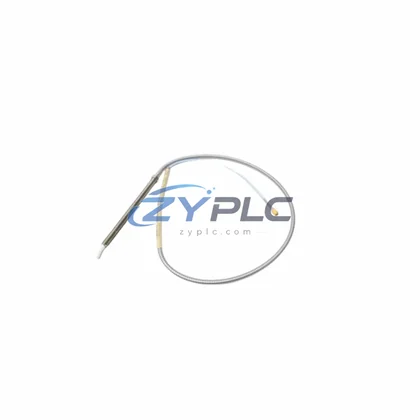
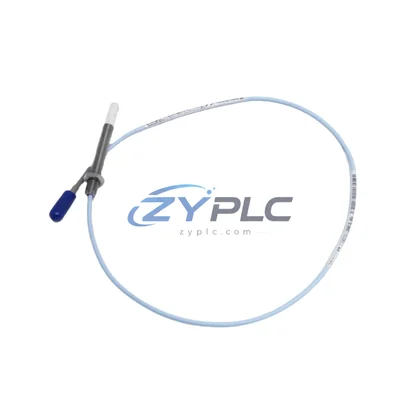
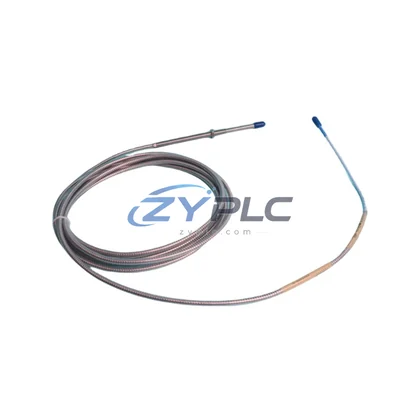
Bently Nevada 330101-00-59-15-02-05: Industrial Data Link for Smart Factory Vibration Networks
The Bently Nevada 330101-00-59-15-02-05 is a high-precision eddy-current proximity probe engineered for the 3300 Series Proximity System — one of the most widely deployed vibration and position monitoring platforms in rotating machinery environments worldwide. Designed to deliver continuous, real-time shaft displacement and vibration data, this probe forms the critical front-end sensing node in an industrial data chain that spans from field-level signal acquisition all the way to SCADA dashboards, DCS control loops, and enterprise asset management systems.
In modern smart factory architectures, the integrity of machine health data begins at the probe tip. The 330101-00-59-15-02-05 operates with a 5-meter (15-foot) integral cable and is calibrated for use with the standard 3300 XL 8mm proximity transducer system, delivering a linear output range compatible with the Bently Nevada 3300 series signal conditioning drivers and proximitor sensors. Its output signal — a DC voltage proportional to the gap between probe tip and target — feeds directly into the 3300 Series proximitor, which then interfaces with the System 1 condition monitoring platform or third-party SCADA/HMI systems via 4–20 mA, Modbus RTU, or OPC-UA communication gateways.
From the moment the probe detects shaft movement, the data pathway is engineered for zero-loss transmission. The analog signal travels through the proximitor to a signal conditioning module, where it is digitized and formatted for protocol-level communication. In distributed control environments, this digitized data is routed through industrial Ethernet switches — such as those in the Bently Nevada I/O module network — to a DCS or PLC controller. From there, the data is aggregated by a SCADA gateway, enabling plant-wide visibility of bearing wear, rotor imbalance, and critical speed events in real time.
This probe is fully compatible with the Bently Nevada 3500 Series Machinery Protection System, allowing seamless migration from legacy 3300 installations to the more advanced 3500 platform without replacing field-mounted hardware. Engineers integrating this probe into a Rockwell Automation ControlLogix PLC environment or a Siemens S7-400 DCS can leverage standard 4–20 mA signal interfaces or deploy Bently Nevada’s TDI (Transient Data Interface) modules to capture high-speed transient waveform data for advanced diagnostics.
In SCADA-connected plants, the 330101-00-59-15-02-05 probe data is typically visualized through System 1 Evolution software or third-party HMI platforms such as Wonderware InTouch or GE iFIX, where operators monitor real-time vibration trends, set alarm thresholds, and trigger automated shutdown sequences when vibration exceeds safe operating limits. Remote diagnostic capability is further enhanced when the proximitor output is connected to an edge gateway device, enabling cloud-based condition monitoring and predictive maintenance analytics without interrupting the local control loop.
For multi-machine installations — such as compressor trains, turbine-generator sets, or pump arrays — the 330101-00-59-15-02-05 can be deployed in arrays alongside Bently Nevada 3300 RAM (Rack Adapter Module) assemblies and 3300 series extension cables, creating a scalable, rack-based monitoring architecture. Each probe channel feeds independently into the monitoring rack, ensuring that a fault on one channel does not compromise data integrity across the entire system. This architecture supports hot-swap maintenance procedures, minimizing unplanned downtime in continuous-process industries such as oil and gas, petrochemical, and power generation.
All units supplied by ZYPLC undergo pre-shipment functional verification, including gap voltage linearity checks and cable continuity testing, ensuring that every 330101-00-59-15-02-05 shipped is ready for immediate installation. Stock is maintained for rapid global dispatch, and each unit is covered by a warranty terms confirmed during quotation against manufacturing defects.
Compatibility & Integration Notes
| Parameter |
Specification |
| SKU |
330101-00-59-15-02-05 |
| Brand |
Bently Nevada |
| Series |
3300 Series Proximity System |
| Product Type |
Eddy-Current Proximity Probe |
| Signal Output |
DC Voltage (Gap-Proportional Analog) |
| Compatible Protocol Interfaces |
4–20 mA, Modbus RTU (via gateway), OPC-UA (via System 1 / edge gateway) |
| Cable Length |
5 m (15 ft) Integral Cable |
| Target Compatibility |
3300 XL 8mm Proximitor / Signal Conditioner |
| Network Compatibility |
DCS, PLC (4–20 mA), SCADA (OPC-UA / Modbus), System 1 Evolution |
| HMI Integration |
Wonderware InTouch, GE iFIX, System 1 HMI |
| System Application |
Rotating Machinery Protection, Vibration Monitoring, Predictive Maintenance |
| Origin |
USA |
| Warranty |
12 Months |
| Pre-Shipment Test |
Gap Voltage Linearity & Cable Continuity Verification |
Connected Automation Data Flow
The 330101-00-59-15-02-05 sits at the origin of a multi-layer industrial data chain. At the field level, the probe’s eddy-current tip continuously measures the radial gap to a rotating shaft target, generating a stable analog voltage that reflects real-time shaft position and vibration amplitude. This signal is conditioned by the Bently Nevada 3300 XL Proximitor Sensor, which provides the regulated power supply and signal buffering required for long-distance transmission to the monitoring rack.
Within the monitoring rack, the conditioned signal enters a Bently Nevada 3500/40M Proximitor Monitor card, where it is digitized, compared against alarm setpoints, and formatted for upstream communication. In plants running a Rockwell Automation PlantPAx DCS, the monitor card’s relay outputs and 4–20 mA retransmission signals are wired directly to ControlLogix I/O modules, enabling the PLC to incorporate vibration data into its process control logic — for example, initiating a controlled shutdown sequence when shaft vibration exceeds the danger setpoint.
For plants requiring higher-bandwidth data — such as full waveform capture for spectrum analysis — the Bently Nevada TDI (Transient Data Interface) module connects the 3500 rack to a System 1 Evolution server via industrial Ethernet, transmitting time-waveform and spectrum data at rates sufficient for detailed rotor dynamic analysis. The System 1 server then exposes this data to plant SCADA systems through an OPC-UA server interface, allowing operators at a central control room HMI — running platforms such as Wonderware System Platform or Ignition SCADA — to view live vibration trends alongside process variables such as flow, pressure, and temperature.
In remote or unmanned installations, an edge gateway device — such as a Bently Nevada System 1 Remote Node or a third-party IIoT gateway — aggregates data from multiple 3300/3500 monitoring racks and transmits it over secure industrial Ethernet or cellular networks to a cloud-based asset performance management platform. This architecture enables remote diagnostic teams to monitor bearing condition, detect early-stage rotor imbalance, and schedule predictive maintenance interventions without requiring on-site presence, directly reducing maintenance costs and unplanned shutdown risk.
Solving Data Isolation in Industrial Sites
One of the most persistent challenges in rotating machinery monitoring is the fragmentation of vibration data from the broader plant control and information network. Legacy proximity probe installations often operate as standalone protection systems — triggering shutdowns when thresholds are exceeded but providing no structured data pathway to SCADA, MES, or EAM systems. The result is a classic data island: critical machine health information exists at the rack level but never reaches the plant historian, the maintenance management system, or the engineering analysis workstation.
The 330101-00-59-15-02-05, when deployed within a properly architected 3300 or 3500 Series monitoring system, directly addresses this isolation problem. By connecting the monitoring rack to the plant’s industrial Ethernet backbone — through OPC-UA, Modbus TCP, or direct System 1 integration — vibration data becomes a first-class citizen in the plant’s data infrastructure. Maintenance engineers can correlate vibration trends with process data in the plant historian, identifying the process conditions that precede elevated vibration events and enabling root-cause analysis that was previously impossible with isolated protection systems.
For plants undergoing digital transformation initiatives, this connectivity also enables production line transparency: real-time machine health KPIs can be surfaced on plant-floor HMI screens, giving operators immediate visibility into the condition of critical rotating assets without requiring specialist vibration analysis skills. Alarm rationalization — the process of ensuring that only actionable, meaningful alarms reach the operator — is also simplified when vibration data is integrated into the plant’s unified alarm management system, reducing alarm floods and improving operator response quality.
System expansion is straightforward: additional 330101-00-59-15-02-05 probes can be added to existing 3300 or 3500 racks by populating spare monitor card slots, with no changes required to the upstream SCADA or DCS configuration beyond adding new OPC-UA tags or Modbus register mappings. This modularity makes the 3300 Series an ideal platform for phased monitoring expansion programs, where plants progressively instrument additional machines as budget and operational priorities allow.
Industrial Connectivity FAQ
Q1: What is the communication latency between the 330101-00-59-15-02-05 probe and the SCADA system?
The analog signal from the probe reaches the proximitor and monitoring rack within microseconds. Digitization and OPC-UA or Modbus transmission to the SCADA server typically adds 100–500 ms of latency depending on network configuration and polling rates — well within the requirements of condition monitoring and predictive maintenance applications. For machinery protection (trip) functions, the relay output from the 3500 monitor card operates independently of the network, ensuring sub-100 ms trip response regardless of SCADA communication status.
Q2: Is the 330101-00-59-15-02-05 compatible with third-party DCS and PLC systems?
Yes. The probe’s output is conditioned by the 3300 XL Proximitor, which provides a standard DC voltage output (typically –24 VDC at full gap) and a 4–20 mA retransmission signal compatible with any DCS or PLC analog input card. For digital integration, the 3500 Series monitor rack supports Modbus RTU/TCP and OPC-UA, enabling direct communication with Siemens, Rockwell, Honeywell, ABB, and Yokogawa control systems without additional protocol converters.
Q3: How is network stability ensured in high-vibration or electrically noisy industrial environments?
The 330101-00-59-15-02-05 uses a shielded coaxial cable construction that provides excellent immunity to electromagnetic interference (EMI) from variable frequency drives, high-voltage switchgear, and other industrial noise sources. The proximitor’s signal conditioning circuitry further filters high-frequency noise before the signal enters the monitoring rack. For network-level stability, industrial-grade managed Ethernet switches with PROFINET or EtherNet/IP support should be used in the plant backbone to ensure deterministic data delivery.
Q4: What warranty and pre-shipment testing does ZYPLC provide for this product?
Every 330101-00-59-15-02-05 unit supplied by ZYPLC is covered by a warranty terms confirmed during quotation against manufacturing defects from the date of shipment. Prior to dispatch, each unit undergoes gap voltage linearity verification and cable continuity testing to confirm that the probe meets Bently Nevada’s published performance specifications. Detailed test records are available upon request. For urgent requirements, expedited shipping and availability confirmed by RFQ availability can be confirmed by contacting our sales team directly.