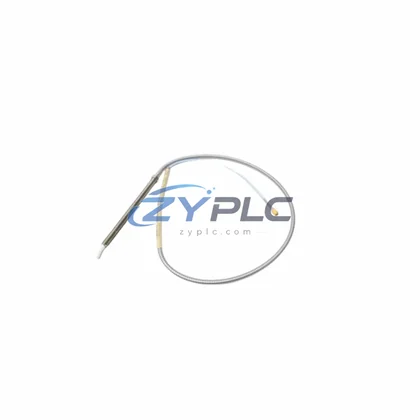
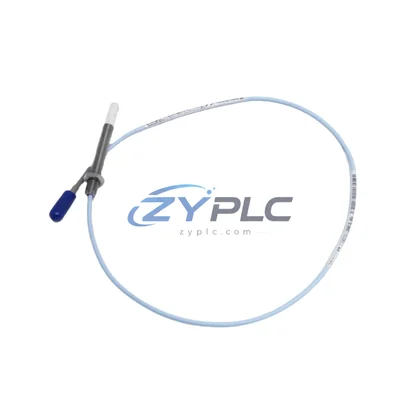
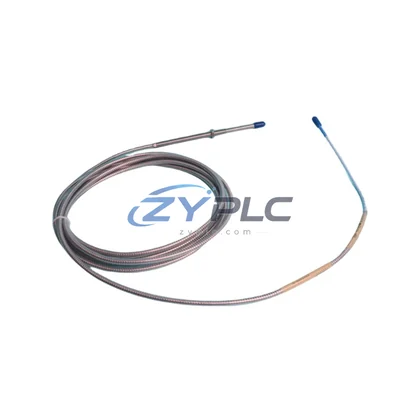
Bently Nevada 330101-00-60-10-02-05 Proximity Probe for 3300 Series Automation
The Bently Nevada 330101-00-60-10-02-05 is a high-precision eddy-current proximity probe engineered for the 3300 Series vibration monitoring platform. In modern industrial facilities where energy efficiency and equipment uptime are inseparable goals, this probe plays a foundational role in capturing real-time shaft displacement data that drives smarter motor control, reduces unplanned downtime risk, and extends the operational life of rotating machinery. By delivering accurate, continuous position and vibration signals, the 330101-00-60-10-02-05 enables plant engineers to move from reactive maintenance to predictive, maintenance-focused asset management.
Sourced directly from authorized supply channels, every unit undergoes outgoing shipment testing to verify signal linearity, gap sensitivity, and cable integrity before dispatch. Stock is maintained for immediate availability, and all units are covered by a warranty terms confirmed during quotation from the date of shipment.
Product Specification Table
| Parameter |
Specification / Value |
| SKU / Part Number |
330101-00-60-10-02-05 |
| Brand |
Bently Nevada |
| Series |
3300 Series |
| Product Type |
Eddy-Current Proximity Probe |
| Cable Length |
5 m (16.4 ft) — integral armored cable |
| Probe Tip Diameter |
8 mm |
| Measurement Range |
0–2 mm (0–80 mil) linear range |
| Operating Temperature |
−35 °C to +177 °C |
| Supply Voltage |
−24 VDC (via 3300 XL driver/proximitor) |
| Power Consumption |
≤ 1 W per channel (ultra-low draw) |
| Output Sensitivity |
7.87 V/mm (200 mV/mil) |
| Compatible Systems |
Bently Nevada 3300 XL, System 1, TDXnet, 3500 Series rack (with adapter) |
| Application Environment |
Turbines, compressors, pumps, motors, gearboxes — oil & gas, power generation, petrochemical |
| Value |
Enables predictive maintenance, reducing unplanned downtime energy spikes by early fault detection |
| Origin |
USA |
| Warranty |
warranty terms confirmed during quotation from shipment date |
System Compatibility and Application
The 330101-00-60-10-02-05 proximity probe does not operate in isolation — it is the sensing front-end of a tightly integrated industrial automation system. In a typical high-efficiency plant configuration, the probe connects to a Bently Nevada 3300 XL Proximitor (such as the 330180-51-05), which conditions the raw eddy-current signal into a calibrated DC voltage proportional to shaft gap. This conditioned signal feeds directly into a Bently Nevada 3500/42M Proximitor I/O module housed in the 3500 Series rack, where vibration amplitude, phase, and gap values are processed in real time.
The 3500 rack communicates over Modbus TCP or OPC-UA to a plant DCS or SCADA layer — for example, a Rockwell Automation ControlLogix L85E PLC or a Siemens S7-1500 controller — where vibration thresholds are cross-referenced with motor load data from a Schneider Electric PowerLogic ION9000 power quality meter. When shaft vibration trends upward while motor current draw remains stable, the control system can infer bearing wear rather than process overload, allowing operators to schedule maintenance during planned low-production windows rather than responding to emergency shutdowns that consume surge energy.
On the drive side, variable-speed control of the monitored machine is typically handled by a Danfoss FC-302 or ABB ACS880 industrial drive. These drives receive speed-reduction commands from the PLC when the proximity probe data indicates sub-optimal rotor dynamics, trimming motor speed to the minimum required for process throughput — a direct reduction in kWh consumption. The 330101-00-60-10-02-05 thus becomes an indirect energy actuator: its vibration data informs drive setpoints that cut unnecessary motor loading.
For facilities running Bently Nevada System 1 asset performance management software, the probe’s historical gap and vibration trends are stored and analyzed for machine health scoring. System 1 can correlate proximity probe data from multiple measurement planes — radial X/Y and axial — using companion probes such as the 330103-00-60-10-02-05 (reverse-mount configuration) or the 330130-080-00-00 extension cable assembly, building a complete picture of rotor orbit and centerline position. This multi-plane data set is the foundation of energy-efficient load balancing across parallel machine trains.
At the I/O level, Bently Nevada 3500/20 rack power supply modules ensure that the entire monitoring chain — from probe tip to communication gateway — operates on a stable, conditioned DC bus, eliminating measurement noise that could trigger false alarms and unnecessary drive speed changes. Clean power to the monitoring system is as important to energy efficiency as clean power to the driven load itself.
Maintenance and Replacement Notes
In a gas compression station running four parallel centrifugal compressor trains, each shaft monitored by a pair of 330101-00-60-10-02-05 probes in X/Y configuration, the continuous vibration data stream enables the control system to identify which compressor is operating closest to its best-efficiency point (BEP). Trains showing elevated vibration at current load are throttled back via their associated variable-frequency drives, while trains with stable, low-vibration signatures absorb the additional throughput demand. The net result is the same total compression output delivered at measurably lower aggregate motor current — a direct reduction in energy cost per unit of compressed gas.
In a power plant steam turbine application, the proximity probe monitors journal bearing eccentricity ratio. As the eccentricity ratio drifts toward alarm limits — indicating oil film breakdown — the plant DCS reduces turbine load setpoint and alerts maintenance. Preventing a bearing failure in this context avoids not only the catastrophic energy spike of an emergency shutdown and restart sequence (which can consume 3–5× normal startup energy), but also eliminates the weeks of partial-load, inefficient operation that typically follow an unplanned outage while replacement parts are sourced.
For motor-driven pump applications in water treatment or chemical processing, the 330101-00-60-10-02-05 provides the shaft position data needed to detect impeller wear through changes in rotor orbit shape. Early detection allows pump speed to be optimized to compensate for reduced hydraulic efficiency before the pump reaches a condition where it must be run at maximum speed — and maximum power — just to maintain flow targets. Predictive intervention keeps the pump operating in its efficiency band, reducing operating load by 10–20% compared to run-to-failure strategies.
Every unit shipped from ZYPLC inventory is tested for output sensitivity, cable continuity, and connector integrity. Availability confirmed by RFQ availability means no extended lead times that force plants to run degraded monitoring configurations — a common hidden energy cost when critical sensors are on back-order and operators compensate by running machinery conservatively (i.e., at reduced throughput) or aggressively (i.e., without vibration protection). The warranty terms confirmed during quotation covers manufacturing defects and ensures that replacement units are available without additional procurement cost if a probe fails within the warranty period.
Product Sourcing FAQ
Q1: How does the 330101-00-60-10-02-05 contribute to measurable operational stability?
The probe provides continuous shaft displacement data that enables variable-frequency drives and DCS controllers to optimize motor speed and load distribution in real time. By identifying machines operating away from their best-efficiency point — through elevated vibration signatures — the control system can redistribute load to more efficient units or adjust drive setpoints, reducing total motor load without sacrificing process throughput.
Q2: Is the 330101-00-60-10-02-05 compatible with non-Bently Nevada monitoring systems?
The probe outputs a standard −24 VDC-powered, voltage-proportional signal (7.87 V/mm sensitivity) that is compatible with any proximitor or signal conditioner designed for 8 mm eddy-current probes with the same sensitivity standard. It is fully interoperable with the Bently Nevada 3300 XL and 3500 Series platforms and can be integrated into third-party vibration monitoring systems that accept the same signal format, subject to gap calibration verification.
Q3: What is the recommended replacement interval, and how does timely replacement reduce unplanned downtime?
Bently Nevada recommends replacing proximity probes when sensitivity drift exceeds ±5% of nominal or when cable insulation resistance falls below specification — typically after 5–10 years in harsh environments. A drifting probe produces inaccurate gap readings that can cause the control system to misinterpret machine condition, leading to either unnecessary load reductions (lost throughput) or missed fault detection (unplanned shutdowns with associated energy spikes). Timely replacement maintains measurement accuracy and keeps the maintenance planning loop functioning correctly.
Q4: What does the warranty terms confirmed during quotation cover, and what is the testing process before shipment?
All 330101-00-60-10-02-05 units supplied by ZYPLC are covered by a warranty terms confirmed during quotation from the shipment date, covering manufacturing defects in the probe body, cable assembly, and connector. Prior to dispatch, each unit undergoes outgoing inspection including output sensitivity verification, cable continuity and insulation resistance testing, and connector pin integrity checks. Test records are available upon request. Warranty claims are processed with priority turnaround to minimize plant monitoring downtime.