Bently Nevada 330101-00-66-20-02-CN Proximity Probe for 3300 XL: Control System and Upstream–Downstream Coordination
In modern industrial automation, vibration monitoring is not an isolated measurement task — it is a foundational layer of the entire machine protection and condition monitoring architecture. The Bently Nevada 330101-00-66-20-02-CN proximity probe is engineered as a system-compatible component within the Bently Nevada 3300 XL platform, designed to deliver consistent, high-fidelity shaft displacement signals that feed directly into the broader control and protection hierarchy. Understanding this product requires understanding where it sits within the full signal chain: from the rotating shaft surface, through the probe tip, along the extension cable, into the proximitor driver, and ultimately into the 3300 XL monitor rack — where that data becomes actionable intelligence for the DCS, safety system, or historian.
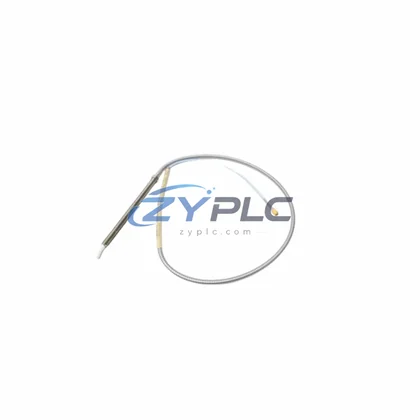
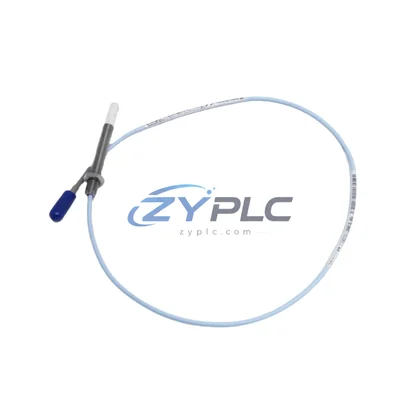
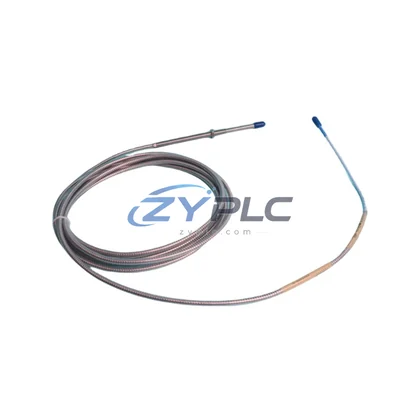
The 330101-00-66-20-02-CN is a 5-meter, 8 mm diameter eddy-current proximity probe with a 20-meter cable configuration, designed for continuous non-contact measurement of radial shaft vibration, axial position, and differential expansion in rotating machinery. Its CN designation indicates compliance with the Chinese national certification standard, making it the preferred specification for projects operating under domestic regulatory frameworks in power generation, petrochemical, and heavy industrial sectors. When deployed within a complete 3300 XL monitoring system, this probe works in concert with the Bently Nevada 330130-080-00-00 extension cable and the Bently Nevada 330180-X1-05 proximitor to form a calibrated three-component transducer system — a configuration that must be treated as an integrated unit rather than interchangeable parts.
At the monitor rack level, the signal from this probe assembly is received by modules such as the Bently Nevada 3300/16-13-01-01-00-00-00 or 3300/20-13-01-01-00-00-00 dual-channel vibration monitors, which process the raw gap voltage into engineering units and compare readings against configurable alert and danger setpoints. These monitors communicate upstream to the plant DCS — commonly a Honeywell Experion PKS, Emerson DeltaV, or ABB System 800xA — via hardwired relay contacts or Modbus/FOUNDATION Fieldbus interfaces, depending on the system integration design. The result is a tightly coupled architecture where the mechanical condition of a turbine, compressor, or pump shaft is continuously visible at the operator workstation and available for automated protective action.
From a system architecture perspective, the 330101-00-66-20-02-CN contributes to multiple layers of the automation hierarchy simultaneously. At the field layer, it provides the raw physical measurement. At the protection layer, it enables the 3300 XL rack to execute trip logic independently of the DCS, ensuring that machine protection is not compromised by network latency or controller faults. At the condition monitoring layer, the continuous waveform data can be routed to a Bently Nevada System 1 software platform for trend analysis, orbit plotting, and predictive maintenance scheduling — reducing unplanned downtime and extending mean time between overhauls. This multi-layer contribution is what distinguishes a system-compatible proximity probe from a generic displacement sensor.
Installation and commissioning of the 330101-00-66-20-02-CN requires careful attention to gap setting, cable routing, and grounding practices. The probe must be installed at the correct radial position relative to the shaft, with the gap voltage verified against the proximitor’s calibration curve — typically targeting a mid-range gap of approximately 1.0 mm, corresponding to a DC output of -10 VDC on a standard 200 mV/mil sensitivity system. Shielded cable routing away from high-voltage conductors, proper grounding at a single point, and secure conduit installation are all prerequisites for achieving the signal quality that the 3300 XL monitor expects. Engineers commissioning this system should also verify compatibility with the Bently Nevada 3300 XL rack backplane and confirm that the monitor channel configuration matches the probe sensitivity and gap range.
For long-term maintenance, the 330101-00-66-20-02-CN benefits from periodic gap verification during planned outages, inspection of the probe tip for contamination or mechanical damage, and continuity testing of the extension cable. Spare probe assemblies should be maintained in inventory as matched sets — probe, extension cable, and proximitor — to ensure that replacement units are pre-calibrated and ready for rapid installation during a forced outage. ZYPLC supports RFQ sourcing for this assembly and its associated components, with all units covered by a warranty terms confirmed during quotation and subject to functional testing prior to shipment.
Product Specification Table
| Parameter |
Specification |
| System Role |
Field-layer eddy-current proximity probe for shaft vibration and position measurement within Bently Nevada 3300 XL machine protection architecture |
| SKU / Part Number |
330101-00-66-20-02-CN |
| Brand / Platform |
Bently Nevada / 3300 XL System |
| Probe Diameter |
8 mm |
| Cable Length |
5 m (probe) + 15 m (extension) = 20 m total system length |
| Measurement Type |
Non-contact radial vibration, axial position, differential expansion |
| Output Sensitivity |
200 mV/mil (7.87 V/mm) nominal |
| Operating Gap Range |
0.25 mm – 2.25 mm (10 mil – 90 mil) |
| Supply Voltage |
-24 VDC (from proximitor / driver module) |
| Operating Temperature |
-35°C to +177°C (probe tip); -35°C to +85°C (cable) |
| Communication / Integration |
Analog DC gap voltage output; integrates with 3300 XL monitor via proximitor; upstream DCS/SCADA via relay, Modbus, or Fieldbus |
| Certification |
CN (Chinese National Standard); suitable for domestic regulatory compliance |
| Installation Environment |
Rotating machinery bearing housings; turbines, compressors, pumps, motors; indoor and outdoor industrial enclosures |
| system integration |
Fully compatible with Bently Nevada 3300 XL rack, System 1 software, and plant DCS/SIS architectures |
| Warranty |
warranty terms confirmed during quotation — all units functionally tested prior to shipment |
System Compatibility Notes
The 330101-00-66-20-02-CN proximity probe is most effectively deployed as part of a coordinated machine protection and condition monitoring system. A complete 3300 XL-based architecture for a single turbine-compressor train typically includes the following coordinated components:
At the transducer layer, the probe pairs with the Bently Nevada 330130-080-00-00 extension cable and 330180-X1-05 proximitor to form a calibrated measurement chain. Multiple probe assemblies are installed at each bearing location — typically two radial probes at 90° to each other for full orbit analysis, plus one axial probe for thrust position monitoring.
At the monitor rack layer, the proximitor outputs feed into the Bently Nevada 3300/16 or 3300/20 series dual-channel vibration monitors housed in the 3300 XL rack. The rack also accommodates 3300/55 keyphasor modules for phase reference, 3300/46M temperature monitors for bearing RTD inputs, and 3300/95 relay modules for trip output logic — creating a unified machine protection rack that handles vibration, position, temperature, and speed in a single integrated chassis.
At the power layer, the 3300 XL rack is powered by redundant Bently Nevada 3300/05 power supply modules, ensuring that a single power supply failure does not interrupt machine protection. The power supplies accept wide-range AC or DC input and provide regulated -24 VDC to all installed monitor modules and proximitors.
At the communication and integration layer, the 3300 XL rack interfaces with the plant DCS through hardwired 4–20 mA analog outputs, relay contacts, or digital communication via Bently Nevada TDI (Transient Data Interface) or System 1 OPC server. This allows vibration data to appear on the operator workstation alongside process variables such as suction pressure, discharge temperature, and flow rate — giving operators a complete picture of machine health in context.
At the condition monitoring layer, waveform data from the proximity probes is archived in Bently Nevada System 1 for long-term trend analysis, alarm management, and predictive maintenance planning. System 1 can generate orbit plots, Bode plots, and cascade diagrams that allow rotating machinery specialists to identify developing faults — such as rotor unbalance, misalignment, oil whirl, or rub — weeks or months before they would trigger a protective trip.
Industrial Application Notes
Power Generation: In gas turbine and steam turbine applications, the 330101-00-66-20-02-CN is installed at journal bearings to monitor shaft vibration during startup, steady-state operation, and shutdown. The 3300 XL system provides independent machine protection that operates even if the plant DCS is in maintenance mode, ensuring that the turbine cannot be damaged by operator error or controller fault during critical transitions.
Petrochemical and Refining: Centrifugal compressors in ethylene, ammonia, and LNG plants operate continuously for years between planned turnarounds. Proximity probe systems based on the 3300 XL platform provide the continuous vibration monitoring required by API 670 — the industry standard for machinery protection systems — and feed data to the plant safety instrumented system (SIS) for automated shutdown on high-vibration events.
Water and Wastewater Treatment: Large vertical turbine pumps and horizontal split-case pumps in water treatment facilities benefit from proximity probe monitoring to detect bearing wear, impeller imbalance, and cavitation-induced vibration before they cause catastrophic failure. The 3300 XL system’s compact rack design allows installation in space-constrained pump station control panels.
Mining and Metallurgy: Ball mills, SAG mills, and large fan drives in mining operations are subject to severe vibration environments. The 330101-00-66-20-02-CN’s robust construction and wide operating temperature range make it suitable for the harsh conditions found in mineral processing plants, where dust, moisture, and mechanical shock are constant challenges.
Packaging and Process Manufacturing: High-speed rotating equipment in food, beverage, and pharmaceutical manufacturing requires vibration monitoring to maintain product quality and comply with GMP requirements. The 3300 XL system’s ability to integrate with plant historians and MES systems via OPC allows vibration data to be correlated with production batch records for quality assurance purposes.
Product Compatibility FAQ
Q1: Is the 330101-00-66-20-02-CN directly interchangeable with other 330101 series probes, and what compatibility checks are required before installation?
The 330101-00-66-20-02-CN is part of the Bently Nevada 330101 series and shares the same 8 mm probe diameter and 200 mV/mil sensitivity as other variants in the series. However, the CN suffix indicates Chinese national certification, and the -66-20-02 configuration specifies a 5 m probe cable with a 20 m total system length. Before substituting this probe into an existing installation, engineers must verify that the total cable length matches the proximitor’s calibration — the 330180 series proximitors are calibrated for specific probe-plus-extension-cable length combinations, and mismatched lengths will introduce measurement error. Always replace probe assemblies as matched sets (probe + extension cable + proximitor) and verify gap voltage against the calibration curve after installation.
Q2: How does the 3300 XL system maintain machine protection during DCS communication failures or network outages?
The Bently Nevada 3300 XL rack is designed as a standalone machine protection system that operates independently of the plant DCS. Trip relay outputs are hardwired directly from the 3300/95 relay modules to the machine’s emergency shutdown system, bypassing the DCS entirely. This means that even if the DCS communication network fails, the 3300 XL system continues to monitor vibration, compare readings against setpoints, and execute trip logic without interruption. The DCS connection is used only for data display and historian archiving — it is not in the protective trip path. This architecture ensures that machine protection is never compromised by control system faults, network latency, or planned DCS maintenance.
Q3: What does the warranty terms confirmed during quotation cover, and what support is available for system integration and commissioning questions?
All 330101-00-66-20-02-CN units supplied by ZYPLC are covered by a warranty terms confirmed during quotation from the date of shipment. This warranty covers manufacturing defects, functional performance against published specifications, and calibration accuracy of the probe assembly. Units are functionally tested prior to shipment, including gap voltage verification and cable continuity testing. For system integration support — including proximitor selection, monitor channel configuration, DCS interface design, and commissioning guidance — ZYPLC’s technical team is available to assist. Contact us at +86 19859288691 or plc.sales@zyplc.com for pre-sales technical consultation and post-sales commissioning support.