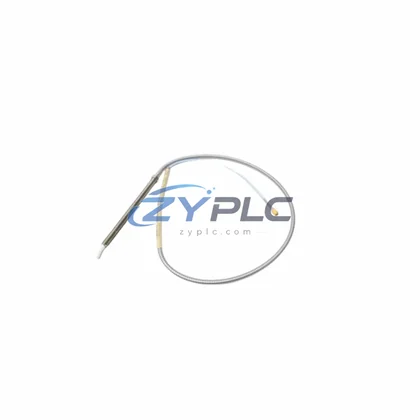
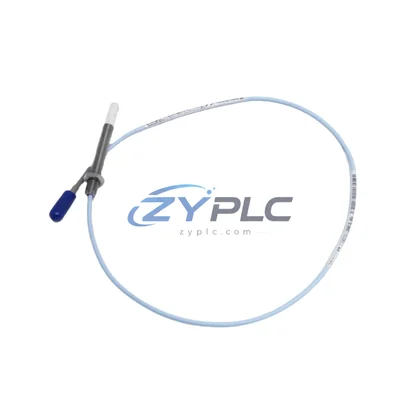
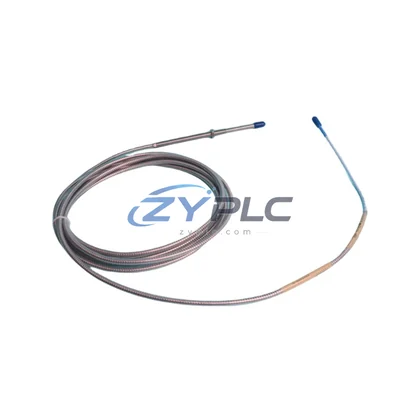
The Bently Nevada 330101-36-80-10-02-00 is a high-performance eddy-current proximity probe engineered for the 3300 Series vibration monitoring platform. Designed for continuous, non-contact measurement of shaft displacement and radial vibration, this probe plays a critical role in reducing unplanned downtime risk across rotating machinery systems. By delivering real-time, high-resolution position data directly to the control loop, the 330101-36-80-10-02-00 enables plant engineers to eliminate inefficient operating conditions before they escalate into costly failures or unplanned shutdowns.
In modern industrial facilities where energy costs represent a significant share of operating expenditure, the ability to monitor shaft behavior with micron-level accuracy translates directly into measurable efficiency gains. The 330101-36-80-10-02-00 integrates seamlessly into the Bently Nevada 3300 Series ecosystem, working alongside the 3300/16 proximitor sensor and 3300/55 extension cable to form a complete proximity measurement chain. This three-component architecture ensures signal integrity from the probe tip to the monitoring rack, minimizing noise-induced false trips that would otherwise force unnecessary motor restarts and associated energy spikes.
Product Specification Table
| Parameter |
Specification |
| SKU / Part Number |
330101-36-80-10-02-00 |
| Series |
Bently Nevada 3300 Series |
| Probe Type |
Eddy-Current Non-Contact Proximity Probe |
| Cable Length |
36 inches (approx. 914 mm) |
| Operating Frequency Range |
DC to 10,000 Hz |
| Power Consumption |
Low-draw passive sensing; powered via proximitor |
| Operating Temperature |
-35°C to +177°C |
| Compatible Systems |
Bently Nevada 3300 Series, System 1 Software, TDXnet |
| Application Environment |
Turbines, compressors, pumps, motors, gearboxes |
| Maintenance Value |
Prevents over-lubrication, reduces vibration-induced energy loss, enables load balancing |
| Warranty |
warranty terms confirmed during quotation |
| Availability |
RFQ Available — Ships after outgoing quality inspection |
System Compatibility and Application
The 330101-36-80-10-02-00 does not operate in isolation — its true efficiency value emerges when it is integrated into a layered automation architecture. At the sensing layer, the probe pairs with the Bently Nevada 3300/16 proximitor sensor, which conditions the raw eddy-current signal into a calibrated voltage output proportional to the gap between probe tip and shaft surface. This conditioned signal feeds into the Bently Nevada 3500/42M proximitor I/O module housed within the 3500 Series rack, where it is processed alongside data from other measurement channels including axial thrust, differential expansion, and case vibration.
At the control execution layer, the vibration data is transmitted via Modbus TCP or FOUNDATION Fieldbus protocol to the plant DCS or PLC — commonly a Rockwell Automation ControlLogix L85E or Siemens SIMATIC S7-400H — where logic routines compare real-time shaft displacement against alarm setpoints. When vibration trends indicate developing imbalance or misalignment, the control system can automatically reduce the load command to the associated ABB ACS880 variable frequency drive, lowering motor speed and cutting energy draw before the condition worsens. This closed-loop response is far more energy-efficient than fixed-speed operation, which would continue driving the motor at full power regardless of mechanical condition.
For drive-level energy regulation, the 330101-36-80-10-02-00 data stream supports adaptive speed control through integration with Siemens SINAMICS G120 or Schneider Electric Altivar Process ATV630 drives. When shaft eccentricity readings from the proximity probe indicate optimal running conditions, the drive can be commanded to operate at its most efficient point on the torque-speed curve, reducing reactive power consumption and improving overall power factor. Power quality monitoring via a Schneider Electric PowerLogic ION9000 power meter installed upstream of the motor control center provides the energy baseline data needed to quantify these savings over time.
At the data monitoring and feedback layer, the 330101-36-80-10-02-00 measurement chain connects to Bently Nevada System 1 asset performance management software, which aggregates vibration, temperature, and process data into unified equipment health dashboards. Maintenance teams can configure predictive alerts based on vibration trend slopes rather than fixed amplitude thresholds, enabling condition-based maintenance scheduling that eliminates both premature part replacement and run-to-failure scenarios — both of which carry significant energy and cost penalties. The Bently Nevada TDXnet communication interface further extends this data to enterprise-level SCADA and MES platforms, closing the loop between field measurement and production planning.
Maintenance and Replacement Notes
In a typical continuous process plant — such as a petrochemical facility running multiple centrifugal compressor trains — undetected shaft vibration is one of the leading causes of both unplanned downtime and unplanned downtime. A compressor operating with developing rotor imbalance draws measurably more current than one running within design tolerances, because the motor must overcome the additional mechanical resistance introduced by the vibration. The 330101-36-80-10-02-00, installed at the compressor’s radial bearing journal, detects this imbalance at its earliest stage — often weeks before it would trigger a conventional vibration switch — allowing maintenance to schedule a balance correction during a planned outage rather than an emergency shutdown.
The operational stability from avoiding a single unplanned shutdown on a large compressor train can be substantial. Emergency restarts require extended run-up periods at high current draw, and the associated process disruption often forces upstream and downstream equipment to operate outside their optimal efficiency windows for hours. By contrast, a planned maintenance intervention guided by 330101-36-80-10-02-00 trend data allows the compressor to be returned to service quickly and at full efficiency, with the drive system re-optimized to the corrected mechanical condition.
On motor-driven pump systems, the proximity probe’s shaft position data can also be used to detect cavitation onset — a condition that dramatically increases operating load while simultaneously damaging the impeller. By integrating the 330101-36-80-10-02-00 output with flow and pressure signals in the plant DCS, control engineers can implement cavitation-avoidance logic that adjusts pump speed via the variable frequency drive before the condition develops, protecting both the equipment and the energy budget. Across a production line with multiple pump stations, this capability can reduce aggregate motor load by several percentage points annually.
From a maintenance cost perspective, the 330101-36-80-10-02-00 supports a shift from time-based to condition-based bearing replacement schedules. Bearings replaced on a fixed calendar interval are often still serviceable, representing wasted material and labor cost. Bearings allowed to run to failure cause secondary damage and extended downtime. The proximity probe’s continuous shaft orbit data provides the objective evidence needed to replace bearings at the optimal point — maximizing service life while preventing failure-mode energy losses.
All units supplied by ZYPLC undergo a comprehensive outgoing quality inspection prior to shipment, including signal output verification, insulation resistance testing, and dimensional checks against OEM specifications. Each 330101-36-80-10-02-00 is covered by a warranty terms confirmed during quotation from the date of shipment, with technical support available throughout the warranty period to assist with installation, calibration, and system integration queries.
Product Sourcing FAQ
Q1: How does the 330101-36-80-10-02-00 contribute to measurable operational stability on a production line?
By providing continuous, high-resolution shaft displacement data, the 330101-36-80-10-02-00 enables the control system to detect mechanical inefficiencies — such as rotor imbalance, misalignment, or bearing wear — at their earliest stage. This allows corrective action to be taken before the condition causes the motor to draw abnormal load, directly reducing operating load. When integrated with a variable frequency drive, the probe data can also support adaptive speed control that keeps the motor operating at its most efficient point on the torque-speed curve.
Q2: Is the 330101-36-80-10-02-00 compatible with my existing Bently Nevada 3500 Series monitoring rack?
Yes. The 330101-36-80-10-02-00 is designed for use within the Bently Nevada 3300 Series measurement chain, which is fully compatible with the 3500 Series monitoring rack via the appropriate proximitor I/O module. The probe, extension cable, and proximitor sensor must be used as a matched set calibrated to the same system sensitivity (typically -7.87 V/mm or -200 mV/mil) to ensure accurate readings. If you are replacing an existing probe in a 3500 Series installation, please confirm the system sensitivity setting before ordering.
Q3: What is the recommended replacement interval, and how does condition-based monitoring change this?
Under traditional time-based maintenance, proximity probes are typically replaced on a fixed interval regardless of condition. With the 330101-36-80-10-02-00 installed and connected to Bently Nevada System 1 software, maintenance teams can monitor probe gap voltage trends over time to identify signal drift that may indicate probe tip contamination or cable degradation. This allows replacement to be scheduled based on actual condition rather than elapsed time, reducing unnecessary maintenance expenditure while ensuring measurement integrity.
Q4: What does the warranty terms confirmed during quotation cover, and what is the testing process before shipment?
Every 330101-36-80-10-02-00 supplied by ZYPLC is tested prior to shipment for signal output accuracy, insulation resistance, and dimensional conformance to OEM specifications. The warranty terms confirmed during quotation covers defects in materials and workmanship under normal operating conditions. Warranty claims are supported by our technical team, who can assist with fault diagnosis and, where applicable, arrange replacement units to minimize production disruption. Contact us at plc.sales@zyplc.com or +86 19859288691 for warranty and technical support inquiries.