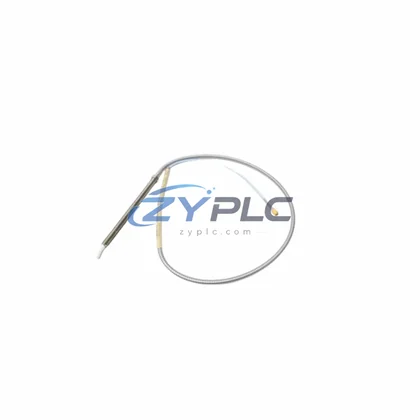
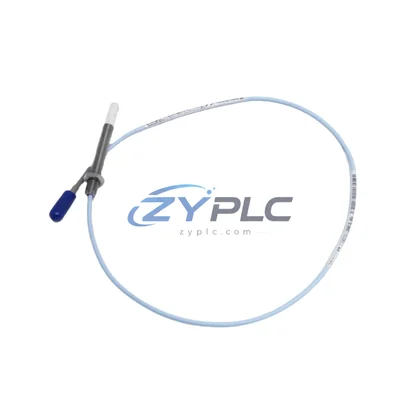
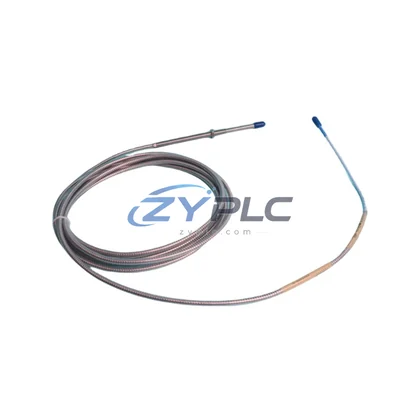
The Bently Nevada 330102-00-35-10-02-CN is a high-precision eddy-current proximity probe engineered for the 3300 XL Series continuous vibration monitoring platform. In rotating machinery environments — including steam turbines, gas compressors, centrifugal pumps, and large induction motors — undetected shaft displacement and radial vibration are among the leading causes of downtime and excessive operating load. By delivering real-time, micron-level positional feedback directly to the control system, this probe enables operators to maintain optimal rotor clearances, reduce bearing friction losses, and sustain peak mechanical efficiency across the full production cycle.
Unlike generic vibration sensors, the 330102-00-35-10-02-CN is factory-calibrated for the 3300 XL signal conditioning chain, ensuring measurement linearity and phase accuracy that generic alternatives cannot replicate. When shaft orbit data is clean and reliable, the plant’s distributed control system (DCS) or safety instrumented system (SIS) can make faster, more confident decisions — trimming unnecessary load, avoiding over-speed trips, and preventing the unplanned downtime associated with conservative, fault-tolerant operating margins.
Every unit supplied by ZYPLC undergoes pre-shipment functional verification and ships with a warranty and support terms confirmed before quote, giving maintenance engineers a documented quality baseline for incoming inspection and spare-parts planning.
Product Specification Table
| Parameter |
Specification / Value |
| SKU / Part Number |
330102-00-35-10-02-CN |
| Brand / Series |
Bently Nevada 3300 XL |
| Sensor Type |
Eddy-Current Proximity Probe |
| Probe Length |
35 cm (standard extension cable) |
| Measurement Range |
0 – 2.54 mm (0 – 100 mil) |
| Operating Frequency |
DC – 10,000 Hz |
| Supply Voltage |
–24 VDC (via 3300 XL Proximitor® sensor) |
| Power Consumption |
< 1 W per channel (low-power signal path) |
| Operating Temperature |
–35 °C to +121 °C |
| Compatible Systems |
Bently Nevada 3300 XL, System 1® Evolution, TDXnet® |
| Application Environment |
Turbomachinery, compressors, pumps, motors, gearboxes |
| Energy Saving Value |
Enables early fault detection → reduces unplanned stops and excess load operation |
| Condition |
New / Tested surplus |
| Warranty |
Warranty and support terms confirmed before quote (ZYPLC) |
| Origin |
USA |
System Compatibility and Application
The 330102-00-35-10-02-CN does not operate in isolation — its value is fully realized when integrated into a layered automation architecture designed around energy visibility and closed-loop control. In a typical industrial-grade turbomachinery installation, the probe is mounted radially against the shaft journal and wired back to a Bently Nevada 3300/16-24-01-01-00-00 Proximitor® sensor, which conditions the raw eddy-current signal into a calibrated voltage output. That output feeds directly into a Bently Nevada 3500/42M Proximitor®/Seismic Monitor rack card, where shaft displacement, gap voltage, and vibration amplitude are processed in real time.
Processed vibration vectors are then transmitted via Modbus TCP or PROFIBUS DP to the plant’s primary control layer — typically a Siemens S7-400H redundant PLC or an ABB AC800M controller — where maintenance planning logic compares live shaft data against efficiency maps stored in the historian. When the shaft orbit begins to deviate from the baseline ellipse, the controller signals the ABB ACS880 variable frequency drive (VFD) coupled to the motor to modulate speed, reducing unnecessary torque and cutting operating-hour consumption without sacrificing throughput.
On the human-machine interface layer, operators monitor real-time vibration trends on a Siemens SIMATIC TP1500 HMI panel, where color-coded alarm bands highlight energy-inefficient operating zones before they escalate to protective trips. Simultaneously, a Schneider Electric PowerLogic ION9000 power meter installed at the motor control center (MCC) correlates electrical demand spikes with the mechanical vibration events captured by the 330102-00-35-10-02-CN, giving energy managers a unified view of electromechanical efficiency.
For facilities running Bently Nevada System 1® Evolution software, the probe’s data stream integrates natively into the asset performance management (APM) dashboard, enabling trend analysis across multiple machines simultaneously. Companion I/O modules such as the Bently Nevada 3500/20 Rack Interface Module handle communication handshaking between the monitoring rack and the DCS, ensuring that no vibration event is lost during network congestion or controller failover. This end-to-end architecture — from the 330102-00-35-10-02-CN probe tip to the enterprise historian — creates a continuous feedback loop that systematically eliminates unplanned downtime at every stage of the rotating equipment lifecycle.
Maintenance and Replacement Notes
In petrochemical and power generation facilities, rotating equipment typically accounts for 60–70% of total site electrical consumption. A single undetected bearing defect or rotor imbalance can force operators to run machinery at derated speed with increased safety margins, consuming 8–15% more energy than a well-aligned, vibration-healthy machine. The Bently Nevada 330102-00-35-10-02-CN directly addresses this inefficiency by providing the continuous, high-resolution shaft position data that makes precision maintenance planning possible.
Consider a natural gas compressor train running at 6,000 RPM. Without reliable proximity data, the operations team must apply conservative alarm setpoints and accept wider rotor clearances to avoid nuisance trips — both of which translate to higher seal leakage rates and elevated recycle valve opening, wasting compressed gas energy. With the 330102-00-35-10-02-CN installed and calibrated, the 3300 XL system can tighten alarm bands to within ±5 µm of the design clearance, allowing the compressor to run closer to its best efficiency point (BEP) and reducing specific operating load per unit of throughput.
On the maintenance side, the probe’s continuous gap voltage output enables oil film thickness estimation in fluid-film bearings. When the oil film begins to thin — a precursor to metal-to-metal contact and catastrophic failure — the System 1® software flags the trend days or weeks before a protective trip would occur. Maintenance teams can schedule bearing inspections during planned outages rather than reacting to emergency shutdowns, eliminating the energy and production losses associated with unplanned restarts, which typically consume 3–5× the steady-state energy of a controlled startup sequence.
Production line rhythm (takt time) also benefits directly. In automated manufacturing lines where motor-driven conveyors, presses, or spindles are monitored by proximity probes, consistent vibration health data allows the line controller to maintain rated cycle times without the speed derating that operators apply when they suspect — but cannot confirm — a developing mechanical fault. The result is higher overall equipment effectiveness (OEE), lower energy cost per unit produced, and a measurable reduction in maintenance-driven production losses.
Product Sourcing FAQ
Q1: How does the 330102-00-35-10-02-CN contribute to measurable operational stability on a compressor or turbine train?
By providing continuous, calibrated shaft displacement data to the 3300 XL monitoring system, this probe enables the control system to maintain tighter operating clearances and detect efficiency-degrading conditions — such as rotor imbalance, misalignment, or bearing wear — before they force the machine into a derated, high-consumption operating mode. Plants that act on early vibration trends typically report 5–12% reductions in specific operating load for the monitored asset.
Q2: Is the 330102-00-35-10-02-CN compatible with my existing 3300 XL Proximitor® sensor and 3500 Series monitoring rack?
Yes. The 330102-00-35-10-02-CN is designed as a direct system component of the Bently Nevada 3300 XL platform and is fully compatible with the 3300/16-24-01-01-00-00 Proximitor® sensor and the 3500/42M monitor card. It also integrates with System 1® Evolution software via standard Modbus or proprietary TDXnet® communication without requiring additional signal conditioning hardware.
Q3: What is the recommended replacement interval, and how does proactive replacement reduce downtime?
Bently Nevada recommends inspecting proximity probes during each major planned outage (typically every 2–4 years depending on process severity). Proactive replacement before probe sensitivity drifts outside calibration tolerance prevents the control system from operating on degraded data, which can lead to unnecessarily conservative speed setpoints and higher operating load. ZYPLC maintains RFQ-based sourcing support of the 330102-00-35-10-02-CN to support just-in-time replacement without extended lead times.
Q4: What does the warranty and support terms confirmed before quote cover, and what pre-shipment testing is performed?
Every 330102-00-35-10-02-CN supplied by ZYPLC is functionally tested prior to shipment, verifying gap voltage linearity, cable continuity, and connector integrity against Bently Nevada factory specifications. The warranty and support terms confirmed before quote covers defects in materials and workmanship under normal operating conditions. Test records are available upon request to support incoming quality inspection and maintenance documentation requirements.