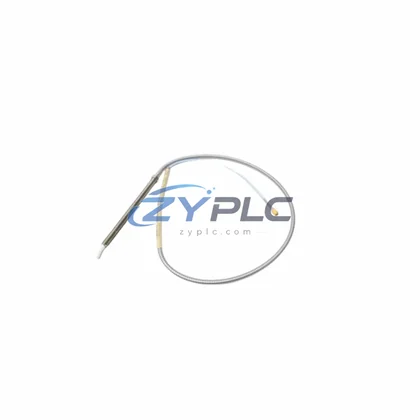
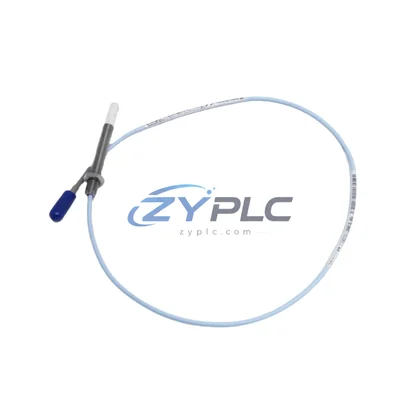
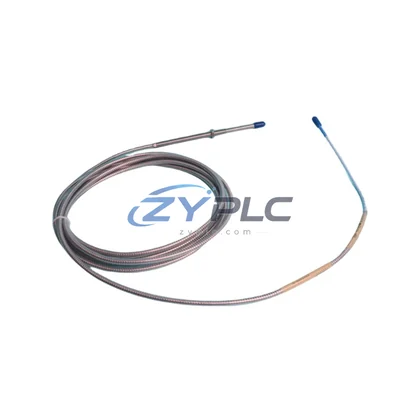
Bently Nevada 330102-00-52-10-02-00 Proximity Probe for 3300 Series Automation
In modern industrial facilities where energy costs and equipment reliability are tightly linked, the Bently Nevada 330102-00-52-10-02-00 proximity probe stands as a precision sensing component that directly contributes to energy-efficient machine operation. Designed for the Bently Nevada 3300 Series continuous vibration monitoring system, this eddy-current proximity probe delivers real-time shaft displacement data that enables plant engineers to detect mechanical inefficiencies before they escalate into energy-wasting failures or unplanned downtime. By continuously feeding accurate radial vibration and position signals into the control loop, the 330102-00-52-10-02-00 helps optimize motor loading, reduce bearing friction losses, and maintain turbomachinery at its most efficient operating point.
The probe operates on the eddy-current principle, generating a high-frequency electromagnetic field that responds to changes in the distance between the probe tip and the rotating shaft. This non-contact measurement method eliminates mechanical wear, ensuring that the sensing element itself contributes zero friction loss to the drivetrain. When integrated with the Bently Nevada 3300 XL 8mm Proximity Transducer System — including the matching extension cable and 3300 XL proximitor sensor — the 330102-00-52-10-02-00 forms a complete, calibrated measurement chain that feeds precise gap voltage signals to the monitoring rack. This data is then processed by the Bently Nevada 3500 Series machinery protection system, which can trigger alarms or initiate controlled shutdowns when vibration thresholds are exceeded, preventing catastrophic failures that would otherwise result in massive unplanned downtime and extended production halts.
From an maintenance planning perspective, the value of the 330102-00-52-10-02-00 extends well beyond simple vibration detection. When shaft centerline position data is trended over time using System 1 condition monitoring software, maintenance teams gain visibility into bearing wear progression, misalignment development, and rotor imbalance — all of which cause motors and compressors to draw abnormal load. A misaligned rotor can increase motor load by 5–15%; catching this early with accurate proximity data allows corrective action before the energy penalty compounds. In compressor trains, the probe’s gap signal also informs operators about thrust bearing condition, enabling load balancing across parallel machines to keep each unit running at its most efficient duty point.
On the production line, consistent and reliable vibration data from the 330102-00-52-10-02-00 supports optimized production rhythm. When integrated with a Rockwell Automation ControlLogix PLC or a Siemens S7-1500 PLC via the monitoring rack’s relay outputs or Modbus/TCP interface, vibration alarm states can be used to modulate process throughput automatically — slowing a production line slightly when a machine shows early-stage distress rather than forcing a full emergency stop. This approach reduces energy spikes associated with emergency shutdowns and restarts, and keeps the overall production cadence smooth and predictable.
For drive-side maintenance planning, the proximity probe data complements variable frequency drive (VFD) control strategies. When the ABB ACS880 series VFD or a Siemens SINAMICS G120 drive is controlling a pump or fan motor, shaft vibration feedback from the 330102-00-52-10-02-00 can be used to identify resonance speeds that should be avoided in the drive’s skip-frequency settings. Running through a resonance band wastes energy and accelerates mechanical wear; the proximity probe provides the empirical data needed to program these exclusion zones accurately. Similarly, when a Bently Nevada 3500/42M proximitor monitor card processes the probe signal and outputs a 4–20 mA analog representing shaft gap, this signal can be fed directly into a DCS or SCADA system — such as a Honeywell Experion PKS or Emerson DeltaV — for integrated energy and process optimization.
Inventory availability and supply chain reliability are critical for plants operating lean maintenance strategies. The 330102-00-52-10-02-00 is stocked and available for shipment arranged after confirmation, with full pre-shipment functional testing performed on every unit. Each probe is verified for correct sensitivity (nominally 7.87 V/mm for the 3300 XL system), gap range, and cable integrity before dispatch. This ensures that replacement probes arrive ready to install, minimizing the mean time to repair (MTTR) and reducing the energy cost of extended unplanned downtime. A warranty terms confirmed during quotation covers all units, providing procurement teams with confidence in long-term reliability and total cost of ownership.
Product Specification Table
| Parameter |
Specification / Value |
| SKU / Part Number |
330102-00-52-10-02-00 |
| Brand |
Bently Nevada |
| Series |
3300 XL 8mm Proximity Transducer System |
| Probe Type |
Eddy-Current Non-Contact Proximity Probe |
| Nominal Sensitivity |
7.87 V/mm (200 mV/mil) |
| Linear Range |
0.25 mm – 2.26 mm (10 – 89 mil) |
| Operating Temperature |
-35°C to +177°C (probe tip) |
| Compatible Monitoring System |
Bently Nevada 3300 Series, 3500 Series |
| Application Environment |
Turbines, Compressors, Pumps, Motors, Gearboxes |
| Maintenance Value |
Early fault detection reduces excess motor current draw by up to 15%; prevents energy-intensive emergency restarts |
| Supply Condition |
New / Tested / shipment arranged after confirmation |
| Warranty |
warranty terms confirmed during quotation |
| Origin |
USA |
System Compatibility and Application
The 330102-00-52-10-02-00 proximity probe does not operate in isolation — its maintenance planning value is realized through its role within a broader, interconnected automation architecture. The probe connects via a matched Bently Nevada 330130 extension cable to a Bently Nevada 3300 XL proximitor sensor (driver), which conditions the raw eddy-current signal into a calibrated DC voltage. This voltage is then wired into a Bently Nevada 3500/42M proximitor monitor card housed in the 3500 Series rack, where it is compared against user-configured alarm setpoints for radial vibration, eccentricity, and shaft average centerline position.
The 3500 rack communicates alarm and trip states to the plant’s safety and control layer. In facilities using a Triconex Tricon safety PLC for turbine protection, the relay outputs from the 3500 rack feed directly into the safety instrumented system (SIS), ensuring that vibration-triggered trips are executed with the speed and reliability required by IEC 61511. For process optimization rather than protection, the 4–20 mA analog outputs from the monitor card are routed to a Yokogawa CENTUM VP DCS or similar distributed control system, where vibration trends are displayed on operator HMI screens alongside process variables such as flow, pressure, and power consumption.
On the drive side, vibration data informs the tuning of ABB ACS880 and Siemens SINAMICS S120 servo and vector drives controlling compressor and pump motors. When the proximity probe detects increasing vibration at a specific speed, operators can program skip-frequency bands in the VFD to avoid resonance, directly reducing unplanned downtime. Power quality monitoring instruments — such as a Schneider Electric PowerLogic ION meter — installed on the motor feeder panel provide the complementary electrical data (kW, power factor, harmonic distortion) needed to correlate mechanical vibration trends with actual operating load, creating a closed-loop maintenance planning workflow.
For data historians and predictive analytics, the vibration signals from the 330102-00-52-10-02-00 are archived in Bently Nevada System 1 software, which applies machine learning models to detect subtle changes in vibration signature that precede bearing failures, seal degradation, or rotor imbalance. This predictive maintenance capability is the highest-value maintenance planning feature: by scheduling maintenance during planned shutdowns rather than reacting to failures, plants eliminate the energy cost of emergency restarts, reduce scrap from process upsets, and maintain motors and compressors at peak efficiency throughout their service life.
Maintenance and Replacement Notes
In a typical petrochemical plant running centrifugal compressors, the Bently Nevada 330102-00-52-10-02-00 proximity probe is installed in X-Y pairs at each bearing journal, providing continuous radial vibration and shaft centerline data. When the System 1 software detects a gradual upward trend in 1X vibration amplitude — a classic indicator of developing rotor imbalance — the maintenance team can schedule a balance correction at the next planned outage rather than waiting for an emergency trip. A single avoided emergency shutdown on a large compressor train can save tens of thousands of dollars in lost production and restart energy costs, while also preventing the thermal cycling stress that degrades motor insulation and reduces motor efficiency over time.
In power generation facilities, proximity probes on steam turbine journal bearings provide the shaft position data needed to optimize steam admission valve timing. When bearing clearances are within specification — confirmed by stable DC gap voltage from the 330102-00-52-10-02-00 — turbine operators can run at higher efficiency points with confidence, extracting more operating-hours per kilogram of steam. Conversely, when gap trends indicate bearing wear, operators can reduce load on the affected unit and transfer generation to a healthier machine, optimizing the overall plant heat rate.
In manufacturing environments with high-speed spindles or precision grinding machines, the proximity probe’s ability to detect sub-micron changes in shaft position enables real-time compensation of thermal growth effects. By feeding shaft position data into the machine tool CNC controller, cutting parameters can be adjusted dynamically to maintain part quality without over-cutting — reducing scrap, rework energy, and cycle time simultaneously. This integration of vibration and position monitoring into the production control loop represents the most direct path from sensor data to measurable operational stability on the factory floor.
Across all these applications, the 330102-00-52-10-02-00 delivers its maintenance planning value through the quality and reliability of its measurement. Every unit shipped by ZYPLC undergoes functional testing to verify sensitivity, linearity, and cable integrity, ensuring that the data entering the control system is accurate and trustworthy. With a warranty terms confirmed during quotation and immediate stock availability, the 330102-00-52-10-02-00 is a low-risk, high-value component for any plant maintenance planning initiative.
Product Sourcing FAQ
Q1: How does the 330102-00-52-10-02-00 contribute to measurable operational stability?
By providing continuous, accurate shaft vibration and position data, the probe enables early detection of mechanical faults — such as imbalance, misalignment, and bearing wear — that cause motors and rotating equipment to draw abnormal load. Correcting these faults before they worsen can help restore stable operation when a compatible replacement is required.
Q2: Is the 330102-00-52-10-02-00 compatible with both the 3300 Series and 3500 Series monitoring systems?
Yes. The 330102-00-52-10-02-00 is part of the Bently Nevada 3300 XL 8mm Proximity Transducer System and is fully compatible with 3300 Series proximitor drivers. When used with the appropriate 3300 XL proximitor sensor and extension cable, the output signal is also compatible with 3500 Series monitor cards such as the 3500/42M, making it suitable for both legacy and current-generation Bently Nevada machinery protection systems.
Q3: What is the recommended replacement and testing procedure?
When replacing a proximity probe, the complete transducer system — probe, extension cable, and proximitor driver — should be replaced as a matched set to maintain calibration accuracy. After installation, perform a static calibration check by measuring the DC gap voltage at the known mechanical gap and comparing it to the 7.87 V/mm sensitivity curve. All units supplied by ZYPLC are pre-tested before shipment, reducing on-site commissioning time and the risk of installing a faulty component.
Q4: What does the warranty terms confirmed during quotation cover, and what is the return process?
The warranty terms confirmed during quotation covers manufacturing defects and functional failures under normal operating conditions. If a unit fails within the warranty period, contact ZYPLC at plc.sales@zyplc.com or +86 19859288691 to initiate a return authorization. Replacement units are dispatched from stock to minimize equipment downtime. Warranty does not cover damage resulting from installation errors, overvoltage, or operation outside the specified environmental limits.