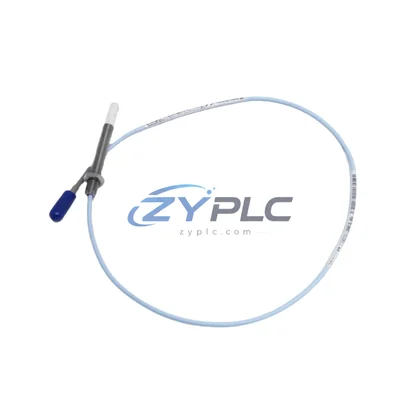
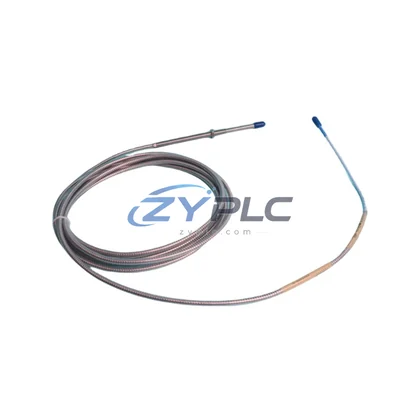
Bently Nevada 330102-00-80-10-11-00 Proximity Probe for 3300
The Bently Nevada 330102-00-80-10-11-00 is a precision eddy-current proximity probe engineered as a core sensing element within the Bently Nevada 3300 Series machinery protection and condition monitoring architecture. Rather than functioning as a standalone transducer, this probe is designed for seamless system integration across the full signal chain — from the rotating shaft surface through the field wiring, into the signal conditioning layer, and ultimately into the plant-level control and safety systems. Its role in the control hierarchy is to deliver continuous, high-fidelity displacement and vibration data that underpins real-time machinery health decisions across turbines, compressors, pumps, motors, and gearboxes in demanding industrial environments.
In a complete 3300 Series monitoring architecture, the 330102-00-80-10-11-00 probe operates in conjunction with the Bently Nevada 330130 extension cable and the 330180 proximitor/oscillator driver, forming a three-component transducer system. The proximitor converts the probe’s raw eddy-current signal into a calibrated DC voltage proportional to the gap distance between the probe tip and the target shaft. This conditioned signal is then routed to the 3500/40M Proximitor Monitor or the 3500/42M Proximitor/Seismic Monitor housed within the 3500 Series rack — a modular, 19-inch rack-mount platform that supports up to 16 monitor modules per chassis, with redundant power supplies such as the 3500/15 Power Supply Module ensuring uninterrupted operation even during single-point power failures.
The 3300 architecture is built around a layered automation philosophy. At the field sensing layer, the 330102-00-80-10-11-00 probe captures shaft radial vibration, axial position, differential expansion, and eccentricity — critical parameters for rotating machinery protection. At the signal conditioning layer, the 330180 proximitor provides the necessary oscillation frequency and demodulation, outputting a buffered signal compatible with both the 3500 Series monitors and external data acquisition systems. At the monitoring and protection layer, the 3500/40M module processes the conditioned signal against user-configured alert and danger setpoints, triggering relay outputs connected to the plant’s emergency shutdown (ESD) system or distributed control system (DCS) — such as a Honeywell Experion PKS, Emerson DeltaV, or ABB System 800xA — via hardwired I/O or FOUNDATION Fieldbus and Modbus TCP communication gateways.
System consistency is a defining advantage of specifying the 330102-00-80-10-11-00 within a Bently Nevada 3300-native architecture. Because the probe, extension cable, and proximitor are factory-matched and calibrated as a system, the overall transducer sensitivity is guaranteed at 7.87 mV/µm (200 mV/mil), with a linear measurement range of 0.25 mm to 2.25 mm (10 to 90 mil). This eliminates the calibration uncertainty that arises when mixing components from different manufacturers or series. For multi-shaft train monitoring — such as a gas turbine driving a centrifugal compressor with an intermediate gearbox — multiple 330102-series probes can be deployed across all bearing positions, all feeding into a common 3500 rack with a 3500/20 Rack Interface Module (RIM) that aggregates data and communicates with the plant historian or asset management system via OPC-DA or OPC-UA.
Redundancy design is another critical consideration in high-availability plant architectures. In API 670-compliant installations, dual-probe configurations are standard at each bearing position, with each probe connected to an independent monitor channel. The 3500 Series supports voted logic — for example, a 2-out-of-2 or 2-out-of-3 voting scheme — so that a single probe failure or cable fault does not trigger a spurious shutdown. The 330102-00-80-10-11-00’s stainless steel housing and armored cable construction are rated for continuous operation in environments with temperatures from -35°C to +177°C, making it suitable for hot-section turbine bearing pedestals, subsea-adjacent compressor trains, and high-ambient-temperature petrochemical process areas.
From an engineering commissioning perspective, the 330102-00-80-10-11-00 integrates directly into the 3500 System’s configuration workflow using Bently Nevada’s System 1 software or the 3500 Rack Configuration Software. Engineers can define gap voltage setpoints, configure buffered output scaling, and verify transducer system performance — all without removing the probe from its installed position. This reduces commissioning time on new installations and simplifies periodic functional testing during planned maintenance outages, directly supporting the plant’s reliability-centered maintenance (RCM) strategy.
Long-term maintenance efficiency is further enhanced by the probe’s standardized mechanical interface: an M8 x 1 threaded body with a 5 mm tip diameter, compatible with standard proximity probe mounting brackets and armored conduit fittings used throughout the 3300 and 3500 ecosystem. When a probe reaches end-of-life or is damaged during a mechanical event, replacement with a new 330102-00-80-10-11-00 requires only re-gapping to the nominal 1.0 mm (40 mil) operating gap and verification of the proximitor output voltage — a procedure that can be completed in under 30 minutes by a qualified instrumentation technician, minimizing machinery downtime.
All 330102-00-80-10-11-00 units supplied by ZYPLC are covered by a undergo pre-shipment functional verification including gap sensitivity testing, insulation resistance measurement, and cable continuity checks. Inventory is maintained in climate-controlled storage to preserve probe tip geometry and cable jacket integrity. Export shipping options are available after RFQ confirmation to support both planned capital projects and urgent unplanned maintenance requirements.
Product Specification Table
| Parameter |
Specification |
| System Role |
Field Sensing Layer — Radial Vibration, Axial Position, Eccentricity |
| Compatible Series |
Bently Nevada 3300 / 3500 Architecture |
| Transducer Sensitivity |
7.87 mV/µm (200 mV/mil), system-matched with 330130 + 330180 |
| Linear Range |
0.25 mm – 2.25 mm (10 – 90 mil) |
| Probe Tip Diameter |
5 mm |
| Thread Size |
M8 x 1 |
| Operating Temperature |
-35°C to +177°C |
| Cable Length (Probe Body) |
0.9 m (part of 330102-00-80-10-11-00 configuration) |
| Target Material Compatibility |
Steel, Stainless Steel, Inconel (non-magnetic metals) |
| Communication Compatibility |
Hardwired I/O, Modbus TCP, FOUNDATION Fieldbus (via 3500 gateway) |
| Compliance |
API 670, CE Marking |
| Warranty |
— All units tested prior to shipment |
System Compatibility Notes
The 330102-00-80-10-11-00 achieves its full architectural value when deployed as part of a coordinated system rather than as an isolated sensor. A typical 3300/3500 machinery protection architecture for a steam turbine-generator train would include the following coordinated components:
At the field sensing layer, multiple 330102-00-80-10-11-00 proximity probes are installed at each radial bearing position (X and Y planes) and at the thrust bearing for axial position monitoring. Each probe is paired with a Bently Nevada 330130 Extension Cable — selected in the appropriate length to bridge the distance between the bearing pedestal and the local junction box — and a Bently Nevada 330180 Proximitor/Oscillator mounted in the junction box or instrument enclosure. This three-component transducer system is the fundamental building block of the 3300 sensing architecture.
At the signal conditioning and monitoring layer, the proximitor outputs feed into the Bently Nevada 3500/40M Proximitor Monitor or 3500/42M Proximitor/Seismic Monitor modules installed in the 3500 Series Rack. The rack is powered by the 3500/15 Dual Power Supply Module, which provides redundant 24 VDC power to all installed monitor modules, ensuring that a single power supply failure does not interrupt machinery protection. The 3500/20 Rack Interface Module (RIM) manages communication between the rack and the plant DCS or historian, supporting Modbus TCP and OPC protocols.
At the network and integration layer, the 3500 rack’s relay outputs are hardwired to the plant’s Safety Instrumented System (SIS) — such as a Triconex Tricon or Rockwell Automation GuardLogix safety PLC — for emergency shutdown logic. Simultaneously, buffered vibration signals from the 3500/40M are routed to a Bently Nevada System 1 Evolution asset performance management server for continuous trending, alarm management, and predictive maintenance analytics. This dual-path architecture ensures that protection and condition monitoring functions remain independent, in compliance with IEC 61511 functional safety requirements.
At the human-machine interface layer, operators monitor real-time shaft vibration trends, Bode plots, orbit plots, and waterfall spectra through System 1 workstations or through DCS faceplates configured with vibration tag data sourced from the 3500 RIM. In some architectures, a dedicated Bently Nevada TDXnet Data Acquisition Module provides high-speed dynamic data capture for detailed rotor dynamics analysis during startup and shutdown transients.
Industrial Application Notes
The 330102-00-80-10-11-00 proximity probe finds application across a broad range of heavy industrial sectors where rotating machinery reliability is critical to process continuity and personnel safety.
In power generation — including gas turbines, steam turbines, and hydro generators — the probe monitors shaft radial vibration and axial thrust position at every bearing, providing the primary input to the turbine protection system. API 670 mandates redundant proximity probe installations at all critical bearing positions, making the 330102 series a standard specification item for new-build and retrofit turbine protection projects.
In oil and gas processing — including centrifugal compressors, reciprocating compressors, and expander-compressor trains in LNG, refinery, and gas processing facilities — the probe’s high-temperature rating and stainless steel construction make it suitable for hot-gas path and high-pressure service environments. Integration with the plant’s SIS via the 3500 relay outputs ensures that compressor surge events or bearing failures trigger automatic shutdown before catastrophic damage occurs.
In petrochemical and chemical processing, the probe supports continuous monitoring of reactor agitator drives, large centrifugal pumps, and blower trains. Its compatibility with the 3500/42M seismic monitor module allows the same rack to simultaneously monitor both shaft-relative vibration (via proximity probes) and casing-absolute vibration (via seismic accelerometers), providing a complete picture of machinery dynamic behavior.
In water and wastewater treatment, large vertical turbine pumps and centrifugal blowers equipped with 330102-series probes benefit from early detection of impeller imbalance, bearing wear, and cavitation-induced vibration — reducing unplanned outages in critical infrastructure applications.
In mining and minerals processing — including SAG mills, ball mills, and large slurry pumps — the probe’s robust construction and wide temperature range support reliable operation in dusty, high-vibration environments where conventional sensors would fail prematurely.
Product Compatibility FAQ
Q1: Is the 330102-00-80-10-11-00 directly compatible with the Bently Nevada 3500 Series rack monitors without additional signal conditioning?
A: The 330102-00-80-10-11-00 probe must be used as part of the complete 3300 transducer system, which includes the 330130 extension cable and the 330180 proximitor/oscillator. The proximitor provides the necessary oscillation frequency and signal demodulation, converting the raw eddy-current signal into a calibrated DC voltage that is directly compatible with the 3500/40M and 3500/42M monitor module inputs. Attempting to connect the probe directly to a monitor input without the proximitor will result in incorrect readings and loss of protection functionality.
Q2: Can the 330102-00-80-10-11-00 be used in a redundant dual-probe configuration for API 670 compliance, and how does the 3500 rack handle probe faults?
A: Yes. API 670 Section 5 requires dual-probe installations at each radial bearing position for critical machinery. Each probe connects to an independent monitor channel within the 3500 rack. The 3500/40M supports channel-level fault detection — if a probe or extension cable develops an open circuit or short circuit, the monitor generates a Not OK (NOK) status output and can be configured to either hold the last valid reading or drive the channel to a danger state, depending on the plant’s safety philosophy. The voted relay logic (e.g., 2oo2 or 2oo3) ensures that a single probe fault does not cause a spurious shutdown while still maintaining protection integrity.
Q3: What does the cover, and what pre-shipment testing is performed on each unit?
A: Every 330102-00-80-10-11-00 unit supplied by ZYPLC is covered by a from the date of shipment, covering manufacturing defects and functional failures under normal operating conditions. Pre-shipment testing includes: (1) gap sensitivity verification — confirming the 7.87 mV/µm output sensitivity across the full linear range using a calibrated target and reference proximitor; (2) insulation resistance measurement — verifying cable jacket and connector insulation integrity; and (3) mechanical inspection — confirming probe tip geometry, thread condition, and armored cable jacket integrity. Units that do not pass all three checks are quarantined and not shipped. Documentation of test results is available upon request for quality assurance and traceability purposes.