Bently Nevada 330102-30-65-10-02-CN: Industrial Data Link and Smart Factory Connectivity for 3300 XL Vibration Monitoring Systems
In modern industrial facilities — from rotating machinery in petrochemical plants to turbine halls in power generation — the integrity of real-time vibration data is not a convenience; it is a safety-critical requirement. The Bently Nevada 330102-30-65-10-02-CN eddy-current proximity probe is a precision sensing component engineered for the 3300 XL Series condition monitoring platform, delivering continuous shaft displacement and vibration signals that feed directly into the plant’s data acquisition, protection, and SCADA layers. Understanding this probe’s role within the full industrial data chain — from raw signal capture at the machine to alarm response at the control room — is essential for engineers designing or maintaining rotating equipment protection systems.
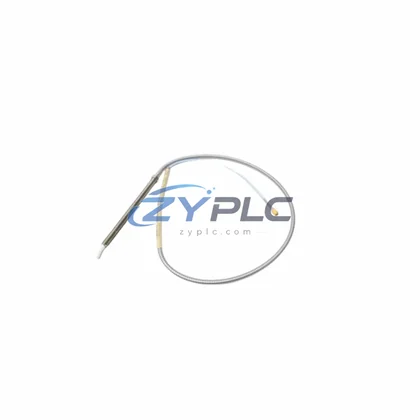
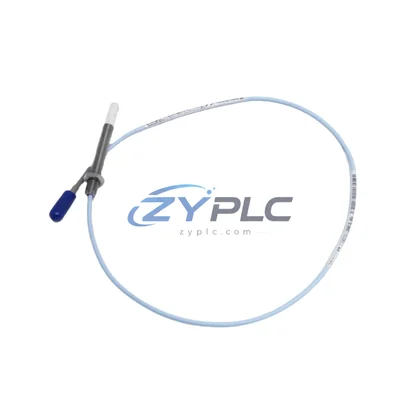
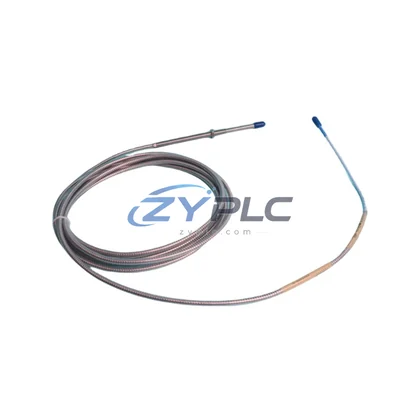
The 330102-30-65-10-02-CN is a 30 mm diameter, 65 mm cable extension, 10 mm range, metric-thread, reverse-mount eddy-current probe. It operates as the front-end sensing element in a three-component measurement chain alongside the Bently Nevada 330130 extension cable and the Bently Nevada 3300 XL 8mm proximitor/oscillator (such as the 330180 series). Together, these three components form a calibrated system that converts shaft proximity into a linear DC voltage signal, typically –24 VDC at full gap, which is then transmitted to the monitoring rack for processing.
Compatibility & Integration Notes
| Parameter |
Specification |
| SKU / Part Number |
330102-30-65-10-02-CN |
| Brand / Series |
Bently Nevada / 3300 XL |
| Probe Type |
Eddy-Current Proximity Probe |
| Probe Diameter |
30 mm |
| Measurement Range |
10 mm (linear) |
| Cable Extension |
65 mm integral cable |
| Thread / Mount |
Metric, Reverse Mount (CN) |
| Output Signal |
DC voltage (–24 VDC nominal scale factor) |
| Compatible Proximitor |
Bently Nevada 330180 / 3300 XL 8mm Proximitor Series |
| System Integration |
3300 XL Monitoring Rack, System 1 Software, SCADA/DCS via 4–20 mA or Modbus |
| Application Environment |
Rotating machinery, turbines, compressors, pumps, motors |
| system integration |
Compatible with full 3300 XL signal chain and upstream data systems |
| Warranty |
warranty terms confirmed during quotation |
| Supply Condition |
New / Surplus New / Tested & Verified |
Connected Automation Data Flow
The 330102-30-65-10-02-CN does not operate in isolation. Its value is realized only when it is correctly integrated into the complete condition monitoring and plant automation data chain. The signal path begins at the probe tip, where the eddy-current field responds to shaft surface proximity with sub-micron sensitivity. The resulting analog voltage travels through the Bently Nevada 330130 armored extension cable to the 330180 proximitor/oscillator mounted in the junction box or directly at the rack, where the raw oscillator signal is converted into a calibrated DC output.
This DC signal enters the Bently Nevada 3500/40M proximitor I/O module or the 3300 XL monitoring rack, where it is processed against configurable alert and danger setpoints. The rack communicates machine health data upstream via the Bently Nevada 3500/92 communication gateway, which supports Modbus RTU, Modbus TCP/IP, and Profibus DP — enabling direct integration with plant DCS platforms such as Honeywell Experion, Emerson DeltaV, or ABB 800xA, as well as SCADA systems running on OSIsoft PI or Wonderware InTouch.
At the HMI and SCADA layer, operators receive real-time shaft vibration trends, gap voltage readings, and alarm states. When the 330102-30-65-10-02-CN detects abnormal shaft displacement — caused by bearing wear, rotor imbalance, or oil whirl — the 3300 XL rack triggers a relay output through the Bently Nevada 3500/32 4-channel relay module, initiating a controlled machine trip or alarm annunciation. This relay signal can simultaneously activate a safety instrumented system (SIS) input module for process shutdown coordination.
For facilities running distributed monitoring across multiple machines, the Bently Nevada System 1 software platform aggregates data from multiple 3300 XL and 3500 racks over Ethernet, providing fleet-wide vibration trending, spectrum analysis, and predictive maintenance scheduling. Engineers can remotely diagnose probe gap drift, cable degradation, or proximitor calibration shift without physical access to the machine — a critical capability in hazardous or confined-space installations such as offshore compressor trains or underground pump stations.
In smart factory architectures, the vibration data from the 330102-30-65-10-02-CN can be routed through an industrial edge gateway (such as a Moxa MGate or Advantech ADAM series) to cloud-based asset management platforms, enabling IIoT-level predictive maintenance and integration with ERP maintenance modules. The probe’s stable, low-noise analog output ensures data fidelity across long cable runs in electrically noisy environments — a common challenge in motor control centers and variable frequency drive (VFD) installations where EMI from ABB ACS880 or Siemens SINAMICS G120 drives can corrupt sensor signals if shielding and grounding are not properly managed.
Solving Data Isolation in Industrial Sites
One of the most persistent challenges in rotating equipment monitoring is data isolation — where vibration data exists only at the local rack display and never reaches the plant historian, SCADA, or maintenance management system. The 330102-30-65-10-02-CN, when deployed within a properly configured 3300 XL or 3500 system, directly addresses this problem by providing a clean, calibrated analog signal that any modern communication gateway can digitize and forward.
Plants that have historically operated with standalone vibration monitors — where an operator must physically walk to a panel to read a meter — can modernize their monitoring infrastructure by adding a Bently Nevada 3500/92 Modbus gateway to an existing rack populated with 330102-series probes. This single addition transforms isolated local data into plant-wide, real-time visibility without replacing the proven sensing hardware already installed on the machine.
Protocol unification is another common pain point. A facility may have legacy Profibus-connected DCS equipment alongside newer Ethernet-based SCADA nodes. The 3300 XL communication architecture supports both, allowing the 330102-30-65-10-02-CN’s data to appear simultaneously in a Profibus DP master and a Modbus TCP/IP SCADA client — eliminating the need for separate protocol converters and reducing network complexity. For sites requiring IEC 61850 integration in power generation applications, additional gateway modules can bridge the 3500 rack data into substation automation networks.
Production line transparency — knowing in real time whether a critical pump, compressor, or gearbox is operating within safe vibration limits — is a prerequisite for uninterrupted production. The 330102-30-65-10-02-CN’s high-resolution, low-latency output supports alarm response times well within the requirements of API 670-compliant machinery protection systems, ensuring that abnormal conditions are detected and acted upon before they escalate to catastrophic failure.
System expansion is straightforward: additional 330102-series probes can be added to existing 3300 XL racks as new measurement points are required, with no changes to the upstream communication or SCADA configuration — only new channel assignments within System 1 software. This modularity protects the plant’s investment in monitoring infrastructure while allowing the condition monitoring scope to grow with operational needs.
Industrial Connectivity FAQ
Q1: Is the 330102-30-65-10-02-CN compatible with both the 3300 XL and 3500 Series monitoring racks?
The 330102-30-65-10-02-CN is primarily calibrated and specified for the 3300 XL 8mm eddy-current system. While the physical signal output (DC voltage) is compatible with 3500 Series I/O modules in principle, system-level compatibility — including scale factor, gap range, and alarm calibration — must be verified against the specific 3500 monitor card in use. We recommend confirming the full three-component chain (probe + extension cable + proximitor) matches the target rack’s input specifications before installation.
Q2: Can this probe’s data be integrated into a SCADA or DCS system, and what protocols are supported?
Yes. When connected to a Bently Nevada 3300 XL or 3500 rack equipped with a communication gateway module (such as the 3500/92), the probe’s processed vibration and gap data can be transmitted via Modbus RTU, Modbus TCP/IP, or Profibus DP to any compatible SCADA, DCS, or historian platform. For IIoT integration, edge gateways can further convert this data to MQTT or OPC-UA for cloud connectivity. Network latency is typically under 100 ms for standard Modbus polling cycles, suitable for condition monitoring applications.
Q3: What does the warranty terms confirmed during quotation cover, and how is the probe tested before shipment?
Every 330102-30-65-10-02-CN supplied by ZYPLC is tested for electrical continuity, coil impedance, and output linearity prior to shipment. The warranty terms confirmed during quotation covers defects in materials and workmanship under normal operating conditions. Probes are supplied with documentation of test results upon request. Warranty claims are processed directly through ZYPLC’s technical support team, with replacement or repair turnaround coordinated to minimize plant downtime.
Q4: How do I verify probe installation and gap setting without specialized Bently Nevada tools?
Gap setting for the 330102-30-65-10-02-CN requires a calibrated DC voltmeter and knowledge of the probe’s scale factor (typically –7.87 V/mm for 8mm systems). The target gap voltage is set per the machine OEM’s specification, usually in the –10 to –18 VDC range for mid-gap. A standard digital multimeter connected to the proximitor output is sufficient for field gap verification. For full system calibration and alarm setpoint configuration, Bently Nevada’s System 1 software or a portable calibration kit is recommended. ZYPLC’s technical team can provide application guidance for gap setting and system commissioning.