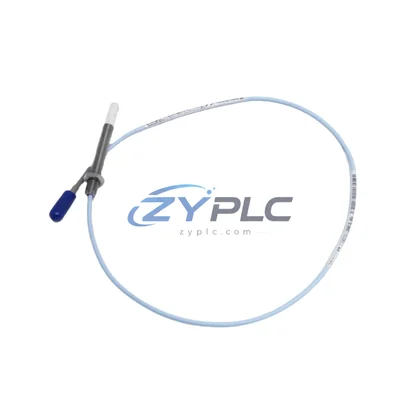
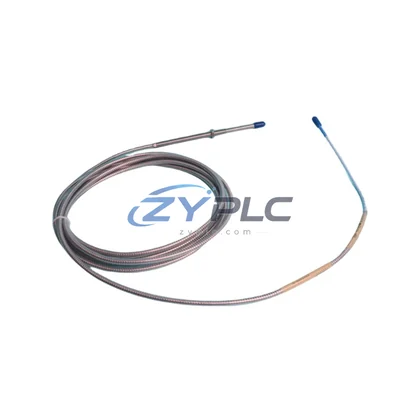
Bently Nevada 330103-00-05-05-02-05 Proximity Probe for 3300 Series
The Bently Nevada 330103-00-05-05-02-05 is a precision eddy-current proximity probe engineered for seamless integration within the Bently Nevada 3300 Series vibration monitoring architecture. In modern industrial automation and machinery protection systems, the proximity probe does not operate in isolation — it functions as the primary sensing element within a layered control hierarchy that spans the field instrumentation layer, signal conditioning layer, data acquisition layer, and supervisory control layer. This product is designed to deliver consistent, high-resolution radial and axial shaft displacement measurements that feed directly into the broader condition monitoring and machinery protection framework.
Within a complete 3300 Series system architecture, the 330103-00-05-05-02-05 probe works in close coordination with the 330130 extension cable, the 330180 proximitor sensor (signal conditioner), and the 3300/16 rack-mounted monitor module. The proximitor converts the probe’s raw eddy-current signal into a calibrated DC voltage proportional to the gap distance between the probe tip and the rotating shaft. This voltage signal is then routed to the 3500/40M proximitor I/O module or the 3300/16 monitor card housed within the 3500 Series rack system, where it is processed for alarm, danger, and trip logic. The seamless signal chain from probe to rack ensures that the entire vibration monitoring loop maintains the sub-millisecond response times required for turbine, compressor, and pump protection applications.
From a system architecture perspective, the 330103-00-05-05-02-05 is rated for use in environments where shaft speeds exceed 3,000 RPM and where bearing clearances must be monitored with micron-level precision. Its 5-meter cable configuration and 5 mm probe tip diameter make it particularly well-suited for installation in tight bearing housings on steam turbines, gas compressors, centrifugal pumps, and large electric motors. The probe’s operating range of 0.25 mm to 2.25 mm (10 to 90 mils) aligns precisely with the input requirements of the 3300/16 and 3500 Series monitor cards, ensuring full-scale calibration without signal clipping or dead-band errors.
In layered automation systems, the proximity probe layer interfaces upward with the DCS (Distributed Control System) or the plant-wide asset management platform via the 3500 rack’s communication gateway. The 3500/92 communication gateway module supports Modbus TCP, PROFIBUS DP, and OPC-DA protocols, enabling the vibration data collected by the 330103-00-05-05-02-05 to be transmitted to Emerson AMS Suite, OSIsoft PI, or third-party SCADA platforms for trend analysis, predictive maintenance scheduling, and regulatory compliance reporting. This system integration capability transforms the proximity probe from a standalone sensor into a critical data node within the plant’s digital infrastructure.
Redundancy is a key design consideration in high-availability machinery protection architectures. The 330103-00-05-05-02-05 supports dual-probe redundant configurations where two probes are installed 90 degrees apart on the same bearing journal, feeding independent signal channels into the 3500/40M dual-channel proximitor I/O module. This XY configuration provides both radial vibration amplitude and shaft orbit data, enabling the 3500 Series system to detect not only excessive vibration levels but also rotor instability, oil whirl, and misalignment conditions. In the event of a single probe failure, the redundant channel maintains continuous protection without requiring a plant shutdown, significantly improving overall system availability.
For engineering teams responsible for system commissioning and long-term maintenance, the 330103-00-05-05-02-05 offers a standardized calibration curve of -7.87 V/mm (-200 mV/mil) when used with the 330180 proximitor, which is consistent across the entire 3300 Series probe family. This uniformity simplifies spare parts management, reduces calibration time during scheduled maintenance outages, and ensures that replacement probes can be installed and verified without reconfiguring the monitor system. The probe’s stainless steel housing and armored cable construction provide robust protection against oil contamination, high-pressure steam environments, and mechanical vibration, supporting reliable operation across 12-month maintenance intervals and beyond.
Supply chain continuity is equally important in industrial control system management. ZYPLC maintains availability subject to RFQ confirmation of the 330103-00-05-05-02-05 alongside complementary components including the 330130-080-00-00 extension cable, 330180-X1-05 proximitor sensor, 3500/40M I/O module, 3500/15 power supply module, and 3500/92 communication gateway. This integrated inventory approach ensures that engineering teams can source complete probe-to-rack signal chains from a single supplier, reducing procurement lead times and minimizing the risk of architecture mismatches caused by mixing incompatible component revisions.
Product Specification Table
| Parameter |
Specification |
| System Role |
Field-level eddy-current proximity sensing within 3300/3500 Series vibration monitoring architecture |
| SKU / Part Number |
330103-00-05-05-02-05 |
| Brand / Manufacturer |
Bently Nevada (Baker Hughes) |
| Series Compatibility |
Bently Nevada 3300 Series, 3500 Series rack systems |
| Probe Tip Diameter |
5 mm |
| Cable Length |
5 meters (integral cable) |
| Measurement Range |
0.25 mm – 2.25 mm (10 – 90 mils) |
| Scale Factor |
-7.87 V/mm (-200 mV/mil) with 330180 proximitor |
| Operating Temperature |
-35°C to +177°C (probe tip); -35°C to +85°C (cable) |
| Target Material |
AISI 4140 steel or equivalent ferromagnetic alloy |
| Electrical Connection |
Coaxial, compatible with 330130 extension cable |
| Communication Capability |
Analog voltage output to 3300/16 or 3500/40M monitor card; upstream Modbus TCP / PROFIBUS DP via 3500/92 gateway |
| Installation Environment |
Bearing housings, turbine pedestals, compressor casings; IP67-rated housing |
| Certifications |
CE, ATEX Zone 1 (Ex ia IIC T4), FM Intrinsically Safe |
| Warranty |
warranty terms confirmed during quotation from date of shipment |
System Compatibility Notes
The 330103-00-05-05-02-05 achieves its full performance potential when deployed as part of a coordinated Bently Nevada control system architecture. A typical machinery protection loop for a steam turbine-generator set begins at the field level with the 330103-00-05-05-02-05 proximity probe installed at the turbine’s journal bearing, connected via the 330130-080-00-00 extension cable to the 330180-X1-05 proximitor sensor mounted on the bearing pedestal. The proximitor’s -24 VDC power is supplied by the 3500/15 power supply module housed in the 3500 Series rack, which also provides regulated power to the 3500/40M dual-channel proximitor I/O module, the 3500/22M transient data interface, and the 3500/92 communication gateway.
Within the rack, the 3500/40M processes the probe’s analog voltage signal and compares it against configurable alert and danger setpoints stored in the 3500/05 system rack interface module. When vibration levels exceed the danger threshold, the 3500 rack issues a hardwired relay output to the turbine’s emergency trip solenoid via the 3500/33 16-channel relay output module, initiating a controlled shutdown sequence within milliseconds. Simultaneously, the 3500/92 gateway transmits the vibration data over Modbus TCP to the plant DCS, where the 3500 Series data is integrated with process variables such as steam flow, bearing temperature, and rotor speed to provide operators with a comprehensive machinery health overview on the HMI workstation.
For facilities requiring enhanced diagnostic capability, the 3500/22M transient data interface captures high-speed waveform data from the 330103-00-05-05-02-05 during startup and shutdown transients, enabling detailed rotor dynamic analysis including Bode plots, polar plots, and cascade spectra. This data is archived in Emerson AMS Machinery Health Manager for long-term trend analysis and maintenance planning, completing the signal flow from the proximity probe at the field layer through to the enterprise asset management layer.
Industrial Application Notes
The 330103-00-05-05-02-05 is deployed across a wide range of heavy industrial applications where continuous shaft vibration monitoring is essential for process safety and equipment reliability. In power generation facilities, the probe monitors journal bearing vibration on steam turbines and gas turbines, providing the real-time displacement data required by API 670 machinery protection standards. In petrochemical and refinery applications, it is installed on centrifugal compressors, boiler feed pumps, and reactor agitators, where early detection of rotor imbalance or bearing wear can prevent unplanned shutdowns that cost hundreds of thousands of dollars per hour.
In the mining and minerals processing sector, the 330103-00-05-05-02-05 is used on large ball mills, SAG mills, and slurry pumps, where the harsh operating environment demands the probe’s robust stainless steel construction and ATEX-certified intrinsic safety design. Water treatment facilities deploy the probe on high-speed centrifugal pumps and blower units, integrating the vibration data with the plant’s SCADA system to support predictive maintenance programs that extend equipment service intervals and reduce lifecycle costs. In steel and aluminum smelting operations, the probe monitors rolling mill drive shafts and continuous caster pinch rolls, where precise shaft position control is critical to product quality and process consistency.
Across all these applications, the 330103-00-05-05-02-05 contributes to a layered automation strategy in which field-level sensing data flows upward through signal conditioning, rack-level processing, network communication, and supervisory control layers to support both real-time protection and long-term asset management objectives. Its compatibility with the 3300 and 3500 Series architecture ensures that it can be integrated into both new greenfield installations and brownfield upgrades without requiring changes to the existing rack infrastructure or monitor configuration.
Product Compatibility FAQ
Q1: Is the 330103-00-05-05-02-05 compatible with both the 3300 Series and 3500 Series rack systems?
Yes. The 330103-00-05-05-02-05 is fully compatible with both the Bently Nevada 3300/16 monitor card used in legacy 3300 Series installations and the 3500/40M proximitor I/O module used in current 3500 Series rack systems. Both platforms accept the probe’s standard -7.87 V/mm output when paired with the 330180 proximitor sensor. No hardware modifications or recalibration are required when migrating from a 3300 Series to a 3500 Series architecture, provided the same 330180 proximitor and 330130 extension cable are retained.
Q2: How does the warranty terms confirmed during quotation apply in a multi-component system architecture?
The warranty terms confirmed during quotation covers the 330103-00-05-05-02-05 proximity probe against manufacturing defects and performance deviations from the published specification for a period of 12 months from the date of shipment. In a system architecture context, ZYPLC recommends procuring the probe, extension cable, and proximitor sensor as a matched set to ensure that the warranty coverage aligns across all signal chain components. Warranty claims are processed through ZYPLC’s technical support team at plc.sales@zyplc.com, and replacement units are dispatched within the agreed lead time to minimize system downtime.
Q3: What commissioning steps are required when installing the 330103-00-05-05-02-05 in an existing 3500 Series architecture?
Commissioning the 330103-00-05-05-02-05 in an existing 3500 Series system involves four key steps: (1) Verify that the 3500/40M I/O module is configured for the correct probe type and scale factor using the 3500 Rack Configuration Software (RCS); (2) Install the probe in the bearing housing and set the initial gap voltage to -10.0 VDC ± 0.5 VDC (corresponding to a 1.27 mm gap) using a calibrated gap tool; (3) Confirm the full-scale output range of -2.0 VDC to -18.0 VDC across the 0.25 mm to 2.25 mm measurement range; (4) Verify alarm and danger setpoint activation by simulating gap changes with a non-rotating target. All commissioning data should be recorded in the plant’s maintenance management system to establish a baseline for future condition monitoring comparisons.