Bently Nevada 330103-00-07-15-02-00: Industrial Data Link and Smart Factory Connectivity in 3300 Series
The Bently Nevada 330103-00-07-15-02-00 is a precision eddy-current proximity transducer engineered for continuous, real-time shaft vibration and position monitoring within the Bently Nevada 3300 Series machinery protection platform. Far beyond a standalone sensing element, this transducer functions as a critical data origination node in a layered industrial automation architecture — converting mechanical motion into high-fidelity analog signals that feed directly into condition monitoring systems, SCADA platforms, DCS controllers, and plant-wide HMI networks. In modern smart factory environments where data isolation is a persistent operational risk, the 330103-00-07-15-02-00 serves as the foundational link between rotating machinery and the digital intelligence layer that governs predictive maintenance, alarm management, and production continuity.
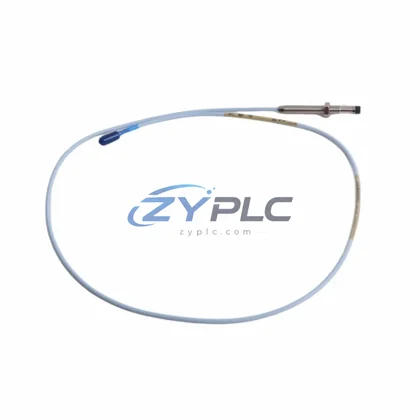
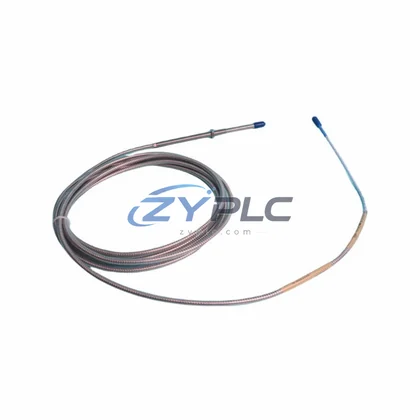
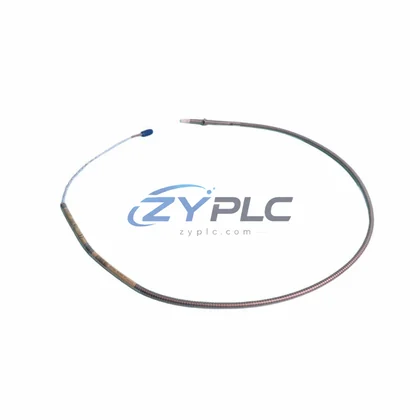
The transducer operates on the proven eddy-current sensing principle, generating a voltage output proportional to the gap between the probe tip and the conductive target surface. This non-contact measurement method eliminates mechanical wear, ensures long-term signal stability, and delivers sub-micron resolution across the full operating range. The 330103-00-07-15-02-00 variant is configured for a 7.87-inch (200 mm) probe-to-extension cable assembly with a 2-meter extension cable and standard TQ connector termination, making it directly compatible with the Bently Nevada 3300 XL 8mm proximity transducer system architecture. Its output integrates seamlessly with the 3300/16 and 3300/20 series monitor modules, which provide signal conditioning, alarm setpoint management, and relay output for machinery trip functions.
Within a complete machinery protection system, the 330103-00-07-15-02-00 does not operate in isolation. The signal chain begins at the probe tip, passes through the extension cable to the proximitor/oscillator driver — typically the Bently Nevada 330180-X1-05 or 330130-040-00-00 proximitor — which converts the raw impedance change into a calibrated DC voltage output ranging from -2 VDC to -18 VDC. This conditioned signal is then routed to rack-mounted monitor cards such as the 3300/16-02-01-01-00-00 dual-channel vibration monitor or the 3300/20-02-01-00-00 thrust position monitor, housed within the 3300 rack assembly. The rack communicates upstream via the System 1 Evolution condition monitoring software platform, enabling real-time trending, spectrum analysis, and alarm event logging accessible from any networked HMI or SCADA workstation.
The integration pathway from the 330103-00-07-15-02-00 into plant-level SCADA and DCS environments is well-established. Monitor rack outputs — both analog 4–20 mA retransmission signals and discrete relay contacts — connect to DCS I/O modules from platforms such as Emerson DeltaV, Honeywell Experion, or ABB 800xA, enabling machinery vibration data to appear alongside process variables in unified operator displays. For facilities running Modbus RTU or Modbus TCP/IP communication backbones, the Bently Nevada 3500/92 communication gateway module provides direct protocol bridging from the 3300/3500 monitor rack to the plant network, eliminating the need for intermediate signal converters and reducing latency in alarm propagation. This architecture ensures that a bearing fault detected by the 330103-00-07-15-02-00 at the machine level triggers a coordinated response across the control layer within milliseconds — a capability that is fundamental to zero-unplanned-downtime strategies in power generation, petrochemical, and heavy manufacturing facilities.
In layered automation deployments, the 330103-00-07-15-02-00 supports both simplex and redundant transducer configurations. Critical machinery such as steam turbines, compressors, and large pumps typically employ dual-transducer setups — pairing the 330103-00-07-15-02-00 with a second probe mounted 90 degrees apart on the shaft — to enable full orbital analysis and cross-channel voting logic within the monitor. This redundancy architecture, supported by the 3300 series monitor’s built-in channel-to-channel comparison, ensures that a single transducer failure does not result in a false machinery trip or, conversely, a missed fault condition. The system’s self-diagnostic capability continuously monitors transducer gap voltage, extension cable continuity, and proximitor supply voltage, generating a dedicated OK relay output that integrates with plant safety instrumented systems (SIS) and emergency shutdown (ESD) logic controllers.
From a smart factory connectivity perspective, the data generated by the 330103-00-07-15-02-00 is increasingly being routed through edge computing nodes — such as the Bently Nevada Scout or third-party industrial IoT gateways — that perform local signal processing and push summarized health indices to cloud-based asset performance management (APM) platforms. This edge-to-cloud architecture reduces network bandwidth consumption while maintaining the sub-second alarm response required for machinery protection. The transducer’s analog output is also compatible with portable data collectors and route-based vibration analyzers, supporting periodic offline analysis workflows that complement the continuous online monitoring provided by the 3300 rack system.
Every 330103-00-07-15-02-00 unit supplied by ZYPLC undergoes pre-shipment functional verification, including gap sensitivity calibration check, output linearity verification, and connector integrity inspection. All units are covered by a warranty terms confirmed during quotation from the date of shipment, providing assurance of performance conformance and supply reliability for maintenance planning and capital project procurement. ZYPLC maintains ready stock of the 330103-00-07-15-02-00 and associated 3300 Series components, supporting urgent replacement requirements and scheduled outage kitting for global industrial facilities.
Compatibility & Integration Notes
| Parameter |
Specification |
| SKU / Part Number |
330103-00-07-15-02-00 |
| Brand / Manufacturer |
Bently Nevada (Baker Hughes) |
| Series |
3300 XL 8mm Proximity Transducer System |
| Sensing Principle |
Eddy-Current (Non-Contact) |
| Probe Length |
7.87 in (200 mm) |
| Extension Cable Length |
2.0 m (6.56 ft) |
| Output Signal |
-2 VDC to -18 VDC (linear range) |
| System Role |
Signal origination node — shaft vibration & position sensing |
| Compatible Monitor Modules |
3300/16, 3300/20, 3300/25, 3300/46, 3300/55 |
| Compatible Proximitor |
330180-X1-05, 330130-040-00-00 |
| Protocol / Interface |
Analog DC voltage output; 4–20 mA retransmission via monitor rack |
| Network Compatibility |
Modbus RTU/TCP via 3500/92 gateway; DCS analog I/O; System 1 Evolution |
| SCADA / HMI Integration |
Compatible with Emerson DeltaV, Honeywell Experion, ABB 800xA, Wonderware |
| Operating Temperature |
-35°C to +121°C (probe); -40°C to +85°C (extension cable) |
| Installation Environment |
Industrial — turbines, compressors, pumps, motors, gearboxes |
| Warranty |
warranty terms confirmed during quotation from date of shipment |
Connected Automation Data Flow
The 330103-00-07-15-02-00 sits at the origin of a multi-layer data flow that connects rotating machinery to plant-wide intelligence systems. At the field level, the probe assembly — paired with the Bently Nevada 330180-X1-05 proximitor/oscillator — converts shaft displacement into a stable DC voltage signal. This signal travels via shielded extension cable to the 3300/16-02-01-01-00-00 dual-channel vibration monitor housed in the Bently Nevada 3300 rack assembly, where it undergoes signal conditioning, alarm comparison against user-defined setpoints, and relay output generation for machinery trip or alert functions.
The monitor rack’s analog retransmission outputs (4–20 mA) connect to DCS I/O cards — such as those in an Emerson DeltaV MD-Plus controller or Honeywell Experion C300 controller — integrating vibration data into the process control layer alongside temperature, pressure, and flow variables. For facilities requiring digital protocol communication, the Bently Nevada 3500/92 Modbus communication module bridges the monitor rack to Modbus TCP/IP or RTU networks, enabling SCADA systems running on platforms such as Wonderware InTouch or GE iFIX to poll vibration and position data at configurable scan rates without analog signal degradation.
At the edge computing layer, industrial IoT gateways aggregate the conditioned signals from multiple 3300 series monitor racks and apply local analytics — calculating RMS vibration levels, peak-to-peak displacement, and gap DC trends — before forwarding summarized health indices to cloud-based APM platforms via MQTT or OPC-UA. The Bently Nevada System 1 Evolution software platform serves as the primary condition monitoring and data historian, providing spectrum analysis, waveform capture, and long-term trending for all channels connected to the 330103-00-07-15-02-00 and its companion transducers. Operator workstations and mobile HMI clients access this data through standard Ethernet TCP/IP connections, enabling remote diagnostics and alarm acknowledgment from any location within the plant network — or remotely via VPN-secured connections for off-site engineering support.
For redundant machinery protection architectures, a second 330103-00-07-15-02-00 or compatible 3300 XL probe is mounted at 90° to enable full orbital plot analysis, with both channels feeding into the same monitor card for cross-channel voting. The monitor’s OK relay output connects to the plant’s Safety Instrumented System (SIS) — such as a Triconex or Hima safety controller — ensuring that transducer health status is factored into emergency shutdown logic. This complete data flow, from probe tip to SIS, represents the system integration capability that makes the 330103-00-07-15-02-00 a system-level asset rather than a simple sensing component.
Solving Data Isolation in Industrial Sites
One of the most persistent challenges in industrial facilities operating legacy machinery protection systems is data isolation — the condition where critical vibration and position data generated by proximity transducers like the 330103-00-07-15-02-00 remains trapped within proprietary monitor racks, inaccessible to plant-wide SCADA, MES, or ERP systems. This isolation creates blind spots in production transparency, delays fault diagnosis, and prevents the implementation of predictive maintenance strategies that depend on correlating machinery health data with process variables and production schedules.
The 330103-00-07-15-02-00, when deployed within a properly architected 3300 series system, directly addresses this challenge. The monitor rack’s multiple output options — analog retransmission, relay contacts, and digital Modbus communication via the 3500/92 gateway — provide flexible integration pathways into any plant network topology. Facilities that previously relied on manual rounds with portable vibration analyzers can transition to continuous online monitoring, with alarm events automatically logged in the SCADA historian and maintenance work orders generated in CMMS platforms such as SAP PM or IBM Maximo based on predefined alarm conditions.
For multi-unit or multi-site operations, the System 1 Evolution platform enables centralized monitoring of all connected 3300 series racks across a facility or across geographically distributed plants, providing a single-pane-of-glass view of machinery health that supports both local maintenance teams and remote engineering specialists. This architecture eliminates the need for on-site presence during routine monitoring activities, reducing travel costs and enabling faster response to developing fault conditions. The 330103-00-07-15-02-00’s role in this architecture is foundational — without accurate, stable, and continuously available proximity data at the field level, the entire upstream analytics and decision-support infrastructure loses its reliability.
System expansion is straightforward within the 3300 platform. Additional transducer channels can be added by installing new monitor cards in available rack slots, with each new 330103-00-07-15-02-00 probe automatically recognized by the System 1 software upon configuration. This modular scalability allows facilities to begin with protection of the most critical machinery and progressively extend coverage to secondary equipment as operational budgets allow, without requiring changes to the network infrastructure or SCADA configuration.
Industrial Connectivity FAQ
Q1: What communication protocols does the 330103-00-07-15-02-00 system support for SCADA and DCS integration?
The 330103-00-07-15-02-00 itself outputs an analog DC voltage signal, which is conditioned by the 3300 series monitor rack. The rack provides 4–20 mA analog retransmission outputs for direct connection to DCS analog input cards, and discrete relay outputs for alarm and trip functions. For digital protocol communication, the Bently Nevada 3500/92 Modbus communication module (compatible with 3300 series racks via the System 1 interface) supports Modbus RTU and Modbus TCP/IP, enabling integration with SCADA systems, historians, and OPC servers. OPC-DA and OPC-UA connectivity is available through the System 1 Evolution software platform, supporting integration with any OPC-compliant HMI or SCADA application.
Q2: Is the 330103-00-07-15-02-00 compatible with existing 3300 series racks and monitor cards already installed in our facility?
Yes. The 330103-00-07-15-02-00 is a standard 3300 XL 8mm proximity transducer system component and is fully compatible with all 3300 series monitor cards, including the 3300/16, 3300/20, 3300/25, 3300/46, and 3300/55 models. The probe, extension cable, and proximitor assembly conform to the standard Bently Nevada calibration curve, ensuring that no recalibration of the monitor card is required when replacing an existing transducer of the same series. ZYPLC recommends verifying the existing proximitor model and cable length configuration before ordering to ensure dimensional and electrical compatibility.
Q3: What does the warranty terms confirmed during quotation cover, and what is the process for warranty claims?
All 330103-00-07-15-02-00 units supplied by ZYPLC are covered by a warranty terms confirmed during quotation from the date of shipment. The warranty covers manufacturing defects, calibration non-conformance, and premature failure under normal operating conditions as specified in the Bently Nevada product documentation. Units that fail within the warranty period will be replaced or repaired at ZYPLC’s discretion, with priority processing to minimize impact on plant operations. To initiate a warranty claim, contact ZYPLC at plc.sales@zyplc.com or +86 19859288691 with the order reference, unit serial number, and a description of the observed failure. Pre-shipment functional verification records are maintained for all units to support warranty assessment.
Q4: How quickly can ZYPLC supply the 330103-00-07-15-02-00 for an urgent maintenance requirement?
ZYPLC maintains ready stock of the 330103-00-07-15-02-00 and associated 3300 Series components to support urgent replacement and scheduled outage requirements. Standard lead times for availability confirmed by RFQ units are 3–7 business days for international shipments, with expedited options available for critical machinery protection applications. Contact ZYPLC directly at +86 19859288691 or plc.sales@zyplc.com to confirm current stock availability and arrange priority dispatch.