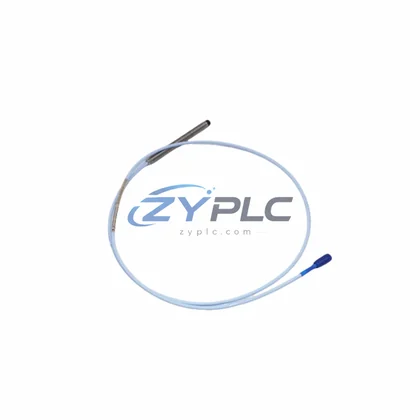
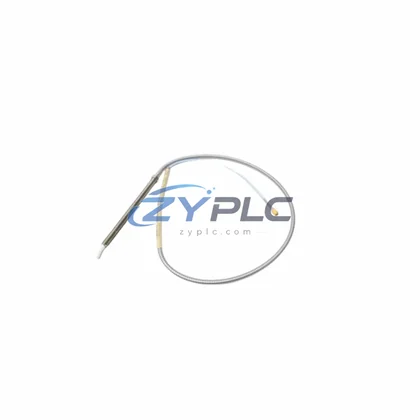
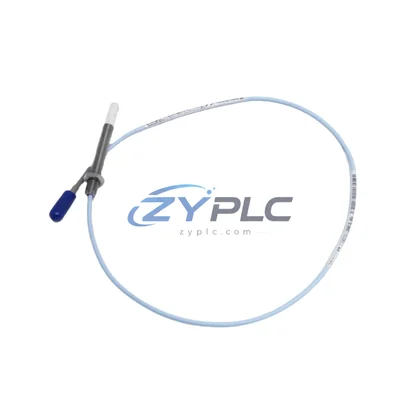
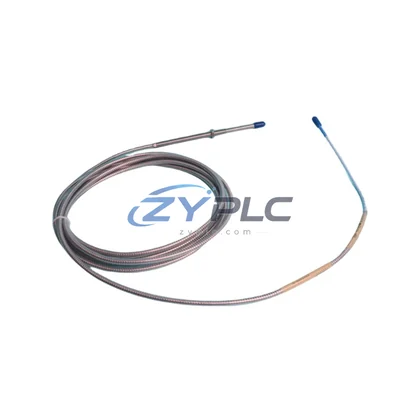
Bently Nevada 330103-00-08-05-02-CN: Industrial Data Link for Smart Factory Vibration Networks
The Bently Nevada 330103-00-08-05-02-CN is a high-precision eddy-current proximity probe engineered for the 3300 XL Series continuous vibration monitoring platform. Designed to operate at the intersection of rotating machinery and industrial data networks, this probe delivers real-time shaft displacement and vibration signals that feed directly into condition monitoring systems, SCADA platforms, and predictive maintenance architectures across smart manufacturing environments.
In modern industrial facilities, the integrity of the data chain — from field sensor to control room — determines the difference between planned maintenance and catastrophic failure. The 330103-00-08-05-02-CN serves as the primary signal acquisition node in this chain, converting mechanical motion into precise analog outputs that are processed by the Bently Nevada 3300 XL Proximitor Sensor (such as the 330180-X1-05 series) before transmission to the System 1 condition monitoring software or third-party SCADA/HMI platforms via standard 4–20 mA or voltage signal interfaces.
Compatibility & Integration Notes
| Parameter |
Specification |
| SKU |
330103-00-08-05-02-CN |
| Brand / Series |
Bently Nevada / 3300 XL |
| Probe Type |
Eddy-Current Proximity Probe |
| Signal Output |
Analog (compatible with 4–20 mA / voltage transmission) |
| Communication Protocol |
Analog signal → Proximitor → Modbus RTU / PROFIBUS / OPC-UA (via gateway) |
| Interface Type |
Coaxial connector, extension cable compatible |
| Transmission Capability |
Real-time shaft displacement, vibration amplitude, phase data |
| Network Compatibility |
DCS, SCADA, PLC, System 1 Software, third-party HMI platforms |
| System Application |
Rotating machinery protection, predictive maintenance, smart factory IIoT |
| Origin |
United States |
| Warranty |
warranty terms confirmed during quotation |
Connected Automation Data Flow
The 330103-00-08-05-02-CN proximity probe operates as the front-end sensing element in a layered industrial connectivity architecture. Mounted radially against a rotating shaft, it generates a continuous analog signal proportional to the gap distance — capturing sub-micron shaft movement with exceptional linearity and repeatability.
This raw signal is transmitted via matched coaxial cable to the Bently Nevada 330180-51-05 Proximitor Sensor, which conditions and converts the eddy-current signal into a calibrated DC voltage output. The conditioned signal then enters the 3300/16 I/O Module rack, where it is digitized and processed by the Bently Nevada 3500/42M Proximitor/Seismic Monitor — a dual-channel monitor capable of tracking radial vibration, axial position, and differential expansion simultaneously.
From the monitor rack, processed vibration data is transmitted over the plant’s industrial Ethernet backbone — typically via Modbus TCP or OPC-UA protocol — to the Bently Nevada System 1 Evolution software platform running on the plant historian server. Parallel data streams are simultaneously routed to the site’s DCS (Distributed Control System) — such as a Honeywell Experion PKS or Emerson DeltaV controller — enabling integrated alarm management and interlock logic.
For facilities integrating legacy fieldbus infrastructure, a PROFIBUS DP to Modbus RTU gateway (such as the HMS Anybus X-gateway AB7000) bridges the 3300 XL monitor outputs into existing PLC networks, including Siemens S7-300/400 or Allen-Bradley ControlLogix platforms. Remote I/O nodes and edge gateways — such as the Moxa MGate MB3170 — further extend the data reach to cloud-based SCADA dashboards and mobile HMI applications, enabling remote diagnostics and real-time vibration trending from any location on the plant network.
This end-to-end data flow — from the 330103-00-08-05-02-CN probe tip to the SCADA historian — ensures that every revolution of every critical shaft is captured, contextualized, and made actionable within the smart factory’s predictive maintenance ecosystem.
Solving Data Isolation in Industrial Sites
One of the most persistent challenges in industrial vibration monitoring is data isolation — the condition where critical machinery health data exists in proprietary monitoring systems that cannot communicate with the plant’s broader automation and control infrastructure. The Bently Nevada 330103-00-08-05-02-CN and the 3300 XL platform directly address this challenge through a combination of open-protocol compatibility and flexible signal architecture.
Protocol Fragmentation: Many industrial sites operate mixed-protocol environments where vibration monitors, PLCs, DCS controllers, and SCADA systems speak different communication languages. The 3300 XL system’s support for Modbus RTU/TCP, OPC-UA, and 4–20 mA analog outputs ensures that the 330103-00-08-05-02-CN’s data can be ingested by virtually any modern control platform without proprietary middleware.
Remote Monitoring Gaps: In geographically distributed facilities — offshore platforms, pipeline compressor stations, or multi-site manufacturing networks — real-time vibration data from the 330103-00-08-05-02-CN can be transmitted over industrial cellular or fiber-optic WAN links to centralized condition monitoring centers, eliminating the need for on-site personnel to manually collect vibration readings.
Production Line Transparency: By integrating proximity probe data into the plant’s MES (Manufacturing Execution System) and ERP platforms, maintenance teams gain full visibility into machinery health trends, enabling data-driven decisions on maintenance scheduling, spare parts procurement, and production planning — transforming reactive maintenance into a proactive, data-driven discipline.
System Scalability: The modular architecture of the 3300 XL platform allows facilities to expand their vibration monitoring network incrementally — adding new probe channels, monitor modules, and communication gateways as machinery assets grow — without disrupting existing data flows or requiring system-wide reconfiguration.
Every unit of the 330103-00-08-05-02-CN supplied by ZYPLC undergoes pre-shipment functional testing to verify signal output linearity, connector integrity, and cable continuity, ensuring that the probe performs to Bently Nevada factory specifications from the moment it is installed in the field.
Industrial Connectivity FAQ
Q1: What communication protocols are compatible with the Bently Nevada 330103-00-08-05-02-CN in a SCADA or DCS environment?
The 330103-00-08-05-02-CN outputs an analog signal processed by the 3300 XL Proximitor Sensor and monitor modules. These monitors support Modbus RTU/TCP and OPC-UA communication, enabling direct integration with SCADA platforms (such as Wonderware, iFIX, or Ignition) and DCS controllers. For PROFIBUS or DeviceNet environments, protocol gateways can be used to bridge the data stream.
Q2: How does the 330103-00-08-05-02-CN ensure network stability and signal integrity over long cable runs?
The probe is designed for use with matched Bently Nevada extension cables and Proximitor Sensors, which maintain signal integrity over the specified cable length range. The coaxial cable assembly minimizes electromagnetic interference (EMI) from adjacent power cables and motor drives, ensuring stable, low-noise vibration data transmission even in electrically noisy industrial environments.
Q3: Can the 330103-00-08-05-02-CN be integrated into an existing IIoT or edge computing architecture for remote diagnostics?
Yes. The analog output from the 3300 XL monitor can be connected to industrial edge gateways (such as the Moxa MGate series or Advantech ADAM modules) that digitize and transmit vibration data over Ethernet or cellular networks to cloud-based condition monitoring platforms. This enables remote diagnostics, vibration trend analysis, and alarm notification without requiring on-site access to the monitor rack.
Q4: What warranty and pre-shipment testing does ZYPLC provide for the 330103-00-08-05-02-CN?
All Bently Nevada 330103-00-08-05-02-CN units supplied by ZYPLC are covered by a warranty terms confirmed during quotation against manufacturing defects and functional failures. Each unit undergoes pre-shipment functional testing — including signal output verification, connector inspection, and cable continuity checks — before dispatch. Availability is confirmed via RFQ for same-week shipment to minimize plant downtime.