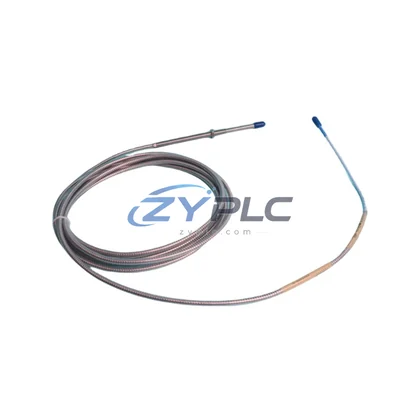
Bently Nevada 330103-00-21-10-02-00 Proximity Probe for 3300 Series
The Bently Nevada 330103-00-21-10-02-00 is a high-precision eddy-current proximity probe engineered for seamless integration within the Bently Nevada 3300 Series continuous vibration monitoring architecture. Unlike standalone sensing devices, this probe is designed from the ground up to function as a contextual component within a layered industrial control system — delivering reliable shaft displacement and radial vibration data to the monitoring layer, which in turn feeds the control layer, safety layer, and historian infrastructure of a complete plant automation environment.
In modern rotating machinery protection systems, the proximity probe does not operate in isolation. It forms the front-end sensing element of a signal chain that begins at the machine shaft and terminates at the control room DCS or safety instrumented system (SIS). The 330103-00-21-10-02-00 is calibrated to work in direct conjunction with the Bently Nevada 330180-X1-05 extension cable and the 330130-040-00-00 proximitor/oscillator, forming a complete eddy-current measurement loop. This three-component architecture — probe, cable, and proximitor — must be treated as a matched system to ensure measurement linearity and signal integrity across the full operating range.
Product Specification Table
| Parameter |
Specification |
| System Role |
Front-end shaft displacement sensor (eddy-current type) |
| Compatible Monitor |
Bently Nevada 3300 Series, 3500 Series (with adapter) |
| Probe Length |
21 inches (533 mm) integral cable |
| Tip Diameter |
8 mm standard |
| Measurement Range |
0–90 mil pp (0–2.286 mm pp) |
| Sensitivity |
200 mV/mil (7.87 V/mm) |
| Supply Voltage |
-24 VDC (nominal, via proximitor) |
| Operating Temperature |
-35°C to +177°C |
| Electrical Connection |
Coaxial, 3/8-24 UNF thread |
| Communication / Signal |
Analog voltage output (DC proportional to gap) |
| Installation Environment |
Bearing housing, turbine casing, compressor frame |
| Ingress Protection |
Suitable for oil mist, high-vibration environments |
| Warranty |
warranty terms confirmed during quotation — covers manufacturing defects and signal calibration integrity |
System Compatibility Notes
The 330103-00-21-10-02-00 proximity probe achieves its full diagnostic value only when integrated within a coherent, multi-layer control architecture. At the monitoring layer, the probe’s analog output is received by the Bently Nevada 3300/16 dual-channel monitor, which processes the raw gap voltage into engineering units — typically mils peak-to-peak or micrometers — and compares the live reading against configurable alert and danger setpoints. When a danger threshold is crossed, the 3300/16 issues a relay output that can be wired directly into the machine’s emergency shutdown (ESD) circuit or into a Bently Nevada 3500/15 power supply and relay module for coordinated trip logic.
At the I/O and communication layer, the 3300 Series rack communicates with the plant DCS via the Bently Nevada 3500/22M transient data interface or through a dedicated Modbus TCP or FOUNDATION Fieldbus gateway, depending on the plant’s network topology. This allows the vibration data captured by the 330103-00-21-10-02-00 to be trended, alarmed, and archived within the plant historian alongside process variables such as bearing temperature, lube oil pressure, and shaft speed — enabling true condition-based maintenance rather than time-based overhaul schedules.
For redundancy-critical applications such as steam turbine generators or centrifugal compressors in petrochemical service, the probe is typically installed in a dual-redundant configuration alongside a second 330103-series probe at 90° offset. The two probes feed separate channels of the 3500/25 keyphasor module, which provides phase reference for orbit plot analysis and balancing diagnostics. The 3500/42M vibration monitor then processes both X and Y channel inputs simultaneously, enabling the control system to detect not only amplitude exceedance but also directional shaft precession — a critical indicator of bearing wear or rotor instability.
At the power layer, the 3300 Series rack is supplied by a redundant 125800-01 power supply module, ensuring that a single power supply failure does not interrupt vibration monitoring continuity. At the field wiring layer, the 330180-X1-05 extension cable connects the probe to the proximitor, with the cable routed through conduit or cable tray to maintain EMI shielding integrity. The 330130-040-00-00 proximitor is typically mounted in a junction box near the machine, converting the high-frequency oscillator signal into a DC voltage proportional to the probe-to-shaft gap before transmitting the conditioned signal to the monitor rack over a longer cable run.
At the human-machine interface layer, operators interact with the vibration data through a Bently Nevada System 1 software platform or a third-party SCADA/HMI, where trend plots, spectrum displays, and orbit diagrams provide actionable insight into machine health. The 330103-00-21-10-02-00, as the primary sensing element, is the origin point of all this diagnostic intelligence — making its calibration accuracy, installation geometry, and long-term signal stability foundational to the entire condition monitoring strategy.
Industrial Application Notes
In power generation facilities, the 330103-00-21-10-02-00 is commonly installed on steam turbine journal bearings, where continuous shaft displacement monitoring is mandated by API 670 and plant insurance requirements. The probe monitors radial vibration during startup, steady-state operation, and coastdown, providing the turbine control system with real-time data to modulate governor response and prevent resonance exceedance during critical speed traversal.
In petrochemical and refinery applications, the probe is deployed on centrifugal compressors, reactor agitators, and boiler feed pumps — equipment where unplanned downtime carries significant production and safety consequences. The warranty terms confirmed during quotation ensures that replacement probes installed during planned turnarounds meet the same calibration standard as the original equipment, maintaining measurement consistency across the asset lifecycle.
In water treatment and municipal infrastructure, the probe monitors large vertical turbine pumps and blower trains, where bearing condition directly affects process availability. In mining and minerals processing, it is applied to SAG mill pinion bearings and crusher drive trains, where the harsh environment demands the probe’s robust construction and wide operating temperature range. In packaging and discrete manufacturing lines, the probe supports predictive maintenance programs on high-speed spindles and conveyor drive motors, reducing unplanned stoppages and extending mean time between failures (MTBF).
Across all these applications, the 330103-00-21-10-02-00 delivers consistent, repeatable eddy-current measurement that forms the foundation of a plant-wide machinery health program — integrating seamlessly with the monitoring, control, safety, and historian layers of the automation architecture.
Product Compatibility FAQ
Q1: Is the 330103-00-21-10-02-00 compatible with the Bently Nevada 3500 Series monitoring system?
A: The 330103-00-21-10-02-00 is natively designed for the 3300 Series architecture. It can be used with 3500 Series monitors when paired with the correct 330130-series proximitor and 330180-series extension cable, provided the system is recalibrated to the 3500 monitor’s input range. Always verify the complete probe-cable-proximitor system compatibility with the target monitor module before installation to ensure signal linearity and setpoint accuracy.
Q2: How does the warranty terms confirmed during quotation apply in a redundant dual-probe installation?
A: The warranty terms confirmed during quotation covers each 330103-00-21-10-02-00 unit individually against manufacturing defects and calibration drift. In a dual-redundant installation, both probes are covered independently. If one probe fails within the warranty period, the replacement unit is supplied pre-calibrated to the same sensitivity specification, minimizing reconfiguration effort and ensuring the redundant channel is restored to full operational status without requiring a full system recalibration.
Q3: What are the key installation and commissioning considerations for system integration with the plant DCS?
A: system integration of the 330103-00-21-10-02-00 into the plant DCS requires attention to three areas: (1) Signal routing — the proximitor output must be wired to the correct monitor input channel with proper shielding and grounding to prevent ground loops; (2) Scaling — the DCS analog input card must be configured to match the proximitor’s output range (typically -2 VDC to -18 VDC) and scaled to engineering units; (3) Alarm rationalization — the monitor’s alert and danger setpoints must be coordinated with the DCS alarm management system to avoid nuisance trips and ensure that the vibration alarm hierarchy is consistent with the plant’s overall safety instrumented system (SIS) logic.