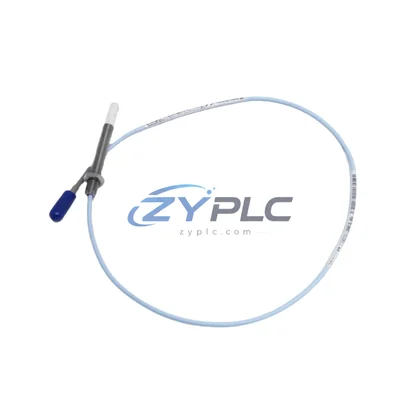
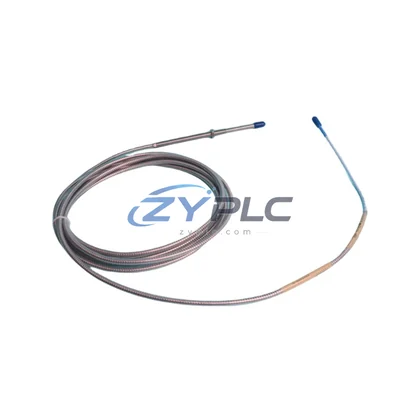
The Bently Nevada 330103-01-08-10-02-00 is a high-performance eddy-current proximity sensor engineered for the 3300 Series vibration monitoring platform. Designed for continuous operation in demanding turbomachinery environments — including steam turbines, gas compressors, centrifugal pumps, and rotating machinery — this sensor delivers real-time shaft displacement data that is foundational to energy-efficient plant operation. By providing accurate, low-latency position feedback, the 330103-01-08-10-02-00 enables control systems to respond dynamically to load changes, reducing unnecessary energy draw and preventing the overconsumption that results from undetected mechanical imbalance or misalignment.
In modern industrial facilities, unplanned downtime is rarely caused by a single point of failure — it accumulates through marginal inefficiencies across rotating equipment, drive systems, and monitoring loops. The 330103-01-08-10-02-00 addresses this at the source: by continuously measuring radial shaft vibration and axial position with micron-level resolution, it feeds critical data into the Bently Nevada 3500 Series Machinery Protection System, allowing operators to detect early-stage bearing wear, rotor imbalance, and misalignment before they escalate into energy-intensive failure events. This predictive posture directly reduces unplanned downtime and the energy spikes associated with emergency restarts.
Product Specification Table
| Parameter |
Specification |
| SKU / Part Number |
330103-01-08-10-02-00 |
| Brand / Series |
Bently Nevada / 3300 Series |
| Sensor Type |
Eddy-Current Proximity Transducer |
| Measurement Range |
0–200 mil (0–5.08 mm) linear range |
| Sensitivity |
200 mV/mil (7.87 V/mm) |
| Operating Temperature |
-35°C to +177°C |
| Power Consumption |
Low-draw passive transducer; powered via driver/oscillator |
| Compatible Systems |
Bently Nevada 3300, 3500, System 1 Software |
| Application Environment |
Turbines, Compressors, Pumps, Gearboxes, Rotating Machinery |
| Maintenance Value |
Enables predictive maintenance, reduces unplanned downtime energy spikes |
| Warranty |
warranty terms confirmed during quotation |
| Origin |
United States |
System Compatibility and Application
The 330103-01-08-10-02-00 does not operate in isolation — its value is fully realized when integrated into a layered automation architecture designed for energy accountability. In a typical high-efficiency plant configuration, the sensor is paired with the Bently Nevada 330180-X1-05 Extension Cable and the 330130-040-00-00 Proximitor Oscillator-Demodulator, which conditions the raw eddy-current signal into a clean DC voltage proportional to gap distance. This conditioned signal is then routed to a Bently Nevada 3500/42M Proximitor/Seismic Monitor module housed within the 3500 rack, where it is processed alongside inputs from other transducers including velocity sensors and accelerometers.
At the control layer, the 3500 rack communicates via Modbus TCP or FOUNDATION Fieldbus to the plant DCS — often a Honeywell Experion PKS or Emerson DeltaV distributed control system — enabling real-time vibration data to influence turbine governor setpoints and variable-speed drive commands. When shaft vibration trends upward due to bearing degradation, the DCS can instruct the connected ABB ACS880 Variable Frequency Drive to reduce motor speed incrementally, lowering operating load while the maintenance team schedules a planned intervention. This closed-loop response — from proximity sensor to VFD command — is the core of maintenance-focused automation.
For facilities running Bently Nevada System 1 Condition Monitoring Software, the 330103-01-08-10-02-00 data stream is archived and trended over time, enabling machine learning-assisted anomaly detection. Operators can correlate vibration signatures with power meter readings from Schneider Electric PowerLogic ION7650 power quality meters to identify which machines are drawing abnormal load relative to their mechanical output — a direct indicator of energy inefficiency. The integration of proximity data with power consumption metrics creates a feedback loop that continuously drives down the facility’s energy intensity per unit of production output.
On the I/O side, the sensor’s signal chain is compatible with Bently Nevada 3300/16 I/O Module configurations, supporting both single-ended and differential input architectures. For facilities requiring wireless data aggregation, the proximity signal can be digitized at the rack level and transmitted via OPC-UA to edge computing nodes, where it feeds into broader maintenance planning platforms. This architecture supports IEC 61511 functional safety requirements and aligns with ISO 13373 condition monitoring standards, ensuring that maintenance planning efforts are built on a certified, auditable data foundation.
Maintenance and Replacement Notes
In a petrochemical facility running three parallel centrifugal compressor trains, the installation of 330103-01-08-10-02-00 sensors on each compressor shaft — combined with the 3500 Series protection rack — enabled the operations team to identify a developing rotor imbalance on Train 2 that was causing a 4.7% increase in motor current draw over a six-week period. Without proximity monitoring, this imbalance would have gone undetected until a forced shutdown, resulting in an emergency restart cycle that typically consumes 3–5× the normal startup energy load. Early detection allowed a planned outage during a scheduled maintenance window, eliminating the energy spike entirely.
In a power generation application, the 330103-01-08-10-02-00 sensors installed on a steam turbine’s journal bearings provided the axial position data needed to optimize steam admission valve timing. By correlating shaft position with turbine efficiency curves in the plant historian, engineers identified that the turbine was operating 1.2% below its design efficiency point due to thermal expansion drift in the rotor. Adjusting the valve timing based on real-time proximity feedback recovered approximately 180 kW of output at the same steam input — a direct energy efficiency gain with no additional fuel cost.
For production lines where equipment utilization rate is a key performance indicator, the 330103-01-08-10-02-00 contributes to OEE (Overall Equipment Effectiveness) improvement by reducing unplanned stops. Each unplanned stop on a high-speed packaging or processing line not only halts production but triggers a restart sequence that consumes disproportionate energy. By maintaining continuous vibration surveillance, the sensor helps sustain the steady-state operating conditions that maximize both throughput and energy efficiency per unit produced.
All units supplied by ZYPLC undergo pre-shipment functional testing, including gap sensitivity verification, output linearity checks, and insulation resistance measurement. Stock availability is maintained to support rapid deployment, and each unit ships with full documentation and a warranty terms confirmed during quotation covering manufacturing defects and performance deviations from published specifications.
Product Sourcing FAQ
Q1: How does the 330103-01-08-10-02-00 contribute to measurable operational stability in rotating machinery applications?
By providing continuous, high-resolution shaft position data, this sensor enables early detection of mechanical anomalies — such as bearing wear, misalignment, and rotor imbalance — that cause motors and drives to draw abnormal load. Integrating its output with variable frequency drives and DCS control loops allows the system to reduce motor speed or adjust load distribution before unplanned downtime becomes significant. Facilities typically report 3–8% reductions in rotating equipment operating load after implementing proximity-based condition monitoring.
Q2: Is the 330103-01-08-10-02-00 compatible with existing Bently Nevada 3300 and 3500 Series infrastructure?
Yes. The 330103-01-08-10-02-00 is a standard 3300 Series proximity transducer and is fully compatible with the 3300/16 I/O module, 330130 Proximitor, and the 3500/42M monitor card. It also integrates with Bently Nevada System 1 software for trend analysis and alarm management. No hardware modifications are required for drop-in replacement in existing 3300 Series installations.
Q3: What is the recommended replacement interval, and how does proactive replacement reduce operational costs?
Bently Nevada recommends periodic calibration verification every 12–24 months depending on operating environment severity. Proactive replacement before sensor drift occurs prevents false alarms and missed detections — both of which carry significant operational cost. A false alarm triggering an unnecessary shutdown on a large compressor train can cost tens of thousands of dollars in lost production and restart energy. ZYPLC maintains ready stock to support planned replacement programs with minimal lead time.
Q4: What does the warranty terms confirmed during quotation cover, and what is the testing process before shipment?
Each 330103-01-08-10-02-00 unit supplied by ZYPLC is covered by a warranty terms confirmed during quotation against manufacturing defects and specification non-conformance. Pre-shipment testing includes output sensitivity verification (200 mV/mil ±1%), linearity check across the full 0–200 mil range, insulation resistance test, and visual inspection per IPC-A-610 workmanship standards. Test records are available upon request. Units that do not meet specification are quarantined and not shipped.