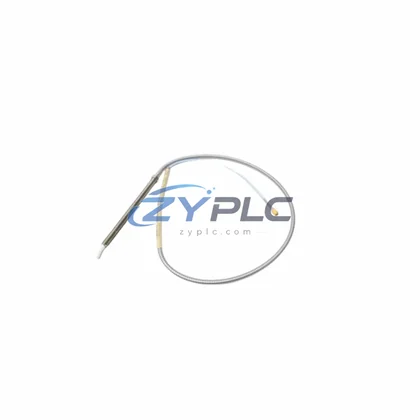
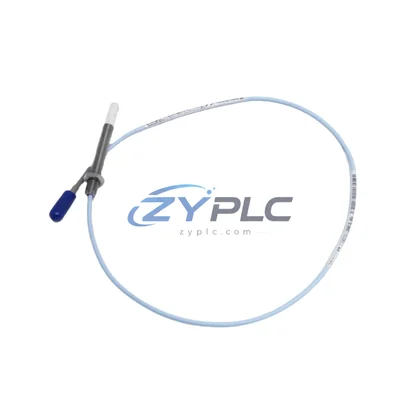
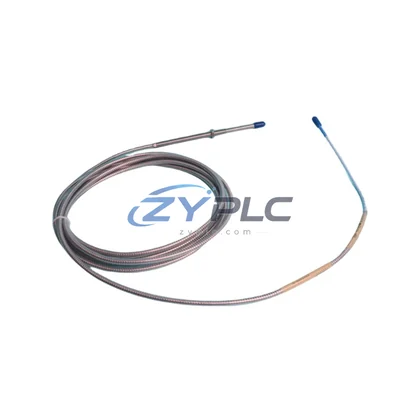
Bently Nevada 330103-05-10-10-02-05: Industrial Data Link for 3300 Series Vibration Monitoring Systems
The Bently Nevada 330103-05-10-10-02-05 is a precision proximity probe cable engineered for continuous, high-integrity signal transmission within the Bently Nevada 3300 Series vibration monitoring architecture. In modern smart factory environments, the reliability of every physical data link — from rotating machinery to the control room — determines the quality of real-time diagnostics, predictive maintenance decisions, and overall plant uptime. This cable serves as a critical conduit in that chain, connecting eddy-current proximity probes directly to 3300 Series monitor modules, ensuring that raw vibration and position signals are delivered with zero degradation across the full measurement bandwidth.
Designed to operate within the demanding signal chain of industrial rotating machinery protection systems, the 330103-05-10-10-02-05 supports the low-impedance, high-frequency analog signal requirements of the Bently Nevada 3300 XL proximity transducer system. Its shielded construction minimizes electromagnetic interference from adjacent variable frequency drives, servo amplifiers, and high-current bus systems — a common challenge in dense industrial panel environments where signal integrity directly impacts SCADA alarm accuracy and HMI display fidelity.
Compatibility & Integration Notes
| Parameter |
Specification |
| SKU / Part Number |
330103-05-10-10-02-05 |
| Brand |
Bently Nevada |
| Series |
3300 Series (3300 XL Proximity Transducer System) |
| Product Type |
Proximity Probe Cable |
| Signal Protocol |
Analog (eddy-current, low-impedance signal) |
| Interface Type |
Coaxial / shielded cable assembly with connector terminations |
| Communication Role |
Probe-to-monitor signal transmission (field device to monitor module) |
| Network Compatibility |
Bently Nevada 3300 Series monitor racks, System 1 condition monitoring platform |
| System Application |
Rotating machinery protection, vibration monitoring, radial/axial position measurement |
| SCADA / HMI Integration |
Compatible with System 1 Evolution software, Modbus-enabled 3300 Series monitors, DCS integration via 4–20 mA or relay outputs |
| Origin |
USA |
| Warranty |
warranty terms confirmed during quotation — tested before shipment, verified against OEM specifications |
Connected Automation Data Flow
In a typical turbomachinery protection architecture, the 330103-05-10-10-02-05 probe cable originates the data flow at the machine casing, where an eddy-current proximity probe — such as those in the Bently Nevada 3300 XL series — is mounted adjacent to the shaft. The cable routes the raw oscillator-demodulator signal from the probe tip through the extension cable to the Bently Nevada 3300/16 or 3300/20 monitor module installed in the rack. From there, the conditioned vibration signal is processed and made available to the plant’s broader automation network.
Within the 3300 Series monitor rack, the processed signal feeds into the Bently Nevada 3500 Series rack gateway or directly into a Modbus RTU/TCP interface card, enabling real-time data transfer to the plant DCS — commonly a Honeywell Experion PKS, Emerson DeltaV, or Yokogawa CENTUM VP system. Simultaneously, the System 1 Evolution condition monitoring software collects continuous waveform data from multiple 3300 Series channels, aggregating shaft vibration, axial position, and differential expansion readings from across the machine train.
At the HMI layer, operators viewing a GE iFIX or Wonderware InTouch SCADA screen receive live vibration trend data, alert thresholds, and danger setpoint alarms — all of which trace their data origin back to the signal integrity maintained by the 330103-05-10-10-02-05 cable assembly. Any degradation in cable shielding or connector termination quality at this stage introduces noise into the signal chain, which can manifest as false alarms on the 3300 Series monitor or masked fault conditions in the System 1 trending database.
Beyond the monitor rack, the 3300 Series outputs interface with plant-level safety systems, including Triconex Safety Instrumented Systems (SIS) and Bently Nevada’s own 3500 Series machinery protection system for cross-validation of vibration trip signals. Remote I/O modules — such as those from Phoenix Contact or Wago — may also aggregate discrete alarm relay outputs from the 3300 Series monitors and forward them via PROFIBUS DP or EtherNet/IP to the main PLC, typically a Rockwell Automation ControlLogix or Siemens SIMATIC S7-400 platform managing the broader plant automation strategy.
For edge analytics and remote diagnostics, an industrial edge gateway — such as a Moxa UC-8100 or Advantech WISE-5000 — can be deployed to collect System 1 OPC-UA data streams and forward compressed vibration spectra to cloud-based predictive maintenance platforms, enabling remote engineering teams to monitor bearing health, rotor dynamics, and seal performance without on-site access. The entire data chain — from probe tip to cloud dashboard — depends on the uninterrupted, low-noise signal delivery that the 330103-05-10-10-02-05 cable provides at the very first link.
Solving Data Isolation in Industrial Sites
One of the most persistent challenges in rotating machinery protection is the fragmentation of vibration data across incompatible monitoring platforms. Older plant installations may combine legacy Bently Nevada 7200 Series monitors with newer 3300 Series racks, creating protocol mismatches that prevent unified SCADA visibility. The 330103-05-10-10-02-05, as a standardized 3300 XL-compatible cable assembly, ensures that field sensors can be connected to current-generation monitor hardware without signal conditioning adapters or custom interface circuits — eliminating one layer of potential data isolation at the physical layer.
In plants where vibration data has historically been siloed within standalone condition monitoring workstations, the integration of 3300 Series monitors with Modbus TCP or OPC-UA gateway modules allows vibration parameters to be surfaced directly within the plant DCS historian — such as OSIsoft PI or Aspentech IP.21 — alongside process variables like temperature, pressure, and flow. This convergence of machinery health data with process data enables operations teams to correlate vibration anomalies with process upsets in real time, accelerating root cause analysis and reducing mean time to repair.
Remote monitoring capability is further enhanced when 3300 Series monitor racks are networked through managed industrial Ethernet switches — such as Hirschmann MICE or Cisco IE-3000 series — providing redundant ring topologies that maintain data continuity even during partial network failures. For sites with geographically distributed machinery trains, such as pipeline compressor stations or offshore platforms, this network resilience is essential for maintaining continuous protection system availability.
Production line transparency is achieved when vibration data from multiple machine trains — each instrumented with 3300 XL proximity probes and 330103-05-10-10-02-05 cable assemblies — is aggregated into a unified System 1 Evolution database, enabling fleet-wide health dashboards that maintenance planners can use to prioritize inspection schedules, optimize spare parts inventory, and defer unnecessary shutdowns based on actual machine condition rather than fixed time intervals.
Industrial Connectivity FAQ
Q1: Is the Bently Nevada 330103-05-10-10-02-05 compatible with both 3300 Series and 3500 Series monitor systems?
The 330103-05-10-10-02-05 is specifically designed for the Bently Nevada 3300 XL proximity transducer system. While the 3500 Series uses a similar eddy-current measurement principle, cable assemblies are system-specific due to differences in connector types, cable impedance specifications, and overall length configurations. Always verify the target monitor module’s transducer input specifications before substituting cable assemblies between series.
Q2: How does cable quality affect communication latency and alarm response time in SCADA systems?
The 330103-05-10-10-02-05 transmits an analog signal, so latency in the traditional digital sense does not apply at the cable level. However, signal degradation caused by damaged shielding, corroded connectors, or incorrect cable routing near high-EMI sources can introduce noise that the 3300 Series monitor’s signal processing must filter — potentially affecting the speed and accuracy of alarm threshold detection. Maintaining cable integrity is therefore directly linked to the responsiveness of the overall protection system.
Q3: Can this cable assembly be used in hazardous area (Ex) installations?
Bently Nevada 3300 XL proximity transducer systems are available in intrinsically safe (IS) configurations for use in hazardous areas classified under ATEX or IECEx standards. The specific cable assembly used in IS installations must be the approved IS-rated variant. The 330103-05-10-10-02-05 part number should be cross-referenced against the applicable system approval documentation to confirm its suitability for the intended hazardous area classification before installation.
Q4: What does the warranty terms confirmed during quotation cover, and how is pre-shipment testing conducted?
All Bently Nevada 330103-05-10-10-02-05 cable assemblies supplied by ZYPLC are covered by a warranty terms confirmed during quotation against manufacturing defects and functional failures under normal operating conditions. Prior to shipment, each unit undergoes continuity testing, shield integrity verification, and connector termination inspection to confirm compliance with OEM specifications. Units that do not pass pre-shipment testing are quarantined and not dispatched, ensuring that every cable delivered to site is ready for immediate installation and commissioning.