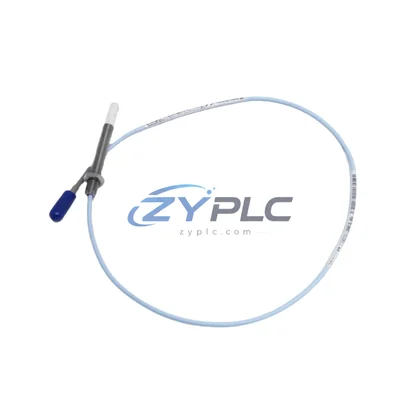
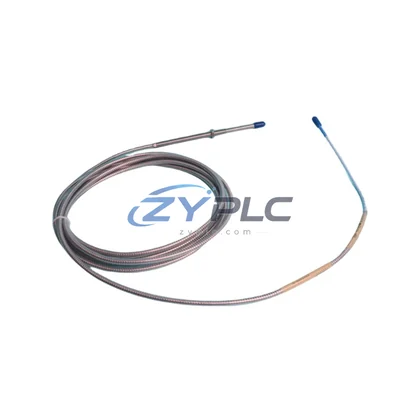
Bently Nevada 330103-08-15-10-02-00 Proximity Probe for 3300 Automation
The Bently Nevada 330103-08-15-10-02-00 is a high-precision eddy-current proximity probe engineered within the renowned 3300 Series platform — one of the most widely deployed continuous vibration monitoring systems in heavy industrial environments. Designed for rotating machinery protection and condition monitoring, this probe delivers real-time shaft displacement data that directly feeds into maintenance planning strategies across compressors, turbines, pumps, and motors. By enabling early fault detection and eliminating unplanned downtime, the 330103-08-15-10-02-00 plays a central role in reducing overall plant unplanned downtime and improving equipment utilization rates.
In modern industrial facilities where energy costs represent a significant share of operating expenditure, the ability to monitor shaft vibration with micron-level accuracy is no longer a luxury — it is a prerequisite for sustainable production. The 330103-08-15-10-02-00 operates with an 8 mm tip diameter, a 15-foot (4.57 m) integral cable, and is calibrated for use with the 3300 XL 8mm Proximitor Sensor, delivering a sensitivity of 200 mV/mil (7.87 V/mm) across a linear range of 10 to 90 mils (0.25 to 2.29 mm). This precision ensures that control systems receive clean, reliable displacement signals — the foundation of any industrial automation system.
All units are sourced from verified supply channels, undergo pre-shipment functional testing, and are backed by a warranty terms confirmed during quotation. Stock is available for shipment arranged after confirmation.
Product Specification Table
| Parameter |
Specification |
| SKU / Part Number |
330103-08-15-10-02-00 |
| Series |
Bently Nevada 3300 XL |
| Probe Tip Diameter |
8 mm |
| Cable Length |
15 ft (4.57 m) Integral |
| Sensitivity |
200 mV/mil (7.87 V/mm) |
| Linear Range |
10–90 mil (0.25–2.29 mm) |
| Supply Voltage |
-24 VDC (nominal) |
| Operating Temperature |
-35°C to +121°C |
| Compatible Proximitor |
3300 XL 8mm Proximitor Sensor |
| Compatible Systems |
3500 Machinery Protection System, System 1 Software |
| Application Environment |
Turbines, Compressors, Pumps, Motors, Gearboxes |
| Maintenance Value |
Reduces unplanned downtime; enables load-based motor control adjustments |
| Warranty |
warranty terms confirmed during quotation |
| Origin |
USA |
System Compatibility and Application
The 330103-08-15-10-02-00 proximity probe does not operate in isolation — its true value emerges when integrated into a layered automation and maintenance planning architecture. At the sensing layer, the probe pairs directly with the Bently Nevada 3300 XL 8mm Proximitor Sensor (e.g., 330180-91-05), which conditions the raw eddy-current signal into a calibrated voltage output readable by monitoring systems. This signal is then routed into the Bently Nevada 3500/42M Proximitor Monitor, a rack-based module within the 3500 Machinery Protection System that performs real-time alarm and danger threshold evaluation.
At the control execution layer, the displacement data feeds into a Bently Nevada 3500/22M Transient Data Interface or directly into a plant DCS via 4–20 mA or relay outputs. When shaft vibration trends indicate bearing wear or rotor imbalance, the control system can instruct a Rockwell Automation PowerFlex 755 Variable Frequency Drive or a Siemens SINAMICS G120 drive to reduce motor speed, cutting energy consumption proportionally to the cube of speed reduction — a critical lever in pump and fan applications.
For broader condition monitoring, the vibration data from the 330103-08-15-10-02-00 is correlated with power consumption readings from a Schneider Electric PowerLogic ION7650 Power Meter, enabling engineers to map vibration severity against kWh draw and identify inefficiency windows. This correlation is visualized and analyzed within Bently Nevada System 1 Condition Monitoring Software, which aggregates data from multiple 3300 and 3500 series probes across the plant floor.
At the I/O and communication layer, probe status and alarm signals are transmitted via Modbus RTU or FOUNDATION Fieldbus to a Siemens S7-1500 PLC or Allen-Bradley ControlLogix L85E controller, which coordinates protective shutdown sequences and energy load shedding routines. An Omron NX-series Safety Controller can be integrated to enforce SIL-rated protective functions when vibration thresholds are breached. Operator visibility is maintained through a Siemens SIMATIC HMI TP1500 Comfort Panel, where real-time vibration trends, energy KPIs, and alarm histories are displayed on a single interface — enabling shift engineers to make informed decisions about load balancing and maintenance scheduling without leaving the control room.
Maintenance and Replacement Notes
In a typical petrochemical plant running multiple centrifugal compressors, undetected rotor imbalance can increase bearing friction losses by 8–15%, translating directly into elevated motor current draw and wasted energy. The 330103-08-15-10-02-00, installed at the drive-end and non-drive-end bearing housings, continuously monitors shaft orbital motion. When the 3500 Machinery Protection System detects a rising vibration trend — even before it reaches alarm level — maintenance teams can schedule a precision balancing intervention during the next planned production window rather than reacting to an emergency shutdown.
This shift from reactive to predictive maintenance has measurable energy impact. Eliminating one unplanned compressor trip per quarter can save thousands of kilowatt-hours in restart energy, purge cycles, and auxiliary system restarts. Furthermore, by feeding accurate shaft position data into the plant’s advanced process control (APC) layer, operators can optimize compressor surge margins and reduce anti-surge valve cycling — a common source of unplanned downtime in gas processing facilities.
In motor-driven pump systems, the proximity probe data enables variable frequency drive setpoint optimization. When vibration signatures indicate cavitation or hydraulic imbalance, the drive speed can be adjusted in real time to restore laminar flow conditions, reducing both vibration amplitude and pump energy consumption simultaneously. Across a production line with 20 or more monitored pump sets, this dynamic optimization can yield operational stability of 5–12% annually.
The 330103-08-15-10-02-00 also contributes to production line rhythm (takt time) optimization. By ensuring that critical rotating equipment operates within its mechanical design envelope, the probe prevents the micro-stoppages and speed derating events that disrupt production cadence. Consistent equipment availability means production schedulers can maintain tighter cycle times without building in excessive buffer capacity — reducing both energy consumption per unit produced and overall plant idle time.
Every unit shipped undergoes pre-dispatch functional verification including signal output linearity testing and cable continuity checks, ensuring that the probe performs to specification from day one of installation. Combined with the warranty terms confirmed during quotation coverage, this testing protocol minimizes the risk of early-life failures that could compromise monitoring integrity and maintenance planning programs.
Product Sourcing FAQ
Q1: How does the 330103-08-15-10-02-00 contribute to measurable operational stability in rotating machinery applications?
By providing continuous, high-resolution shaft displacement data, this proximity probe enables early detection of mechanical faults such as rotor imbalance, misalignment, and bearing wear. Early intervention prevents the progressive efficiency losses associated with these faults — including increased friction, elevated motor current, and reduced hydraulic efficiency — resulting in measurable reductions in energy consumption per unit of production output.
Q2: Is the 330103-08-15-10-02-00 compatible with existing 3300 and 3500 Series monitoring infrastructure?
Yes. The 330103-08-15-10-02-00 is designed for use with the Bently Nevada 3300 XL 8mm Proximitor Sensor and is fully compatible with the 3500 Machinery Protection System rack architecture. It integrates with System 1 Condition Monitoring Software for trend analysis and alarm management, and its output signals are compatible with standard 4–20 mA, Modbus, and FOUNDATION Fieldbus interfaces used in most DCS and PLC environments.
Q3: What is the recommended replacement interval, and how should the transition be managed to avoid monitoring gaps?
Bently Nevada recommends periodic calibration verification rather than fixed replacement intervals for proximity probes in stable environments. However, in high-temperature or chemically aggressive installations, inspection every 2–3 years is advisable. When replacing the 330103-08-15-10-02-00, the new probe should be bench-verified against the Proximitor’s gap voltage curve before installation to confirm matching sensitivity, ensuring no recalibration of the monitoring system is required.
Q4: What does the warranty terms confirmed during quotation cover, and what is the pre-shipment testing process?
The warranty terms confirmed during quotation covers manufacturing defects and functional failures under normal operating conditions as specified in the Bently Nevada 3300 Series documentation. Prior to shipment, each 330103-08-15-10-02-00 unit undergoes output linearity verification, cable insulation resistance testing, and connector integrity inspection. Test records are available upon request. Warranty claims are processed through our technical support team with a target response time of 24 business hours.