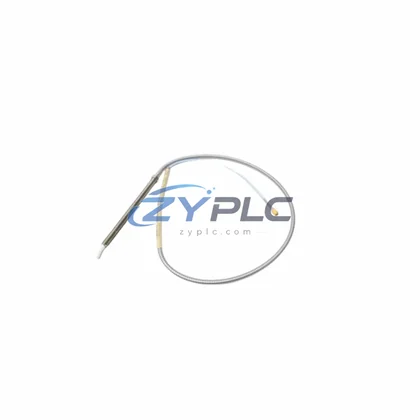
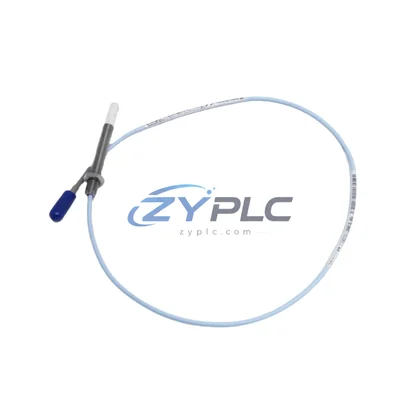
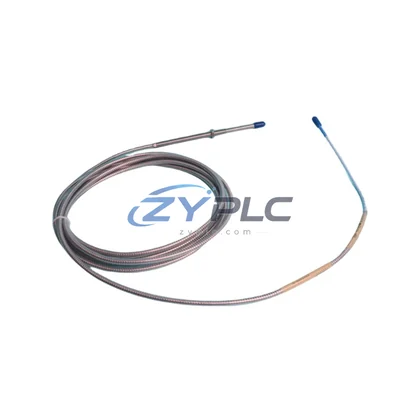
Bently Nevada 330104-00-07-05-02-00 Proximity Probe for 3300 Series
The Bently Nevada 330104-00-07-05-02-00 is a high-precision eddy-current proximity probe engineered as a core sensing element within the Bently Nevada 3300 Series machinery protection and condition monitoring architecture. Rather than functioning as a standalone transducer, this probe is designed to operate as an integrated node within a layered automation system — delivering continuous, real-time shaft displacement and vibration data to upstream monitoring modules, control platforms, and plant-wide SCADA or DCS environments. Its role spans the signal acquisition layer, feeding critical process variables upward through the control hierarchy to enable informed decision-making at every level of the automation pyramid.
In modern industrial facilities — including rotating machinery applications in power generation, petrochemical processing, water treatment, mining, metallurgy, and heavy manufacturing — the integrity of the vibration monitoring layer directly determines the reliability of the entire protection architecture. The 330104-00-07-05-02-00 probe, when paired with compatible Bently Nevada 3300 XL 8mm extension cables and proximitor sensors such as the 3300 XL NSv Proximitor, forms a complete eddy-current measurement chain that delivers calibrated output signals to the 3500 Series rack-based monitoring system. This system-level integration ensures that shaft orbit analysis, gap voltage measurement, and dynamic vibration trending are all performed with the accuracy and repeatability demanded by API 670 machinery protection standards.
From a control architecture perspective, the 330104-00-07-05-02-00 occupies the field instrumentation layer — the foundation upon which all higher-level control decisions are built. Its 5-metre armored cable assembly and 7.87mm sensing tip geometry are optimized for direct installation on turbine bearing housings, compressor pedestals, pump shafts, and gearbox assemblies. The probe’s output is routed to the proximitor module, which conditions the raw eddy-current signal into a calibrated DC voltage proportional to the gap between the probe tip and the rotating target. This conditioned signal is then transmitted to the 3500/40M Proximitor Monitor or 3500/42M Proximitor/Seismic Monitor card within the 3500 Series rack, where it is processed against user-defined alert and danger setpoints.
Product Specification Table
| Parameter |
Specification |
| Part Number |
330104-00-07-05-02-00 |
| Brand |
Bently Nevada |
| Series |
3300 XL 8mm Proximity Transducer System |
| Product Type |
Eddy-Current Proximity Probe |
| System Role |
Field Instrumentation / Signal Acquisition Layer |
| Sensing Technology |
Eddy-Current (Non-Contact) |
| Probe Tip Diameter |
7.87 mm (0.31 in) |
| Cable Length |
5 metres (standard) |
| Linear Range |
0.25 mm to 2.54 mm (10 to 100 mil) |
| Scale Factor |
7.87 V/mm (200 mV/mil) nominal |
| Supply Voltage |
-24 VDC (via Proximitor module) |
| Output Signal |
DC voltage proportional to gap distance |
| Operating Temperature |
-35°C to +177°C (probe body) |
| Target Material Compatibility |
AISI 4140 steel (standard); other ferrous/non-ferrous with recalibration |
| Communication / Integration |
Analog signal to 3500 Series Monitor Cards; compatible with DCS/SCADA via 4–20 mA or Modbus RTU gateway |
| Mounting |
Threaded body, bracket or direct housing mount |
| Compliance |
API 670, CE, RoHS |
| Origin |
United States |
| Warranty |
warranty terms confirmed during quotation — covers manufacturing defects, calibration drift, and connector integrity |
System Compatibility Notes
The 330104-00-07-05-02-00 achieves its full protective value only when deployed as part of a coordinated, multi-layer control system architecture. At the field level, the probe is installed in close proximity to the rotating shaft, typically within a machined bracket on the bearing housing. Its signal travels through the matched extension cable — commonly the Bently Nevada 330130-045-00-00 5-metre extension cable — to the proximitor sensor, such as the 3300 XL NSv Proximitor (330180-X1-05), which is mounted in a junction box or directly on the machinery skid. The proximitor converts the raw eddy-current impedance change into a calibrated voltage output, which is then routed via shielded twisted-pair cabling to the 3500 Series monitoring rack.
Within the 3500 rack, the signal is received by the 3500/40M Proximitor Monitor or the 3500/42M Proximitor/Seismic Monitor module. These cards process the incoming voltage against configured gap, direct vibration, and 1X/2X vector setpoints, triggering relay outputs on the 3500/32 Relay Output Module when alarm or danger thresholds are exceeded. The relay outputs are wired to the plant’s safety instrumented system (SIS) or directly to the DCS — for example, a Honeywell Experion PKS, Emerson DeltaV, or Yokogawa CENTUM VP — enabling automated shutdown sequences or operator alerts without manual intervention.
For facilities requiring redundant protection, the 3500 rack supports dual-voting architectures where two 330104-00-07-05-02-00 probes are installed at 90° to each other (X-Y configuration) on the same bearing journal. This configuration, combined with the 3500/15 Power Supply Module (with redundant power input capability), ensures that no single-point failure in the sensing chain can compromise machinery protection. The 3500 rack’s Ethernet gateway card — such as the 3500/92 Communication Gateway Module — enables Modbus TCP or OPC-UA data export to the plant historian or SCADA layer, providing long-term vibration trending data for predictive maintenance programs.
At the human-machine interface layer, operators interact with vibration data through Bently Nevada System 1 software or third-party HMI platforms, where shaft orbit plots, Bode diagrams, and waterfall spectra are rendered in real time. The 330104-00-07-05-02-00’s consistent scale factor and low noise floor ensure that these visualizations accurately reflect machine condition, supporting confident engineering decisions during startup, steady-state operation, and coast-down analysis.
Industrial Application Notes
Power Generation: In gas turbine and steam turbine applications, the 330104-00-07-05-02-00 is installed on journal bearings to monitor rotor radial displacement. Paired with the 3500 Series rack and integrated into the turbine control system (TCS), it provides the real-time shaft position data required for automatic rundown initiation when vibration exceeds API 670 danger setpoints. This integration is critical in combined-cycle power plants where unplanned turbine trips carry significant generation loss penalties.
Petrochemical and Refinery Processing: Centrifugal compressors in ethylene crackers, hydrogen reformers, and LNG liquefaction trains rely on continuous proximity monitoring to detect surge precursors and rotor instability. The 330104-00-07-05-02-00, operating within a 3500 rack integrated to a Modbus-capable DCS, enables the anti-surge control system to receive real-time shaft position feedback, improving compressor protection and process stability.
Water and Wastewater Treatment: Large vertical turbine pumps and horizontal split-case pumps in municipal water infrastructure benefit from non-contact proximity monitoring to detect bearing wear and rotor eccentricity before catastrophic failure. The probe’s robust armored cable construction withstands the humid, chemically aggressive environments typical of pump stations and treatment facilities.
Mining and Minerals Processing: Ball mills, SAG mills, and large slurry pumps in copper, gold, and iron ore processing plants operate under extreme mechanical loads. The 330104-00-07-05-02-00 provides the continuous shaft monitoring required to detect mill shell deflection and pinion bearing degradation, enabling condition-based maintenance scheduling that reduces unplanned downtime in high-throughput production environments.
Metallurgy and Steel Production: Rolling mill drive trains and continuous casting machine drives require precise shaft monitoring to maintain product dimensional tolerances. Integration of the 330104-00-07-05-02-00 into the mill automation system — via the 3500 rack’s analog output cards connected to the mill’s PLC or DCS — enables real-time correlation between vibration events and product quality deviations.
Product Compatibility FAQ
Q1: Is the 330104-00-07-05-02-00 compatible with existing 3300 Series proximitor modules and 3500 Series monitor cards without recalibration?
Yes. The 330104-00-07-05-02-00 is a standard 3300 XL 8mm probe and is fully calibrated to operate with 3300 XL NSv Proximitor sensors and 3500/40M or 3500/42M monitor cards using the standard 7.87 V/mm (200 mV/mil) scale factor. No field recalibration is required when replacing a like-for-like probe on a standard AISI 4140 steel target. If the target material differs, a system-level recalibration using the Bently Nevada TK-3 calibration kit is recommended to maintain measurement accuracy within API 670 tolerances.
Q2: How does this probe integrate into a DCS or SCADA architecture for long-term condition monitoring?
The 330104-00-07-05-02-00 outputs a calibrated DC voltage to the 3500 Series monitor card, which can be configured to provide 4–20 mA analog outputs to the DCS I/O cards or digital data via the 3500/92 Communication Gateway Module using Modbus TCP or OPC-UA protocols. This enables seamless system integration with plant historians such as OSIsoft PI, Emerson AMS, or Honeywell PHD, where vibration trends are correlated with process variables for advanced predictive maintenance analytics. The gateway module supports up to 16 monitor cards per rack, making it suitable for large rotating machinery trains with multiple measurement points.
Q3: What does the warranty terms confirmed during quotation cover, and what support is available for installation and commissioning?
The warranty terms confirmed during quotation covers manufacturing defects, calibration drift beyond published specifications, and connector and cable assembly integrity under normal operating conditions. Warranty claims are processed with documented failure analysis and replacement dispatch within agreed lead times. For installation and commissioning support, our engineering team provides gap voltage verification procedures, probe mounting torque specifications, and system-level loop checks to ensure the complete measurement chain — from probe tip to monitor card output — meets API 670 acceptance criteria before machinery startup. Spare probe inventory is maintained to support rapid field replacement during planned outages or unplanned shutdowns.