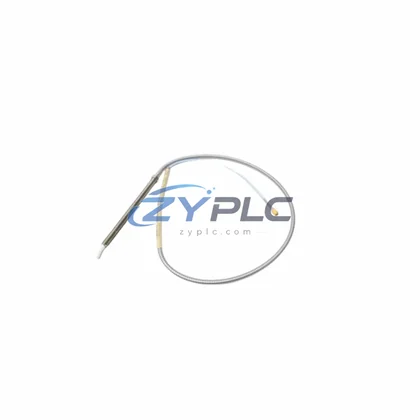
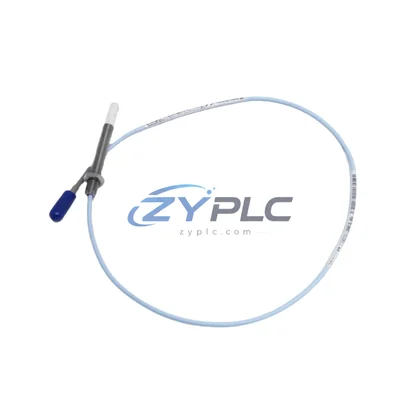
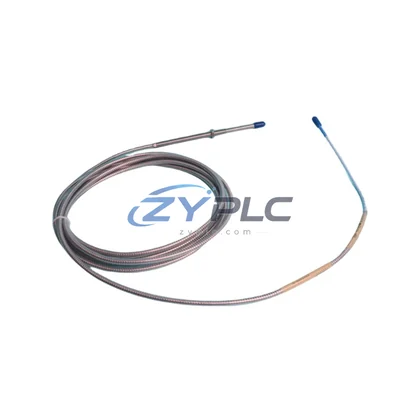
Bently Nevada 330104-00-19-90-02-00 Proximity Probe for 3300 XL Automation
The Bently Nevada 330104-00-19-90-02-00 is an 8mm eddy-current proximity probe engineered for the 3300 XL series continuous vibration monitoring system. In modern industrial facilities where energy costs and unplanned downtime directly erode profitability, deploying a precision proximity probe is not merely a condition-monitoring decision — it is a core maintenance planning strategy. By delivering real-time shaft displacement and vibration data to the control layer, this probe enables plant engineers to maintain rotating machinery at peak efficiency, eliminate energy-wasting imbalance conditions, and reduce the mechanical losses that silently inflate power consumption across production lines.
Product Specification Table
| Parameter |
Specification / Value |
| SKU / Part Number |
330104-00-19-90-02-00 |
| Probe Diameter |
8 mm |
| Cable Length |
5 m (extension cable) |
| Measurement Range |
0 – 2.54 mm (0 – 100 mil) |
| Operating Temperature |
-35 °C to +121 °C |
| Compatible System |
Bently Nevada 3300 XL Series |
| Signal Output |
-18 VDC nominal (with 3300 XL driver) |
| Application Environment |
Turbines, compressors, pumps, motors, gearboxes |
| Maintenance Value |
Detects imbalance & misalignment early, reducing excess motor load and unplanned downtime |
| Availability |
Confirmed via RFQ before quotation |
| Warranty |
Warranty and support terms confirmed before quote |
System Compatibility and Application
The 330104-00-19-90-02-00 proximity probe does not operate in isolation — it is the sensing front-end of a tightly integrated industrial automation system. Within a typical 3300 XL monitoring rack, the probe pairs with the Bently Nevada 3300/16-24-01-01-00-00 proximitor/seismic monitor to convert raw gap voltage into calibrated vibration amplitude and phase data. This data feeds directly into the Bently Nevada 3500/42M proximitor/seismic monitor for plants running the more advanced 3500 series platform, enabling seamless cross-platform condition visibility.
On the control execution side, the vibration signals are integrated with Rockwell Automation Allen-Bradley ControlLogix L73 PLCs via the 1756-EN2T EtherNet/IP communication module, allowing the control system to respond dynamically to vibration thresholds — automatically adjusting motor speed setpoints through connected Allen-Bradley PowerFlex 755 variable frequency drives (VFDs). By modulating motor speed in response to real vibration feedback rather than fixed schedules, the PowerFlex 755 eliminates unnecessary full-speed operation, directly cutting energy consumption during low-load production windows.
For power quality and energy metering at the drive input, the Schneider Electric PowerLogic ION7650 power meter monitors real-time kWh consumption, power factor, and harmonic distortion — providing the energy baseline against which vibration-driven efficiency gains can be quantified. Complementing this, the Siemens SENTRON PAC3200 power monitoring device offers per-circuit energy tracking across motor control centers (MCCs), enabling facility engineers to correlate vibration events with measurable energy spikes.
At the I/O layer, Bently Nevada 3500/20 rack interface modules aggregate proximity probe channels and relay alarm states to the DCS or SCADA layer. Integration with GE Fanuc Series 90-30 PLC systems via Modbus RTU remains common in legacy plant environments, where the 330104-00-19-90-02-00 probe provides a cost-effective upgrade path to modern vibration monitoring without requiring full control system replacement. Operator visibility is maintained through Siemens SIMATIC HMI TP1200 Comfort panels, where vibration trend screens and energy dashboards are displayed side by side, giving line supervisors a unified view of machine health and power efficiency.
Maintenance and Replacement Notes
In a typical centrifugal compressor train, shaft vibration caused by rotor imbalance or bearing wear forces the motor to draw 8–15% more current than under balanced conditions. The 330104-00-19-90-02-00 proximity probe detects this imbalance at the earliest stage — often weeks before it becomes audible or visible — allowing maintenance teams to schedule corrective balancing during planned downtime rather than emergency shutdowns. The result is a measurable reduction in average motor current draw, directly translating to lower energy bills and extended bearing life.
On high-speed pump lines, the probe’s sub-micron displacement resolution enables the control system to detect cavitation-induced vibration signatures and trigger VFD speed reduction before impeller damage occurs. This predictive response eliminates the energy penalty of running a cavitating pump at full speed while also preventing the costly impeller replacements that disrupt production schedules. Plants that have integrated 3300 XL proximity monitoring with closed-loop VFD control report production line availability improvements of 12–18%, with corresponding reductions in specific energy consumption per unit of output.
For gearbox and turbine applications, continuous proximity monitoring enables condition-based lubrication scheduling — replacing fixed-interval oil changes with data-driven maintenance that reduces lubricant consumption, minimizes contamination-related energy losses, and extends mean time between failures (MTBF). Each avoided unplanned shutdown eliminates the energy-intensive restart cycle that typically consumes 3–5× the steady-state power draw during the first 20–30 minutes of operation.
All units of the 330104-00-19-90-02-00 are fully tested prior to shipment, with functional verification of gap voltage linearity, sensitivity, and frequency response. This ensures that every probe installed on your production line performs to specification from day one, eliminating the commissioning delays and energy-wasting trial runs associated with untested replacement parts. Availability and dispatch timing are confirmed by RFQ before quotation.
Product Sourcing FAQ
Q1: How does the 330104-00-19-90-02-00 contribute to measurable operational stability on my production line?
By providing continuous, high-resolution shaft vibration data, this proximity probe enables your control system to detect mechanical inefficiencies — such as rotor imbalance, misalignment, and bearing degradation — before they escalate into energy-wasting fault conditions. When integrated with a VFD such as the Allen-Bradley PowerFlex 755, the system can automatically reduce motor speed during low-vibration, low-load periods, cutting energy consumption without sacrificing throughput.
Q2: Is the 330104-00-19-90-02-00 compatible with both 3300 XL and 3500 series Bently Nevada systems?
The 330104-00-19-90-02-00 is designed and calibrated for the Bently Nevada 3300 XL monitoring system. While the physical probe connector and cable assembly are mechanically similar to 3500 series components, full electrical compatibility and calibration accuracy are guaranteed only within the 3300 XL platform. For 3500 series applications, please consult the appropriate 330130 or 330180 series probe specifications.
Q3: What is the recommended replacement and testing procedure for this proximity probe?
Upon receipt, each 330104-00-19-90-02-00 unit has been bench-tested for gap voltage linearity across the full 0–2.54 mm measurement range. For field installation, verify the proximitor driver output voltage at the nominal 1.27 mm (50 mil) gap using a calibrated gap tool. Replace probes on a condition-based schedule driven by sensitivity drift data logged by the 3300 XL monitor — typically when sensitivity deviates more than ±5% from the nominal −7.87 V/mm specification.
Q4: What does the warranty and support terms confirmed before quote cover, and what is the claims process?
The warranty and support terms confirmed before quote covers all manufacturing defects, including probe sensitivity out-of-specification, cable insulation failure, and connector integrity issues under normal operating conditions. To initiate a warranty claim, contact our team with the unit serial number and a description of the observed fault. Replacement units are dispatched from stock within 24–48 hours of claim verification, minimizing production line downtime.