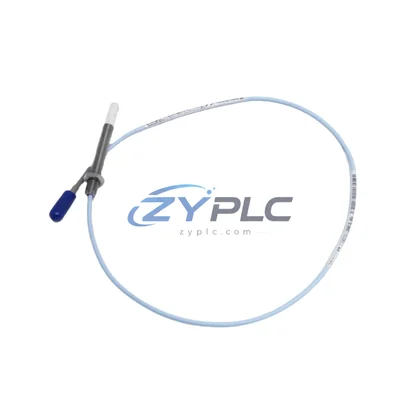
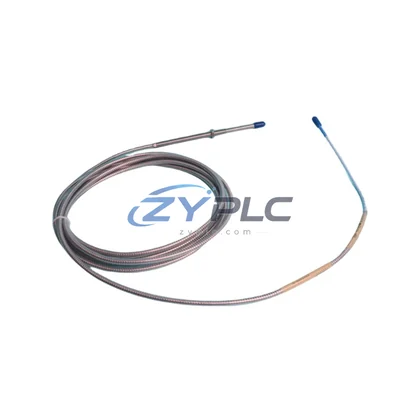
Bently Nevada 330104-01-11-10-01-00 Proximity Probe: Control System and system integration
The Bently Nevada 330104-01-11-10-01-00 is a precision eddy-current proximity probe engineered for seamless integration within the Bently Nevada 3300 Series vibration monitoring architecture. Rather than functioning as a standalone sensing element, this probe is designed as a foundational component of a layered industrial control system — one that spans the signal acquisition layer, the condition monitoring layer, the communication layer, and ultimately the supervisory control and data acquisition (SCADA) or distributed control system (DCS) layer. Understanding its role within this full-stack architecture is essential for engineers specifying rotating machinery protection systems in power generation, petrochemical, mining, metallurgy, and heavy process industries.
In a complete 3300 Series monitoring system, the 330104-01-11-10-01-00 probe operates in conjunction with the Bently Nevada 330130 extension cable and the 330180 proximitor sensor (signal conditioner), forming the three-component transducer chain that converts mechanical shaft displacement into a calibrated DC voltage signal. This signal is then routed to the 3300/16 or 3300/20 series monitor modules housed within a standard 19-inch rack enclosure, where it is processed for radial vibration, axial position, or differential expansion measurement depending on system configuration. The monitor modules communicate upstream via the System 1 condition monitoring software platform, enabling real-time trending, alarm management, and predictive maintenance analytics at the supervisory layer.
At the control layer, the 330104-01-11-10-01-00 integrates with the broader plant automation infrastructure through relay output modules such as the 3300/32 relay module, which interfaces with the plant’s emergency shutdown system (ESD) or safety instrumented system (SIS). This ensures that vibration exceedances detected at the probe level propagate correctly through the protection logic to initiate turbine trip or compressor shutdown sequences without latency. The probe’s 5-metre cable configuration and standard 8 mm tip diameter make it compatible with the majority of 3300 Series mounting brackets and proximity probe holders used in horizontal and vertical rotating machinery installations.
Product Specification Table
| Parameter |
Specification |
| System Role |
Eddy-Current Proximity Probe — Signal Acquisition Layer |
| Compatible System |
Bently Nevada 3300 Series Vibration Monitoring Architecture |
| Probe Tip Diameter |
8 mm (standard) |
| Cable Length |
1.0 m integral cable (extension via 330130 series) |
| Sensitivity |
7.87 V/mm (200 mV/mil) nominal |
| Linear Range |
0.25 mm to 2.25 mm (10 mil to 90 mil) |
| Operating Temperature |
-35°C to +177°C |
| Supply Voltage |
-24 VDC (via proximitor/driver) |
| Output Signal |
DC voltage proportional to gap distance |
| Communication Compatibility |
Analogue 4–20 mA / System 1 via monitor module |
| Installation Environment |
IP67-rated, suitable for oil mist, high-vibration environments |
| Certification |
CE, FM, ATEX (zone-dependent configuration) |
| Warranty |
warranty terms confirmed during quotation — covers manufacturing defects and calibration integrity |
System Compatibility Notes
Deploying the 330104-01-11-10-01-00 within a coordinated control system requires careful attention to the upstream and downstream components that define system performance and reliability. At the transducer chain level, the probe pairs with the Bently Nevada 330130-080-00-00 extension cable to achieve the required gap distance between the probe tip and the rotating shaft target area. The combined transducer chain then connects to the Bently Nevada 330180-X1-05 proximitor sensor, which conditions the raw oscillator signal into a usable DC voltage output. This three-component chain must be matched in terms of system gain and linear range to ensure calibration accuracy across the full operating envelope.
At the monitor module level, the conditioned signal feeds into the Bently Nevada 3300/16-14-01-01-00-00 monitor or the 3300/20-11-01-01-00-00 dual-channel monitor, depending on whether the application requires radial vibration, axial position, or differential expansion measurement. These monitors are rack-mounted within the Bently Nevada 3300/05 five-slot rack or the 3300/10 ten-slot rack, which provides the backplane power distribution and inter-module communication bus. The rack system accepts a 3300/15 power supply module that delivers regulated -24 VDC to all installed monitor and I/O modules, ensuring stable transducer excitation across all channels simultaneously.
For systems requiring redundant protection, the Bently Nevada 3300/32 relay output module provides configurable relay logic that interfaces directly with the plant’s safety instrumented system. In turbine protection applications, this relay module is typically wired in series with the Woodward 505 governor controller or equivalent turbine control system, ensuring that vibration-initiated trip signals are executed within the required safety response time. At the human-machine interface layer, the Bently Nevada System 1 software aggregates data from all monitor channels, providing operators with real-time vibration spectra, trend plots, and alarm event logs that support both online condition monitoring and post-event forensic analysis.
In multi-machine train configurations — such as a gas turbine driving a centrifugal compressor through a gearbox — multiple 330104-01-11-10-01-00 probes are deployed at each bearing location, with signals routed to dedicated monitor channels within the same rack system. This architecture ensures that the condition monitoring system maintains full observability of the entire rotating train, enabling engineers to correlate vibration events across machine elements and identify the root cause of anomalies before they escalate to unplanned shutdowns.
Industrial Application Notes
The 330104-01-11-10-01-00 proximity probe finds application across a broad range of heavy industrial sectors where rotating machinery protection is a critical element of plant safety and operational continuity. In power generation, the probe is deployed on steam turbine shaft lines to monitor radial vibration at journal bearings, providing early warning of rotor imbalance, misalignment, or bearing wear that could lead to catastrophic failure if left undetected. The probe’s wide operating temperature range makes it suitable for high-temperature turbine environments where conventional sensors would degrade rapidly.
In petrochemical and refinery applications, the 330104-01-11-10-01-00 is used on centrifugal compressors, pumps, and expanders operating in hazardous area classifications. Its ATEX-compatible configuration allows installation in Zone 1 and Zone 2 environments when paired with appropriate intrinsically safe barriers or Zener barriers at the control room boundary. The probe’s robust stainless steel construction and oil-resistant cable jacket ensure long-term reliability in environments where hydrocarbon vapours, process fluids, and mechanical vibration are constant operational factors.
In mining and mineral processing, the probe monitors large grinding mills, crushers, and conveyor drive systems where bearing failures result in extended production downtime and significant repair costs. The ability to integrate probe data with the plant’s DCS via the 3300 Series monitor’s analogue output allows mining engineers to incorporate vibration data into their existing process control loops, enabling condition-based maintenance scheduling that reduces unplanned outages. Similarly, in water treatment and municipal infrastructure, the probe supports continuous monitoring of large pump stations and blower systems, where the cost of unplanned failure extends beyond equipment repair to include regulatory compliance and public service disruption.
Product Compatibility FAQ
Q1: Is the 330104-01-11-10-01-00 directly compatible with all Bently Nevada 3300 Series monitor modules, and what system configuration steps are required during commissioning?
The 330104-01-11-10-01-00 is designed for use within the Bently Nevada 3300 Series architecture and is compatible with all standard 3300 Series monitor modules when used as part of the correct three-component transducer chain (probe + extension cable + proximitor). During commissioning, engineers must verify the gap voltage at the proximitor output — typically -10 VDC at the nominal operating gap — and confirm that the monitor module’s channel configuration matches the probe’s sensitivity of 7.87 V/mm. System 1 software should then be used to validate alarm setpoints against the machinery manufacturer’s vibration limits before the system is placed in service.
Q2: Can this probe be used as a direct replacement in an existing 3300 Series installation, and are there any architectural compatibility considerations?
Yes, the 330104-01-11-10-01-00 is a direct form-fit-function replacement for equivalent 8 mm probes within the 3300 Series architecture, provided the replacement probe is matched with the same extension cable and proximitor model as the original installation. Engineers should verify that the replacement probe’s part number suffix codes — which encode cable length, connector type, and temperature rating — match the original specification. If the installation involves a different cable length or connector configuration, the system gain must be re-verified and the monitor channel recalibrated to maintain measurement accuracy. No firmware or software changes to the System 1 platform are required for a like-for-like replacement.
Q3: What does the warranty terms confirmed during quotation cover, and how does it support long-term maintenance planning for critical rotating machinery protection systems?
The warranty terms confirmed during quotation covers manufacturing defects, calibration integrity, and material failures under normal operating conditions as specified in the product datasheet. For maintenance engineers managing critical rotating machinery protection systems, this warranty provides a defined baseline for spare parts lifecycle planning — ensuring that replacement probes sourced from ZYPLC meet the same performance standards as original equipment. The warranty also supports audit and compliance documentation requirements in regulated industries such as power generation and petrochemical processing, where traceability of safety-critical instrumentation is mandated by applicable standards including IEC 61511 and API 670.