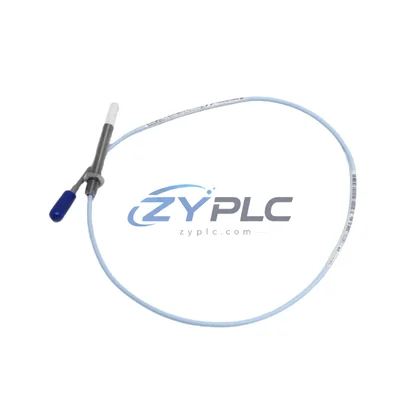
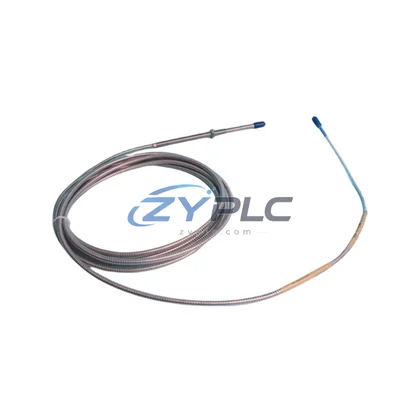
Bently Nevada 330104-02-12-10-01-00 Probe for 3300: Control System and system integration
The Bently Nevada 330104-02-12-10-01-00 is a precision proximity transducer engineered for seamless deployment within the 3300 Series vibration monitoring architecture. As a core sensing element in rotating machinery protection systems, this transducer does not operate in isolation — it functions as an integral node within a layered industrial control hierarchy that spans the field sensing layer, signal conditioning layer, data acquisition layer, and supervisory control layer. Understanding its role within this architecture is essential for engineers designing high-availability protection systems for turbines, compressors, pumps, and generators.
Product Specification Table
| Parameter |
Specification |
| System Role |
Field-level proximity sensing element for shaft vibration and position measurement |
| Compatible Series |
Bently Nevada 3300 Series Monitoring System |
| Probe Length |
12 inches (305 mm) |
| Cable Length |
10 feet (3 m) integral cable |
| Tip Diameter |
8 mm eddy-current sensing tip |
| Sensitivity |
200 mV/mil (7.87 V/mm) |
| Frequency Range |
DC to 10,000 Hz |
| Operating Temperature |
-35°C to +121°C |
| Supply Voltage |
-24 VDC (via 3300 XL driver) |
| Output Signal |
-1 VDC to -17 VDC linear range |
| Communication / Integration |
Analog signal to 3300 Series monitor cards; system integration with DCS/PLC via 4–20 mA or Modbus |
| Installation Environment |
IP67-rated, suitable for oil mist, high-vibration, and high-temperature environments |
| Warranty |
warranty terms confirmed during quotation from date of shipment |
System Compatibility Notes
In a complete rotating machinery protection architecture, the 330104-02-12-10-01-00 proximity transducer is paired with the Bently Nevada 330180 Extension Cable to bridge the distance between the probe tip and the signal conditioning driver. The driver — typically the Bently Nevada 330130 Proximitor Sensor — converts the raw eddy-current impedance change into a calibrated DC voltage signal that the monitoring system can interpret. This signal is then routed to a Bently Nevada 3300/16 Monitor Card housed within the 3300 Series rack, where it is processed against user-defined alert and danger setpoints.
At the rack level, the 3300 Series chassis accommodates multiple monitor cards alongside a Bently Nevada 3300/05 Power Supply Module, which provides regulated -24 VDC to all connected transducer circuits. Redundant power supply configurations are supported, ensuring that a single power module failure does not interrupt vibration monitoring continuity — a critical requirement in API 670-compliant installations. The rack also interfaces with a Bently Nevada 3300/46 Keyphasor Module, which provides the once-per-revolution reference signal necessary for phase-referenced vibration analysis, orbit plots, and Bode diagrams during machinery startup and coast-down events.
At the supervisory layer, the 3300 Series system communicates with plant-level DCS platforms — such as Emerson DeltaV, Honeywell Experion, or ABB System 800xA — through the Bently Nevada 3500/92 Communication Gateway or equivalent Modbus TCP/IP interface modules. This system integration enables operators to view real-time vibration trends, alarm states, and historical waveform data directly within the plant historian or SCADA environment, eliminating the need for separate operator workstations dedicated solely to machinery protection. For facilities running Bently Nevada System 1 Software, the 330104-02-12-10-01-00 transducer data feeds directly into the predictive analytics engine, enabling condition-based maintenance scheduling and early fault detection for bearing wear, rotor imbalance, and shaft misalignment.
In multi-machine train configurations — such as a gas turbine driving a centrifugal compressor — multiple 330104-02-12-10-01-00 probes are deployed at each bearing journal, with X-Y probe pairs installed 90 degrees apart to capture full orbital motion. The resulting data is processed by the Bently Nevada 3300/25 Dual Vibration Monitor, which simultaneously monitors two radial channels per card, maximizing rack density while maintaining per-channel alarm independence. Terminal blocks and field wiring are managed through Bently Nevada I/O Terminal Modules, which provide clearly labeled, screw-terminal connections that simplify field installation, loop checking, and future maintenance access.
Industrial Application Notes
The 330104-02-12-10-01-00 proximity transducer finds application across a broad spectrum of process industries where rotating machinery reliability is non-negotiable. In oil and gas processing, this transducer is deployed on centrifugal compressors and gas turbines at LNG terminals and upstream compression stations, where API 670 compliance mandates continuous shaft vibration monitoring with automatic trip capability. In power generation, it monitors steam turbine shaft displacement at thermal and combined-cycle power plants, providing the early warning data that prevents catastrophic rotor-stator contact events.
In petrochemical and refinery environments, the transducer is installed on reactor feed pumps, cracked gas compressors, and wet gas compressors, where process fluid contamination and high ambient temperatures demand the robust IP67 construction and wide operating temperature range that the 330104-02-12-10-01-00 provides. Water and wastewater treatment facilities use this transducer on large vertical turbine pumps and blower trains, integrating vibration data into their SCADA systems for remote condition monitoring across geographically distributed pump stations.
In mining and minerals processing, the transducer is applied to SAG mill pinion bearings and large slurry pump drives, where the harsh environment and high replacement costs make predictive maintenance economically essential. Metallurgical and steel plant applications include rolling mill drive train monitoring and blast furnace blower protection, where the transducer’s ability to operate in high-temperature, high-vibration environments is critical. Packaging and discrete manufacturing lines use the 3300 Series system for high-speed spindle monitoring on precision machining centers, where micron-level shaft displacement data directly correlates with finished part quality.
Product Compatibility FAQ
Q1: Is the 330104-02-12-10-01-00 compatible with both the legacy 3300 Series and the newer Bently Nevada 3500 Series monitoring racks?
The 330104-02-12-10-01-00 is natively designed for the 3300 Series architecture and uses the standard 8 mm eddy-current probe format with 200 mV/mil sensitivity. It is electrically compatible with 3500 Series monitor cards that accept the same probe/driver combination, provided the correct Proximitor driver (such as the 330130 or 330180 series) is used as the signal conditioning intermediary. Always verify the specific monitor card input specifications before cross-series deployment, and consult the system integration documentation to confirm setpoint calibration requirements.
Q2: What installation and commissioning steps are required to achieve accurate vibration readings in a new system build?
Proper installation requires precise gap setting between the probe tip and the target shaft surface, typically 50 mils (1.27 mm) for the 330104 series, verified using a calibrated DC voltmeter to confirm the output sits within the linear range (-10 VDC ±0.5 VDC at gap). Cable routing must avoid proximity to high-voltage power cables to prevent electromagnetic interference. After physical installation, the system requires a full loop calibration check using the 3300 Series calibration procedure, including verification of alert and danger setpoint relay outputs. Commissioning documentation should record as-found gap voltage, sensitivity verification, and alarm function test results for future maintenance reference.
Q3: What does the warranty terms confirmed during quotation cover, and how does it support long-term maintenance planning?
The warranty terms confirmed during quotation covers manufacturing defects in materials and workmanship from the date of shipment. For maintenance planners, this warranty period aligns with annual plant turnaround cycles, allowing facilities to procure replacement transducers as part of a planned spare parts strategy without incurring immediate replacement costs for early-life failures. The warranty also supports the business case for maintaining a certified spare inventory of 330104-02-12-10-01-00 units at site, ensuring that unplanned machinery trips can be resolved within the minimum time required to source, install, and recommission a replacement transducer — typically within one shift when spares are on hand.