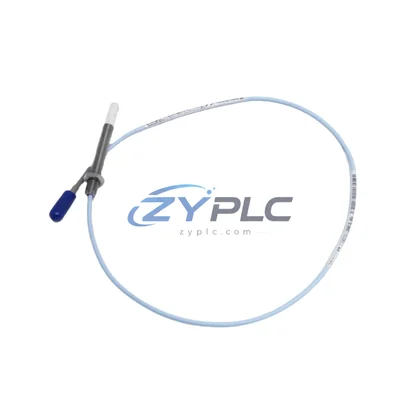
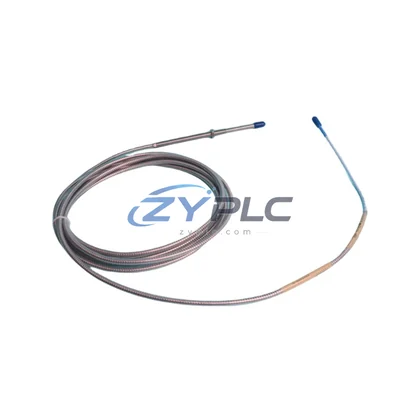
Bently Nevada 330104-05-18-50-02-05 3300 XL Proximity Probe: Industrial Data Link for Rotating Machinery Monitoring
The Bently Nevada 330104-05-18-50-02-05 is an 8mm eddy current proximity probe engineered for the 3300 XL Series condition monitoring platform. Designed to deliver continuous, high-resolution shaft vibration and position data, this probe forms the critical first link in the industrial data chain — from rotating machinery to PLC controllers, SCADA systems, and enterprise-level asset management platforms. In smart factory environments where machine uptime directly impacts production throughput, the 330104-05-18-50-02-05 provides the real-time signal integrity that modern condition monitoring demands.
Operating on the proven eddy current sensing principle, this proximity probe generates a continuous DC voltage output proportional to the gap between the probe tip and the target shaft surface. The signal is conditioned through a paired Proximitor sensor — typically the 330180 series — which converts the raw probe output into a clean, calibrated voltage signal compatible with the 3300 XL monitoring system. This signal chain ensures that vibration amplitude, shaft eccentricity, and axial position data are captured with the precision required for early fault detection and predictive maintenance decisions.
Compatibility & Integration Notes
| Parameter |
Specification |
| SKU / Part Number |
330104-05-18-50-02-05 |
| Brand / Manufacturer |
Bently Nevada |
| Series |
3300 XL |
| Probe Type |
Eddy Current Proximity Probe (8mm) |
| Signal Output |
DC Voltage (via Proximitor) |
| Communication Protocol |
Analog 4–20mA / DC Voltage; compatible with 3500 System digital I/O |
| Interface Type |
3-wire coaxial (probe + extension cable + Proximitor) |
| Network Compatibility |
3300 XL, 3500 Series, ADRE System, SCADA/DCS integration via 3500/22M or 3500/42M modules |
| System Application |
Shaft vibration, radial position, axial thrust monitoring on turbines, compressors, pumps, motors |
| Warranty |
warranty terms confirmed during quotation — all units shipped after full functional testing |
Connected Automation Data Flow
In a typical smart factory deployment, the 330104-05-18-50-02-05 proximity probe is installed radially at the bearing housing of a high-speed rotating machine — a steam turbine, centrifugal compressor, or large induction motor. The probe tip maintains a precise gap to the shaft, and the eddy current field continuously measures any deviation. This raw displacement signal travels through a matched 330130 extension cable to the 330180 Proximitor sensor mounted in the field junction box.
The Proximitor converts the probe signal into a buffered DC voltage output, which feeds directly into the 3300 XL monitoring rack or, in more complex installations, into the 3500 Series modular monitoring system. Within the 3500 rack, the 3500/42M vibration monitor module processes the signal, applies alarm setpoints, and communicates machine health data upstream via the 3500/22M transient data interface module. This module bridges the analog vibration world with digital plant networks, enabling real-time data transfer to DCS platforms, PLC controllers, and SCADA gateways.
At the SCADA layer, operators viewing the Bently Nevada ADRE system or a third-party HMI platform receive live vibration trend data, alarm states, and historical waveform captures. The 3500/22M’s digital output can interface with Modbus RTU or Ethernet-based protocols, allowing the vibration data to flow into plant-wide historian systems and ERP platforms for maintenance scheduling and production planning. For installations requiring remote I/O expansion, the 3500 system’s modular architecture supports the addition of the TDI module 135489-04, enabling transient data capture during machine startups and coastdowns — critical events for diagnosing rotor dynamic issues before they escalate.
In parallel, the 3300 XL NSv driver module provides the oscillator-demodulator function for installations where the Proximitor is integrated directly into the monitoring rack rather than field-mounted. This configuration reduces cable runs and simplifies the signal path in compact machinery trains. The 330106 reverse mount probe variant serves installations where standard axial access is restricted, completing the probe family coverage across diverse machine geometries.
This end-to-end data flow — from the 330104-05-18-50-02-05 probe tip, through the Proximitor, into the 3500 monitoring rack, across the plant network, and up to the SCADA/HMI layer — represents the backbone of a modern predictive maintenance architecture. Every component in this chain is engineered to maintain signal fidelity, minimize latency, and ensure that alarm conditions are communicated to operators and control systems within milliseconds of detection.
Solving Data Isolation in Industrial Sites
One of the most persistent challenges in industrial facilities is the fragmentation of machine health data across incompatible systems. Legacy vibration monitoring equipment often operates in isolation, with no pathway to share data with the plant DCS, PLC network, or enterprise asset management system. The result is data silos — critical vibration trends visible only to maintenance technicians with direct access to the monitoring rack, invisible to production planners, reliability engineers, and remote operations centers.
The 330104-05-18-50-02-05, deployed within the 3300 XL or 3500 Series ecosystem, directly addresses this isolation problem. By pairing the probe with the 3500/22M transient data interface and leveraging the system’s digital communication capabilities, vibration data becomes available across the plant network in real time. SCADA operators can configure alarm thresholds, trend historical data, and initiate remote diagnostics without dispatching field technicians to the machine location. This remote monitoring capability is particularly valuable in hazardous areas — offshore platforms, chemical plants, and power generation facilities — where physical access to machinery is restricted or time-consuming.
Protocol unification is another key benefit. The 3500 system’s ability to output data via Modbus, OPC-DA, or direct Ethernet connections means that vibration data from the 330104-05-18-50-02-05 can be integrated into any modern SCADA or historian platform without custom protocol converters. Production line transparency improves dramatically when vibration, temperature, and process data streams are unified in a single dashboard, enabling operators to correlate machine health with process variables and identify root causes of performance degradation before unplanned shutdowns occur.
System scalability is built into the architecture. As production lines expand or new machinery is commissioned, additional 3300 XL or 3500 monitoring channels can be added without redesigning the network infrastructure. The modular rack design supports incremental growth, protecting the initial investment while accommodating future capacity increases.
Industrial Connectivity FAQ
Q: What is the communication latency between the 330104-05-18-50-02-05 probe and the SCADA system?
A: The eddy current signal from the probe to the Proximitor is essentially instantaneous — the analog signal path introduces negligible delay. Digital communication latency from the 3500/22M module to the SCADA system depends on the network protocol and polling rate configured, but typical Modbus or OPC update cycles operate at 100–500ms intervals, well within the requirements for vibration alarm response.
Q: Is the 330104-05-18-50-02-05 compatible with third-party monitoring systems and DCS platforms?
A: Yes. The probe and Proximitor output a standard DC voltage signal that is compatible with any monitoring system capable of accepting analog inputs. For digital integration, the 3500 Series rack provides Modbus RTU, Modbus TCP, and OPC-DA interfaces, enabling connectivity with Honeywell, Emerson, Siemens, ABB, and other major DCS and SCADA platforms.
Q: How is network stability ensured in high-vibration or electrically noisy industrial environments?
A: The 3300 XL probe system uses shielded coaxial cable throughout the signal path, and the Proximitor sensor provides signal conditioning that rejects common-mode electrical noise. The extension cable and probe are designed to maintain signal integrity in environments with high electromagnetic interference from variable frequency drives, large motors, and switching power supplies.
Q: What does the warranty terms confirmed during quotation cover, and how are units tested before shipment?
A: Every 330104-05-18-50-02-05 unit is functionally tested prior to shipment, verifying probe sensitivity, output linearity, and cable integrity. The warranty terms confirmed during quotation covers defects in materials and workmanship under normal operating conditions. Units are shipped with test documentation, and our technical team provides post-sale support for installation, commissioning, and system integration queries.