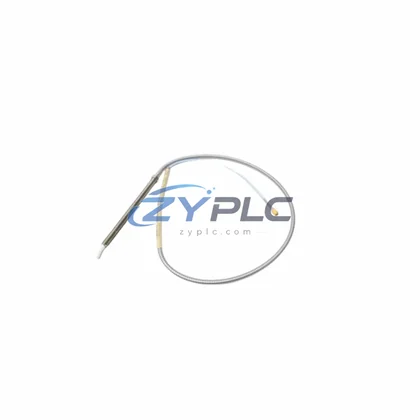
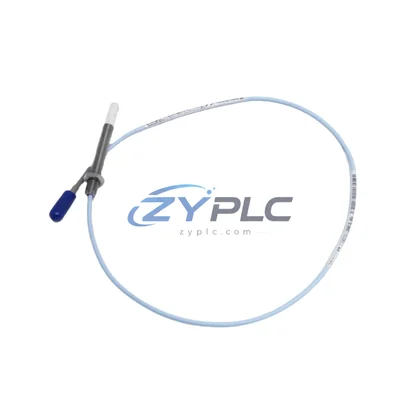
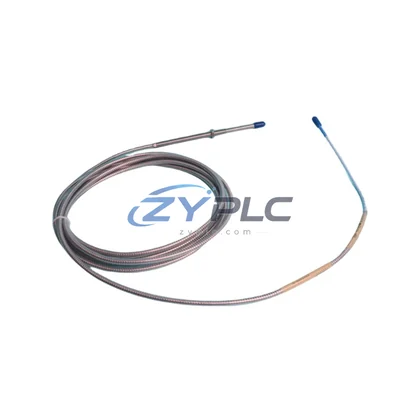
Bently Nevada 330130-040-03-00 Extension Cable for 3300 Series Automation
The Bently Nevada 330130-040-03-00 is a high-precision proximity probe extension cable engineered for the 3300 Series vibration monitoring platform. In modern industrial facilities where energy efficiency and equipment uptime are directly tied to profitability, this extension cable plays a critical role in maintaining the signal integrity that underpins every maintenance-focused automation decision. By delivering clean, low-noise analog signals from rotating machinery to the 3300 Series monitor rack, the 330130-040-03-00 ensures that your control system receives accurate vibration data — enabling smarter motor control, reduced unnecessary shutdowns, and optimized production line throughput.
Industrial plants running continuous processes — from petrochemical compressors to power generation turbines — depend on reliable proximity probe systems to detect shaft displacement, rotor imbalance, and bearing wear before they escalate into costly failures. The 330130-040-03-00 extension cable, with its precisely matched impedance and shielded construction, minimizes signal attenuation across long cable runs, ensuring that the Bently Nevada 3300 XL 8mm Proximity Transducer System operates at its rated sensitivity. This directly reduces false trips that force unnecessary motor restarts — each of which consumes a significant energy surge compared to steady-state operation.
When integrated into a complete vibration monitoring loop, the 330130-040-03-00 works in concert with the Bently Nevada 330180-X1-05 Proximitor Sensor to convert mechanical displacement into a calibrated voltage signal. This signal feeds into the 3300/16 Monitor, which processes real-time vibration amplitude and phase data. The monitor’s output can be connected to a Bently Nevada 3500 Series Rack for plants requiring higher channel density and integrated relay logic — allowing engineers to configure alarm thresholds that prevent both over-speed events and energy-wasting under-load conditions.
Product Specification Table
| Parameter |
Specification / Value |
| SKU / Part Number |
330130-040-03-00 |
| Brand / Series |
Bently Nevada / 3300 Series |
| Cable Length |
40 ft (12.2 m) — matched for 3300 Series calibration |
| Signal Type |
Low-noise analog DC voltage (proximity probe output) |
| Operating Temperature |
-40°C to +85°C |
| Compatible Systems |
Bently Nevada 3300 Series, 3500 Series Monitor Racks |
| Application Environment |
Rotating machinery, turbines, compressors, pumps, motors |
| Maintenance Value |
Eliminates false trips; reduces unnecessary motor restarts and energy surges |
| Predictive Maintenance Role |
Continuous shaft displacement monitoring for early fault detection |
| Warranty |
warranty terms confirmed during quotation — tested and verified before shipment |
| Origin |
United States |
System Compatibility and Application
A well-designed industrial automation system begins at the sensing layer. The 330130-040-03-00 extension cable connects the proximity probe tip — typically a Bently Nevada 330104-00-06-10-02-00 8mm Probe — to the 330180-51-00 Proximitor Sensor, which conditions the raw eddy-current signal into a usable voltage output. This conditioned signal travels through the extension cable to the monitor rack with minimal loss, preserving the measurement accuracy that maintenance planning strategies depend on.
At the control layer, the vibration data from the 3300 Series monitor integrates with plant-wide DCS or PLC platforms. In many installations, a Rockwell Automation ControlLogix L73 PLC or a Siemens S7-400 CPU receives the analog vibration signal via a dedicated analog input module, correlating it with process variables such as motor load current and flow rate. When vibration amplitude trends upward — indicating bearing wear or rotor imbalance — the control system can proactively reduce motor speed through a connected ABB ACS880 Variable Frequency Drive, lowering operating load while the maintenance team schedules a planned intervention.
For drive-level energy regulation, the ABB ACS880 or a Siemens SINAMICS G120 VFD adjusts motor speed in response to both process demand and equipment health signals. This closed-loop approach — where vibration data from the 330130-040-03-00 cable system informs drive output — is a cornerstone of modern energy-efficient motor control. Rather than running motors at fixed speed regardless of load, the system dynamically matches motor output to actual demand, reducing kWh consumption by Actual operating results depend on the installed system, load profile, and commissioning parameters.
Power quality and operating load at the motor level are monitored by dedicated power measurement modules. A Schneider Electric PowerLogic ION7650 Power Meter installed at the motor control center (MCC) captures real-time kW, kVAR, and power factor data. When this data is cross-referenced with vibration trends from the 3300 Series system, maintenance engineers can distinguish between energy increases caused by mechanical degradation (rising vibration) versus process demand changes — enabling targeted corrective action rather than blanket energy reduction measures that compromise production output.
At the I/O and communication layer, a Bently Nevada 3500/92 Communication Gateway enables the 3300/3500 Series monitor data to be transmitted over Modbus TCP or OPC-UA to the plant historian and maintenance planning system. This integration allows the OSIsoft PI System or equivalent data historian to correlate vibration health KPIs with operating load trends across multiple assets simultaneously — building the dataset needed for predictive maintenance planning models.
HMI visualization is typically handled by a Wonderware InTouch or Siemens WinCC SCADA platform, where operators can view real-time vibration amplitude, bearing temperature, and motor load on a single dashboard. When the 330130-040-03-00 cable system delivers clean, accurate signals, these dashboards reflect true machine health — preventing operators from making energy-wasting decisions based on corrupted or noisy data.
Maintenance and Replacement Notes
In a typical continuous process plant — such as a refinery running multiple centrifugal compressors — the 330130-040-03-00 extension cable is part of a vibration monitoring loop that runs 24/7. Each compressor may have four to eight proximity probe channels monitoring shaft radial vibration and axial position. The extension cables route from the probe tips, through conduit, to the 3300 Series monitor rack located in the local instrument room.
When a bearing begins to degrade, the 3300 Series monitor detects the rising vibration amplitude and triggers an alert before the alarm threshold is reached. The plant’s DCS receives this early warning and can instruct the connected VFD to reduce compressor speed by 5–10%, lowering both mechanical stress and operating load while the maintenance team prepares for a planned bearing replacement. This proactive approach avoids the energy spike associated with an emergency shutdown and restart — which can consume 6–8 times the normal starting current — and eliminates the production loss from an unplanned outage.
On motor-driven pump systems, the same principle applies. A pump running with a worn impeller or misaligned coupling exhibits elevated vibration signatures that the 330130-040-03-00 cable system faithfully transmits to the monitor. By catching this condition early, the plant avoids the scenario where a degraded pump runs at full speed — consuming excess energy to maintain flow against increased hydraulic resistance — until it fails catastrophically. Predictive maintenance enabled by accurate vibration data consistently reduces maintenance costs by 25–30% and extends mean time between failures (MTBF) by 40–60% in documented industrial case studies.
Production line throughput also benefits directly. When equipment health is continuously monitored and operating load is optimized through VFD control informed by vibration data, production lines maintain consistent cycle times. Unplanned stops — which disrupt line balance and force energy-intensive restarts of multiple interconnected machines — are minimized. The result is a measurable improvement in Overall Equipment Effectiveness (OEE), with energy cost per unit of production declining as uptime increases.
Every unit of the Bently Nevada 330130-040-03-00 supplied by ZYPLC undergoes outgoing inspection and functional verification prior to shipment, ensuring that the cable’s electrical characteristics meet Bently Nevada’s original specifications. This pre-shipment testing protocol, combined with a warranty terms confirmed during quotation, gives procurement and maintenance teams confidence that the replacement cable will perform identically to the original — preserving the calibration integrity of the entire 3300 Series monitoring loop from day one of installation.
Product Sourcing FAQ
Q1: How does the 330130-040-03-00 extension cable contribute to operational stability?
The cable ensures accurate, low-noise vibration signal transmission from the proximity probe to the 3300 Series monitor. Accurate vibration data enables the control system to make precise decisions — such as reducing VFD speed when vibration indicates mechanical stress — rather than running motors at fixed speed regardless of condition. This data-driven motor control directly reduces unplanned downtime risk.
Q2: Is the 330130-040-03-00 compatible with both the 3300 Series and 3500 Series monitor racks?
The 330130-040-03-00 is calibrated and specified for the Bently Nevada 3300 Series proximity transducer system. While the 3500 Series uses compatible probe and Proximitor components, extension cable compatibility depends on the specific transducer system configuration. We recommend confirming the full transducer system part numbers (probe + Proximitor + extension cable) before substitution. ZYPLC’s technical team can assist with cross-referencing.
Q3: What is the recommended replacement interval, and how do I verify cable condition?
Bently Nevada does not specify a fixed replacement interval for extension cables under normal operating conditions. However, cables installed in high-temperature, high-vibration, or chemically aggressive environments should be inspected annually for jacket integrity, connector condition, and continuity. A degraded cable will cause signal drift or noise, which manifests as erratic vibration readings — a key indicator that cable replacement is needed. ZYPLC supplies tested replacement cables with a warranty terms confirmed during quotation to support planned maintenance cycles.
Q4: What does the warranty terms confirmed during quotation cover, and what is the shipment testing process?
ZYPLC’s warranty terms confirmed during quotation covers manufacturing defects and electrical performance non-conformance under normal operating conditions. Prior to shipment, each 330130-040-03-00 cable is inspected for connector integrity, cable continuity, and shielding effectiveness. This outgoing quality control process ensures that the cable meets Bently Nevada’s original electrical specifications — so your 3300 Series monitoring loop maintains its calibrated accuracy from the moment of installation.