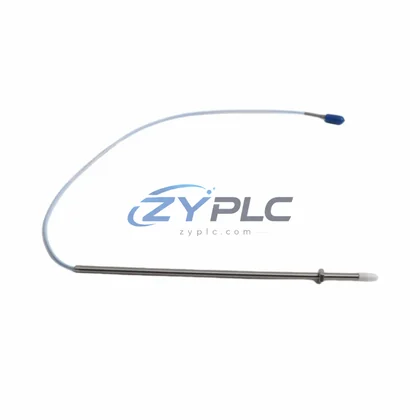
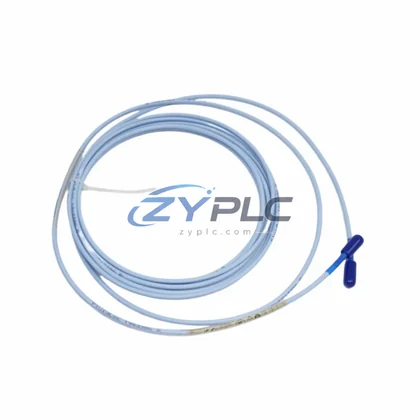
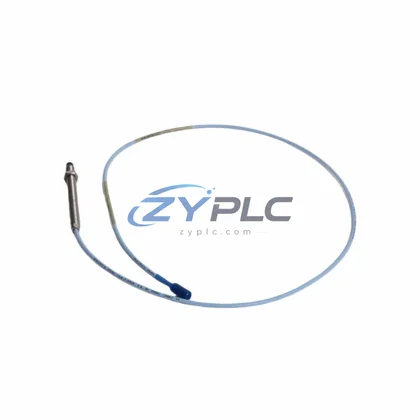
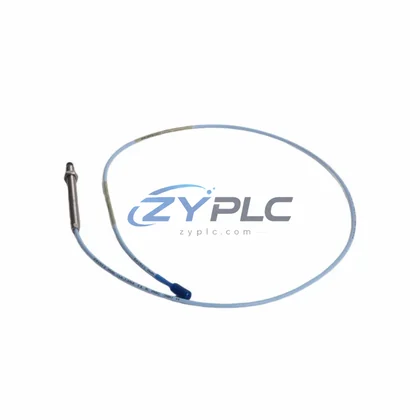
Bently Nevada 330130-060-02-05 Proximity Transducer for 3300 XL
The Bently Nevada 330130-060-02-05 is a precision eddy-current proximity transducer engineered for seamless integration within the 3300 XL Series vibration monitoring architecture. Designed to operate as a critical sensing node in multi-layer industrial automation systems, this transducer delivers continuous, high-resolution shaft displacement and radial vibration data to the control and protection layers of rotating machinery systems. Its role extends far beyond a standalone sensor — it functions as the foundational signal source that enables the entire condition monitoring chain to operate with accuracy, reliability, and long-term consistency across demanding industrial environments.
In modern industrial control architectures, the proximity transducer occupies the field instrumentation layer, interfacing directly with rotating shafts and transmitting analog gap voltage signals to the 3300 XL monitor modules. These signals are then processed, conditioned, and routed through the system’s I/O and communication layers to supervisory control platforms, historian servers, and alarm management systems. The 330130-060-02-05 is calibrated to work within the Bently Nevada standard signal chain, ensuring that every measurement delivered upstream is consistent, repeatable, and traceable to established engineering baselines.
Product Specification Table
| Parameter |
Specification |
| System Role |
Field-Level Proximity Sensing Node — 3300 XL Vibration Monitoring Architecture |
| SKU / Part Number |
330130-060-02-05 |
| Brand / Manufacturer |
Bently Nevada (Baker Hughes) |
| Series Compatibility |
3300 XL Proximity Transducer System |
| Transducer Type |
Eddy-Current (Non-Contact) Proximity Transducer |
| Cable Length |
6.0 m (Extension Cable Included) |
| Probe Tip Diameter |
8 mm |
| Linear Range |
Approx. 0.25 mm to 2.25 mm (target material dependent) |
| Output Signal |
-18 VDC nominal gap voltage (analog) |
| Supply Voltage |
-24 VDC (via 3300 XL driver/monitor) |
| Frequency Response |
DC to 10,000 Hz |
| Temperature Range (Operating) |
-35°C to +177°C (probe); -35°C to +85°C (extension cable) |
| Communication / Signal Interface |
Analog voltage output to 3300 XL monitor input channel |
| Installation Environment |
Rotating machinery — turbines, compressors, pumps, motors |
| Approvals / Compliance |
CE, ATEX (zone-dependent configuration), API 670 compatible |
| Warranty |
warranty terms confirmed during quotation — covers manufacturing defects and functional performance |
System Compatibility Notes
The 330130-060-02-05 proximity transducer is designed to function as part of a tightly coordinated Bently Nevada 3300 XL system architecture. In a complete machinery protection and condition monitoring installation, this transducer works in conjunction with the 330180 extension cable and the 330100 proximitor/oscillator to form the three-component probe system that Bently Nevada specifies for API 670-compliant installations. The proximitor converts the raw eddy-current signal into a calibrated analog voltage that is then routed to the 3300/16 monitor or 3300/20 monitor input channels for real-time processing.
At the monitor layer, the 3300 XL series modules — including the 3300/55 Dual Voting Logic and 3300/46 Keyphasor module — process the incoming vibration and position data and apply configurable alarm and danger thresholds. The Keyphasor signal, typically sourced from a dedicated 330980 Keyphasor transducer, provides the once-per-revolution reference that enables phase and amplitude analysis across all monitored channels. This integration is essential for machinery diagnostics, balancing, and orbit analysis in turbomachinery applications.
At the rack and backplane level, the 3300 XL monitors are housed in the 3300/05 rack or 3300/10 rack, which provide the structural and electrical backbone for the entire monitoring system. Power is supplied through the 3300/15 power supply module, which delivers regulated DC power to all installed monitor cards. For critical applications requiring continuous availability, a redundant power supply configuration using dual 3300/15 units ensures that a single power supply failure does not interrupt machinery protection coverage.
Communication from the 3300 XL system to the plant DCS or SCADA layer is typically achieved through the 3500/92 communication gateway or via Modbus TCP/RTU interfaces supported by compatible gateway modules. This allows vibration, position, and alarm data to be transmitted to the plant historian, operator workstation, or safety instrumented system (SIS) in real time. The system integration of the 330130-060-02-05 within this layered architecture ensures that every measurement it generates contributes directly to plant-wide condition awareness and machinery protection decisions.
Industrial Application Notes
The 330130-060-02-05 proximity transducer is deployed across a wide range of heavy industrial sectors where rotating machinery reliability is critical to operational continuity and safety. In power generation facilities — including gas turbine, steam turbine, and combined-cycle plants — this transducer monitors shaft radial vibration and axial position on main generator shafts and auxiliary turbines, providing the early warning data that prevents catastrophic bearing failures and unplanned outages.
In petrochemical and refinery environments, the 330130-060-02-05 is installed on centrifugal compressors, booster pumps, and reactor agitators operating in hazardous classified areas. Its ATEX-compatible configuration options allow deployment in Zone 1 and Zone 2 environments, where intrinsically safe or explosion-proof installations are mandated by process safety regulations. The transducer’s wide operating temperature range makes it suitable for both ambient-temperature utility machinery and high-temperature process compressors operating near heat exchangers or fired heaters.
In water treatment and municipal infrastructure applications, the transducer is used on large vertical turbine pumps and horizontal split-case pumps, where continuous vibration monitoring enables predictive maintenance scheduling and reduces the risk of unplanned service interruptions. For mining and mineral processing operations, it is installed on ball mill drives, SAG mill pinion shafts, and slurry pump systems, where the harsh operating environment demands robust, field-proven sensing technology.
Metallurgical and steel mill applications deploy the 330130-060-02-05 on rolling mill drive motors, continuous caster drives, and blast furnace blower trains. In packaging and discrete manufacturing lines, it monitors high-speed spindles and servo-driven conveyor systems where vibration anomalies can cause product quality defects or line stoppages. Across all these applications, the transducer’s role within the 3300 XL architecture ensures that condition data is continuously available to the control and maintenance layers, supporting both real-time protection and long-term reliability engineering.
Product Compatibility FAQ
Q1: Is the 330130-060-02-05 directly compatible with existing 3300 XL monitor racks without additional adapters?
Yes. The 330130-060-02-05 is a standard Bently Nevada 3300 XL series proximity transducer and is designed for direct plug-and-play compatibility with all 3300 XL monitor input channels when used with the corresponding 330180 extension cable and 330100 proximitor. No additional signal conditioning adapters or interface modules are required. The system is calibrated to the standard Bently Nevada scale factor, ensuring that monitor channel configuration requires only standard gap voltage and scale factor entry during commissioning.
Q2: Can this transducer be used in a redundant monitoring architecture, and how does it support system availability?
Yes. In critical machinery protection applications, the 330130-060-02-05 is commonly deployed in dual-redundant transducer configurations, where two probes are mounted at 90° to each other on the same shaft journal to provide XY vibration measurement. This configuration, combined with the 3300 XL’s dual-voting logic modules, ensures that a single transducer failure does not result in a spurious trip or loss of protection coverage. The warranty terms confirmed during quotation on each unit further supports system availability by guaranteeing replacement or repair of any transducer that fails due to manufacturing defects within the warranty period, minimizing the risk of extended downtime during the early operational phase.
Q3: What are the recommended commissioning steps and long-term maintenance considerations for this transducer in a 3300 XL system?
During commissioning, the transducer gap should be set to the midpoint of the linear range (approximately 1.0–1.25 mm) using a calibrated gap-setting tool, with the gap voltage verified at the monitor input channel against the Bently Nevada calibration curve for the target material. The extension cable routing should be secured to avoid mechanical vibration transmission to the cable itself, and all connectors should be inspected for proper seating and environmental sealing. For long-term maintenance, annual inspection of the probe tip for wear or contamination, verification of gap voltage stability, and functional testing of the complete probe-extension-proximitor chain are recommended. Spare transducer assemblies should be maintained in inventory to support rapid replacement during planned outages, and all units are covered by the warranty terms confirmed during quotation from the date of shipment, providing assurance during the initial operational period.