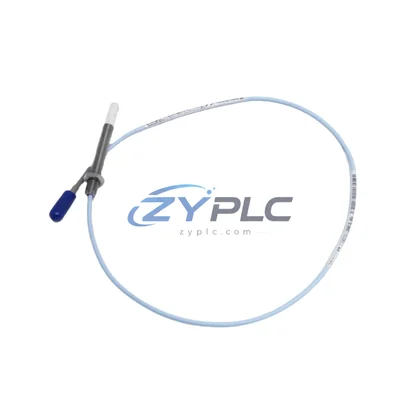
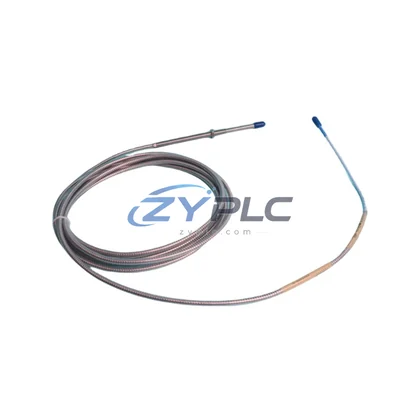
Bently Nevada 330130-090-10-00 Industrial Network Interface for 3300 Series Systems: Precision Data Link for Smart Factory Vibration Monitoring
The Bently Nevada 330130-090-10-00 is a 9-meter (30-foot) proximity probe extension cable engineered for the 3300 XL 8mm Proximity Transducer System. Designed to bridge the gap between field-mounted proximity probes and vibration monitoring rack systems, this extension cable forms a critical segment of the industrial data chain — transmitting high-fidelity analog signals from rotating machinery to condition monitoring platforms with minimal signal degradation. In smart factory environments where uptime is non-negotiable, the 330130-090-10-00 ensures that every micron of shaft displacement is accurately captured and delivered to the control layer.
As industrial facilities transition toward IIoT-enabled architectures, the integrity of the physical signal path becomes as important as the digital communication layer above it. The 330130-090-10-00 serves as the foundational link in a vibration data acquisition chain that feeds directly into SCADA systems, DCS platforms, and predictive maintenance engines — enabling real-time monitoring, alarm management, and remote diagnostics across the entire plant network.
Compatibility & Integration Notes
| Parameter |
Specification |
| SKU / Part Number |
330130-090-10-00 |
| Brand |
Bently Nevada |
| Series |
3300 XL 8mm Proximity Transducer System |
| Cable Length |
9 meters (30 feet) |
| Signal Protocol |
Analog (eddy-current proximity signal, -24 VDC bias) |
| Interface Type |
Coaxial extension cable with MIL-spec connectors |
| Transmission Capability |
High-fidelity vibration, position, and speed signal transmission |
| Network Compatibility |
3500 Series Monitoring Rack, 3300 XL Proximitor, ADRE SXP, DCS/SCADA integration |
| System Application |
Rotating machinery condition monitoring, shaft vibration, axial position, Keyphasor |
| Operating Temperature |
-40°C to +85°C |
| Origin |
United States |
| Warranty |
warranty terms confirmed during quotation |
Connected Automation Data Flow
In a fully integrated condition monitoring architecture, the 330130-090-10-00 extension cable connects the 330180-91-05 proximity probe — mounted directly on the bearing housing of a turbine, compressor, or pump — to the 3300 XL Proximitor sensor, which converts the raw eddy-current signal into a calibrated voltage output. This signal is then routed into the 3500/42M Proximitor Monitor housed within the 3500 Series monitoring rack, where it is processed for vibration amplitude, phase, and DC gap measurements.
The 3500 rack communicates over Modbus TCP/IP or Ethernet/IP to the plant’s SCADA gateway or DCS controller, enabling operators to view real-time vibration trends on HMI panels and historian platforms. For transient data capture during machine startups and shutdowns, the 3500/22M Transient Data Interface works in tandem with the ADRE SXP data acquisition system, providing high-resolution Bode plots, polar plots, and orbit diagrams that are essential for root-cause analysis.
In parallel, the 1900/65A General Purpose Monitor may be deployed for auxiliary machinery — pumps, fans, and gearboxes — where the same 330130-series extension cables provide the signal path. The 330104 and 330105 proximity probes, used in conjunction with the 330130-090-10-00, complete the transducer chain for radial vibration and axial position monitoring on critical rotating assets.
At the network layer, edge gateways aggregate condition monitoring data from multiple 3500 racks and transmit it via OPC-UA or MQTT to cloud-based predictive maintenance platforms, closing the loop between field instrumentation and enterprise-level asset management systems. The reliability of this entire data flow depends on the signal integrity maintained by components like the 330130-090-10-00 — a cable that must perform flawlessly in high-vibration, high-temperature, and electrically noisy industrial environments.
Solving Data Isolation in Industrial Sites
One of the most persistent challenges in industrial condition monitoring is data isolation — the inability to correlate vibration data from field instruments with process data from PLCs, flow meters, and temperature transmitters. The 330130-090-10-00 addresses this at the hardware level by ensuring that the analog signal from the proximity probe reaches the monitoring rack without attenuation, noise injection, or phase distortion that would compromise the accuracy of downstream digital analysis.
When facilities operate mixed fleets of legacy and modern instrumentation, protocol fragmentation becomes a barrier to plant-wide transparency. By maintaining a clean, calibrated signal path through the 330130-090-10-00, engineers can trust that the vibration data entering the 3500 monitoring system is accurate — enabling reliable protocol conversion at the rack level and consistent data quality when the signal is ultimately digitized and transmitted to SCADA or DCS platforms.
Remote monitoring and diagnostics are increasingly critical as maintenance teams are asked to manage more assets with fewer personnel. The 330130-090-10-00 supports this shift by providing a durable, low-maintenance signal path that reduces the frequency of field calibration visits. When integrated with the ADRE SXP and 3500/22M Transient Data Interface, remote engineers can access full-spectrum vibration data from any location — enabling proactive maintenance decisions without requiring physical presence at the machine.
For facilities expanding their condition monitoring coverage, the 330130-090-10-00 is available in multiple lengths within the 330130 series, allowing system designers to configure the optimal cable run for each machine train without compromising signal integrity. This scalability supports phased IIoT rollouts where monitoring coverage is extended incrementally across the plant.
All units supplied by ZYPLC are sourced from verified supply channels, undergo pre-shipment functional inspection, and are backed by a warranty terms confirmed during quotation. Availability confirmed by RFQ inventory ensures rapid fulfillment via DHL or FedEx international express, with same-day dispatch available for urgent maintenance requirements.
Industrial Connectivity FAQ
Q1: Does the 330130-090-10-00 introduce signal delay or latency in the vibration monitoring chain?
A: As a passive coaxial extension cable, the 330130-090-10-00 does not introduce measurable latency. Signal propagation through the cable is effectively instantaneous relative to the sampling rates of the 3500 Series monitors. Any signal conditioning delay occurs within the Proximitor sensor and monitor electronics, not the cable itself.
Q2: Is the 330130-090-10-00 compatible with all 3300 XL proximity probes and Proximitor sensors?
A: Yes. The 330130-090-10-00 is designed for use within the 3300 XL 8mm Proximity Transducer System and is compatible with 330180-series probes, 3300 XL Proximitor sensors, and the full range of 3500 Series monitors. Always verify connector type and cable length requirements against your specific machine train configuration.
Q3: How does ZYPLC ensure network stability and signal integrity for shipped units?
A: Each 330130-090-10-00 unit undergoes pre-shipment inspection covering connector integrity, cable continuity, and shielding effectiveness. Units are packaged to prevent mechanical damage during international transit. The warranty terms confirmed during quotation covers defects in materials and workmanship, with rapid replacement support available through our technical team.
Q4: Can the 330130-090-10-00 be used in systems that are being expanded or upgraded to IIoT-enabled architectures?
A: Absolutely. The 330130-090-10-00 is fully compatible with both legacy 3300/3500 Series installations and modern IIoT-integrated deployments. As facilities upgrade their monitoring racks to support Ethernet/IP or Modbus TCP communication, the existing transducer cabling — including the 330130-090-10-00 — remains valid, protecting the original instrumentation investment while enabling digital transformation at the rack and network layer.