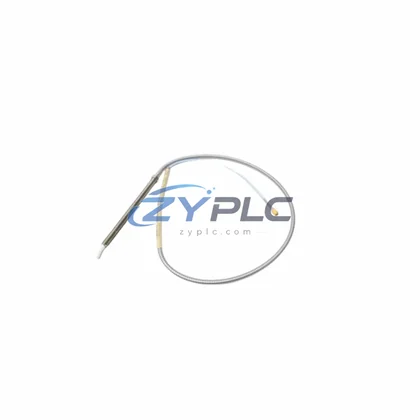
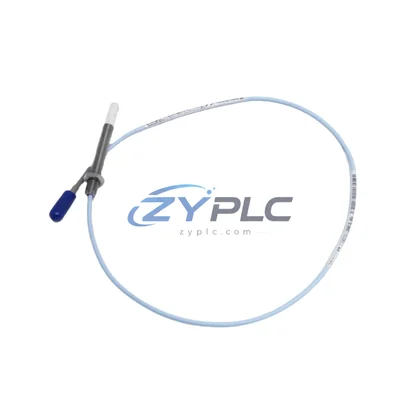
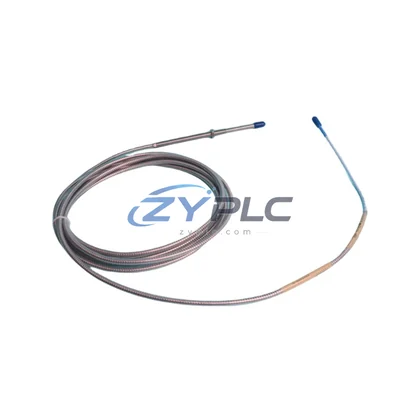
Bently Nevada 330180-50-05 Proximitor Sensor for 3300 Series Automation
The Bently Nevada 330180-50-05 is a high-precision eddy-current proximitor sensor engineered for the 3300 Series vibration monitoring platform. In industrial environments where unplanned downtime and excessive operating load directly erode profitability, this sensor plays a critical role in enabling predictive maintenance strategies that reduce both mechanical failures and the energy overhead associated with reactive repair cycles. By delivering continuous, real-time shaft displacement and vibration data, the 330180-50-05 allows control systems to make informed decisions — throttling drive output, adjusting motor load, and preventing the energy spikes that accompany uncontrolled equipment failures.
Factories operating rotating machinery — turbines, compressors, pumps, and gearboxes — depend on accurate proximity sensing to maintain optimal equipment utilization rates. When a machine runs outside its design envelope, it consumes disproportionate energy. The 330180-50-05, paired with the 3300 XL 8mm Proximitor System, continuously monitors radial shaft position and feeds that data into the plant’s condition monitoring architecture. This allows operators to detect early-stage bearing wear, rotor imbalance, or misalignment before these conditions escalate into high-current draw events or catastrophic failures that require emergency shutdowns.
Product Specification Table
| Parameter |
Specification / Value |
| SKU / Part Number |
330180-50-05 |
| Brand / Series |
Bently Nevada / 3300 Series |
| Sensor Type |
Eddy-Current Proximitor (Non-contact) |
| Measurement Range |
0 – 2.54 mm (0 – 100 mil) |
| Operating Frequency |
DC – 10,000 Hz |
| Power Consumption |
Low-draw design; compatible with 3300 Series low-power driver modules |
| Operating Temperature |
-35°C to +85°C (sensor); -35°C to +65°C (proximitor) |
| Compatible Systems |
Bently Nevada 3300 XL, System 1 Software, TDI Modules |
| Application Environment |
Turbines, Compressors, Pumps, Gearboxes, Motors |
| Maintenance Value |
Enables predictive maintenance; reduces unplanned downtime energy spikes |
| Output Signal |
-24 VDC nominal (standard Bently Nevada proximitor output) |
| Warranty |
warranty terms confirmed during quotation — Tested before shipment |
System Compatibility and Application
The 330180-50-05 does not operate in isolation — it is a precision data source within a broader industrial automation system. In a typical industrial deployment, the sensor cable assembly connects to the 3300 XL 8mm Proximitor, which conditions the raw eddy-current signal into a calibrated voltage output readable by the Bently Nevada 3500/40M Proximitor Monitor. This monitor feeds shaft position data into the plant’s DCS or PLC — commonly a Rockwell Automation ControlLogix L7x or a Siemens S7-400 — where logic programs use the vibration trend data to modulate the output of connected variable frequency drives (VFDs) such as the ABB ACS880 or Siemens SINAMICS G120.
When the 330180-50-05 detects a shaft displacement trend indicating developing imbalance, the control system can proactively reduce motor speed via the VFD, lowering operating load before the fault worsens. This closed-loop feedback between the proximity sensor, the Bently Nevada 3500 Series rack, and the drive system is the foundation of energy-efficient predictive maintenance. The 3500/22M Transient Data Interface (TDI) module further captures high-resolution waveform data during transient events, enabling engineers to analyze startup and shutdown energy profiles and identify inefficiencies in motor acceleration curves.
For power quality monitoring, the 330180-50-05 deployment is often complemented by Schneider Electric PowerLogic ION7650 power meters or similar condition monitoring devices installed at the MCC (Motor Control Center) level. These meters track real-time kW demand, power factor, and harmonic distortion — data that, when correlated with the vibration trends from the 330180-50-05, provides a complete picture of machine health versus operating load. Communication between these systems typically runs over PROFIBUS DP, Modbus TCP/IP, or EtherNet/IP, ensuring that the Bently Nevada 3300 Series data integrates seamlessly into the plant’s SCADA or MES layer.
HMI visualization — often through a GE iFIX or Wonderware InTouch workstation — presents operators with real-time vibration amplitude, gap voltage, and operating load trends on a single dashboard, enabling rapid decision-making without requiring manual inspection of rotating equipment. The I/O modules within the 3500 rack, such as the 3500/20 Rack Interface Module, manage the communication handshake between the monitoring system and the plant control network, ensuring data integrity even in electrically noisy industrial environments.
Maintenance and Replacement Notes
In a petrochemical plant running a multi-stage centrifugal compressor train, the 330180-50-05 sensors mounted at the compressor’s journal bearings provide continuous radial position data. When the system detects a gradual increase in 1X vibration amplitude — a classic indicator of rotor unbalance developing over time — the control system flags the condition and schedules a maintenance window during a planned low-demand period. This avoids the scenario where the compressor runs to failure, triggering an emergency shutdown that requires the entire train to be restarted from cold — a process that consumes 3–5 times the normal operating energy during the acceleration phase.
In a paper mill application, the 330180-50-05 sensors on the main drive rolls feed data into the Bently Nevada System 1 software platform, where machine learning algorithms analyze vibration signatures against historical baselines. When a bearing begins to show sub-synchronous vibration — often a precursor to oil whirl instability — the system alerts maintenance teams before the condition causes the roll to seize. Preventing a single unplanned roll replacement can save tens of thousands of dollars in lost production and the energy cost of reheating process equipment after an emergency stop.
For motor-driven pump systems in water treatment facilities, the 330180-50-05 enables continuous monitoring of pump shaft alignment. Misalignment increases bearing load, raises motor current draw, and accelerates seal wear — all of which increase operating load and maintenance frequency. By detecting misalignment-induced vibration early, maintenance teams can correct alignment during scheduled downtime, restoring the pump to its best efficiency point (BEP) and reducing motor load by 5–15% compared to a misaligned operating condition.
Every unit shipped undergoes functional testing and signal calibration verification prior to dispatch. Stock is maintained for rapid fulfillment, and all units are covered by a warranty terms confirmed during quotation from the date of shipment, ensuring operational confidence for production-critical applications.
Product Sourcing FAQ
Q1: How does the 330180-50-05 contribute to operational stability in a rotating machinery application?
The sensor provides continuous, high-accuracy shaft displacement data that enables predictive maintenance scheduling. By identifying developing faults before they cause performance degradation, the system prevents the elevated motor current draw and energy spikes associated with machines operating in a deteriorated mechanical condition. Proactive maintenance keeps equipment running at its design efficiency point, directly reducing operating load per unit of output.
Q2: Is the 330180-50-05 compatible with existing Bently Nevada 3300 Series installations?
Yes. The 330180-50-05 is designed for direct compatibility with the Bently Nevada 3300 XL 8mm Proximitor System, including existing cable assemblies, extension cables, and proximitor driver modules. It integrates with the 3500 Series monitoring racks and System 1 software without requiring hardware modifications, making it a straightforward replacement or expansion component for established monitoring architectures.
Q3: What is the recommended replacement interval, and how does timely replacement affect energy efficiency?
Proximitor sensors do not have a fixed replacement interval under normal operating conditions, but performance should be verified during scheduled maintenance outages. A sensor with degraded sensitivity or drift in its gap voltage output can cause the monitoring system to miss early fault indicators, allowing machines to operate in inefficient states longer than necessary. Regular calibration checks and prompt replacement of out-of-specification sensors maintain the integrity of the maintenance planning feedback loop.
Q4: What testing is performed before shipment, and what does the warranty terms confirmed during quotation cover?
Each 330180-50-05 unit undergoes functional output testing and signal linearity verification prior to shipment. The warranty terms confirmed during quotation covers defects in materials and workmanship under normal operating conditions. Units that fail to meet specification within the warranty period are repaired or replaced at no charge, ensuring that your monitoring system maintains its maintenance planning capability without unbudgeted replacement costs.