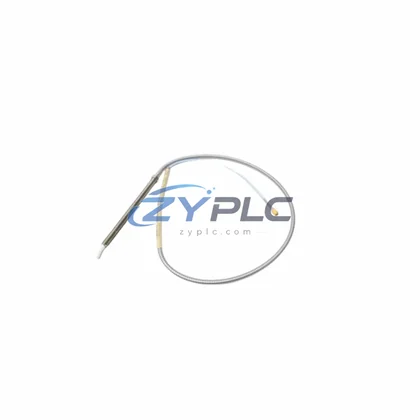
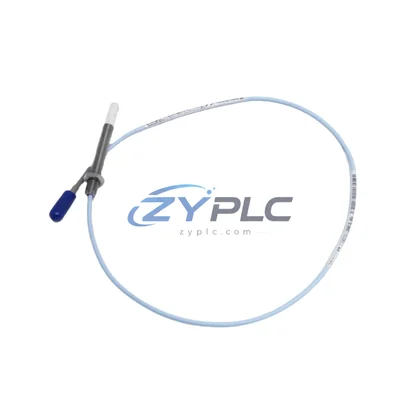
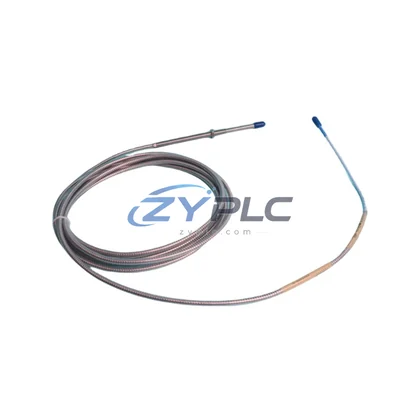
The Bently Nevada 330190-040-01-CN is a high-precision eddy-current proximity probe engineered for the 3300 Series Machinery Protection System. Designed for continuous, non-contact measurement of shaft vibration, axial position, and differential expansion in rotating machinery, this probe plays a critical role in reducing unplanned downtime, optimizing motor drive efficiency, and enabling data-driven maintenance planning across industrial production lines.
In modern manufacturing environments where energy costs and equipment utilization directly impact profitability, the 330190-040-01-CN delivers measurable value. By providing real-time, high-resolution displacement signals to the 3300 Series monitor rack, it enables control systems to detect abnormal vibration patterns before they escalate into mechanical failures — eliminating the unplanned downtime associated with unscheduled shutdowns and emergency maintenance cycles.
Product Specification Table
| Parameter |
Specification / Value |
| SKU / Part Number |
330190-040-01-CN |
| Brand / Series |
Bently Nevada / 3300 Series |
| Probe Type |
Eddy-Current Proximity Probe |
| Measurement Range |
0–40 mil (0–1.016 mm) linear range |
| Operating Frequency |
DC to 10,000 Hz |
| Power Consumption |
Low-draw passive sensor; powered via 3300 Series driver |
| Compatible Systems |
Bently Nevada 3300 Series Monitor Rack, 3500 Series (with adapter), DCS/SCADA integration |
| Application Environment |
Turbines, compressors, pumps, motors, gearboxes — oil & gas, power generation, petrochemical |
| Maintenance Value |
Prevents vibration-induced energy losses; enables predictive maintenance scheduling |
| Warranty |
warranty terms confirmed during quotation — tested and verified before shipment |
| Stock Status |
RFQ Available — shipment arranged after confirmation |
| Origin |
United States |
System Compatibility and Application
The 330190-040-01-CN does not operate in isolation — it is a precision sensing node within a broader industrial automation system. When paired with the Bently Nevada 3300/16-02-01-01-00-00 proximitor/driver module, the probe’s raw displacement signal is conditioned and scaled into a 4–20 mA or voltage output compatible with plant-level DCS and SCADA platforms. This signal chain allows the control system to continuously monitor shaft centerline position and vibration amplitude without interrupting production flow.
In drive-intensive applications, the proximity probe data feeds directly into variable frequency drive (VFD) control loops. For example, when integrated with a Siemens SINAMICS G120 or ABB ACS880 series drive, the vibration feedback from the 330190-040-01-CN can trigger automatic speed adjustments that reduce mechanical stress and lower motor energy draw during off-peak load conditions. This closed-loop interaction between sensing and drive control is one of the most effective strategies for reducing kWh consumption per production cycle.
On the control execution side, the probe’s output is typically processed by a Bently Nevada 3500/42M proximitor I/O module within the 3500 Series rack, or routed through a 3300/55 dual-channel monitor card in legacy installations. These monitor cards interface with plant PLCs — commonly Allen-Bradley ControlLogix L7x or Siemens S7-400H redundant controllers — via Modbus TCP or PROFIBUS DP, enabling the PLC to execute protective shutdowns or load-shedding routines based on real-time vibration thresholds.
For facilities implementing condition monitoring at the equipment level, the proximity probe data can be correlated with power consumption readings from Schneider Electric PowerLogic ION7650 power meters or ABB M2M energy analyzers. This correlation allows maintenance engineers to identify the precise vibration signature that corresponds to peak energy inefficiency — for instance, a rotor imbalance condition that forces a motor to draw 8–12% more current than its rated baseline.
HMI visualization of the 330190-040-01-CN signal is typically handled through GE iFIX, Wonderware InTouch, or Rockwell FactoryTalk View SE platforms, where operators can monitor shaft orbit plots, trend vibration over time, and set alarm thresholds that align with energy efficiency targets rather than purely mechanical safety limits.
Maintenance and Replacement Notes
In a typical centrifugal compressor train operating in a petrochemical plant, undetected rotor imbalance or bearing wear can cause the machine to operate at reduced aerodynamic efficiency for weeks before a catastrophic failure occurs. During this degraded period, the compressor may consume 10–20% more electrical energy than its design point while delivering below-specification throughput. The 330190-040-01-CN proximity probe, mounted radially at the compressor’s journal bearing, continuously tracks shaft displacement with micron-level resolution. When the 3300 Series monitor detects a rising vibration trend, the control system can schedule a corrective maintenance window during a planned production pause — avoiding both the unplanned downtime of degraded operation and the far greater cost of an emergency shutdown.
In steam turbine applications, axial position monitoring using the 330190-040-01-CN prevents rotor-to-stator contact events that would require full turbine cool-down and restart cycles — processes that consume significant thermal and electrical energy. By maintaining continuous axial position feedback to the turbine control system, operators can optimize steam admission valve timing and reduce auxiliary power consumption during startup and load-following operations.
For pump stations in water treatment or pipeline facilities, the probe’s vibration data enables condition-based maintenance scheduling that replaces fixed-interval overhauls. This shift from time-based to condition-based maintenance reduces the number of unnecessary disassembly events, each of which requires energy-intensive recommissioning and alignment procedures. Plants that have implemented proximity probe-based CBM programs report 15–25% reductions in maintenance-related operating load annually.
All units supplied by ZYPLC undergo functional output testing and signal linearity verification prior to shipment. Each 330190-040-01-CN is backed by a warranty terms confirmed during quotation, with availability confirmed by RFQ availability ensuring rapid deployment to minimize production line downtime.
Product Sourcing FAQ
Q1: How does the 330190-040-01-CN contribute to operational stability in rotating machinery?
By providing continuous, high-resolution shaft vibration and position data to the 3300 Series monitor, this probe enables the control system to detect mechanical inefficiencies — such as rotor imbalance, misalignment, or bearing wear — at an early stage. Early detection allows corrective action before the machine enters a degraded operating state that consumes excess electrical energy. In compressor and turbine applications, this can translate to measurable reductions in specific operating load (kWh per unit of output).
Q2: Is the 330190-040-01-CN compatible with modern DCS and PLC platforms?
Yes. When used with the appropriate Bently Nevada 3300 Series driver and monitor modules, the probe’s conditioned output is compatible with standard 4–20 mA and voltage input cards on major DCS platforms including Emerson DeltaV, Honeywell Experion PKS, and ABB System 800xA. It also interfaces with Allen-Bradley and Siemens PLCs via the monitor rack’s communication modules.
Q3: Can this probe replace an existing 330190 series unit without system recalibration?
The 330190-040-01-CN is a direct form-fit-function replacement for other 330190 series probes of the same cable length and connector configuration. In most installations, replacement requires only mechanical remounting and gap-setting verification — no driver recalibration is needed if the replacement probe is from the same sensitivity family (7.87 V/mm). ZYPLC recommends verifying the gap voltage after installation using the existing driver’s output.
Q4: What does the warranty terms confirmed during quotation cover, and what is the testing process?
Every 330190-040-01-CN supplied by ZYPLC is tested for output linearity, sensitivity, and connector integrity before shipment. The warranty terms confirmed during quotation covers defects in materials and workmanship under normal operating conditions. Units that fail within the warranty period are replaced or refunded. For time-critical applications, ZYPLC maintains RFQ-confirmed sourcing to support same-week shipment and minimize production line exposure.