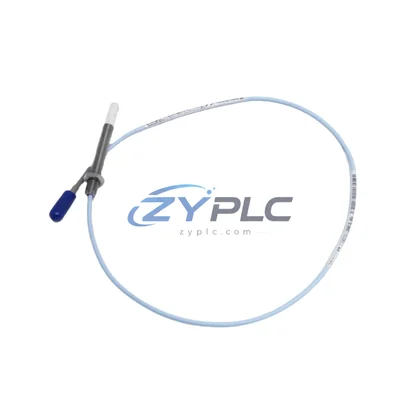
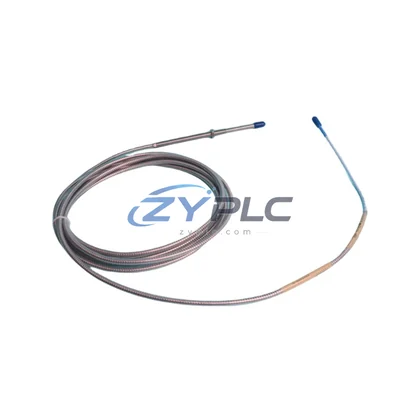
Bently Nevada 330500-06-04 Piezo-Velocity Sensor for 3500
The Bently Nevada 330500-06-04 is a precision piezo-velocity sensor engineered for seamless integration within the Bently Nevada 3500 Series machinery protection system architecture. Rather than functioning as a standalone measurement device, this sensor occupies a critical node in a layered industrial control hierarchy — bridging the physical machine layer with the signal conditioning, monitoring, and protection layers that define modern rotating equipment management. Its role in the overall system is to deliver accurate, low-noise velocity signals that feed directly into the 3500 rack-based monitoring platform, enabling real-time vibration analysis, alarm management, and protective shutdown logic across the full control architecture.
In a complete 3500 system deployment, the 330500-06-04 operates in close coordination with the 3500/42M Proximitor/Seismic Monitor Module, which processes the raw velocity signal and converts it into engineering units for display, trending, and relay output. The monitor module communicates upstream with the 3500/22M Transient Data Interface or the 3500/92 Communication Gateway, enabling data exchange with distributed control systems (DCS), SCADA platforms, and historian servers via Modbus, Ethernet/IP, or OPC-DA protocols. This multi-layer communication architecture ensures that vibration data captured by the 330500-06-04 is not siloed at the sensor level but is propagated throughout the plant-wide automation network for centralized condition monitoring and predictive maintenance decision-making.
At the power and signal integrity layer, the 330500-06-04 is typically powered through the 3500 rack’s internal power distribution bus, supplied by the 3500/15 Power Supply Module. Redundant power configurations using dual 3500/15 modules ensure that sensor excitation remains uninterrupted even during power supply maintenance or single-point failures — a critical requirement in continuous-process industries such as petrochemical refining, LNG compression, and power generation. The sensor’s cable routing and shielding practices are designed to comply with the 3500 system’s EMC requirements, minimizing interference from adjacent variable frequency drives (VFDs), motor control centers (MCCs), and high-voltage bus systems commonly found in industrial switchgear environments.
From a system architecture perspective, the 330500-06-04 supports both simplex and redundant monitoring configurations. In redundant deployments, dual sensors are mounted at orthogonal positions on the machine bearing housing, with each sensor feeding an independent channel of the 3500/42M module. This dual-channel redundancy eliminates single-sensor failure as a cause of undetected machine deterioration, and it aligns with API 670 machinery protection standards widely adopted in turbomachinery, compressor trains, and pump systems. The 3500 rack’s voting logic can be configured to require agreement between both channels before triggering a protective shutdown, reducing nuisance trips while maintaining protection integrity.
For engineering teams responsible for system commissioning and long-term maintenance, the 330500-06-04 offers significant advantages in terms of interchangeability and calibration traceability. The sensor’s standardized output characteristics — expressed in millivolts per millimeter per second (mV/mm/s) — are compatible with the 3500/42M module’s input scaling parameters, allowing field replacement without recalibration of the monitoring system. This plug-and-replace capability reduces mean time to repair (MTTR) during unplanned maintenance events and supports the broader goal of minimizing unplanned downtime in critical asset management programs. Spare sensor inventory management is simplified by the sensor’s single-model compatibility across multiple 3500 rack configurations, including those using the 3500/25 Enhanced Keyphasor Module for phase reference and speed measurement.
In layered automation systems, the 330500-06-04 contributes to the overall system’s diagnostic transparency. Vibration trends captured through this sensor can be correlated with process variables — such as flow rate, pressure differential, and bearing temperature — sourced from the plant DCS or from Bently Nevada’s System 1 condition monitoring software. This cross-layer data correlation enables maintenance engineers to distinguish between vibration anomalies caused by process upsets, mechanical wear, rotor imbalance, or misalignment — supporting root cause analysis without requiring machine shutdown for physical inspection.
Supply chain continuity is a key consideration for long-term system operators. ZYPLC maintains availability subject to RFQ confirmation of the 330500-06-04 alongside complementary components including the 3500/42M monitor module, 3500/15 power supply, 3500/20 Rack Interface Module, and associated interconnect cabling assemblies. This integrated inventory approach ensures that system operators can source matched components from a single supplier, reducing procurement lead times and ensuring compatibility across the full sensor-to-rack signal chain. All units supplied by ZYPLC are covered by a warranty terms confirmed during quotation, with pre-shipment functional verification performed against Bently Nevada factory specifications.
Product Specification Table
| Parameter |
Specification |
| System Role |
Piezo-velocity vibration sensor for 3500 Series machinery protection rack |
| Compatible Monitor Module |
Bently Nevada 3500/42M Proximitor/Seismic Monitor |
| Output Sensitivity |
Typically 100 mV/in/s (industry standard for this series) |
| Frequency Response |
10 Hz – 1,000 Hz (±3 dB) |
| Operating Temperature |
-40°C to +121°C |
| Electrical Connection |
2-wire, low-impedance voltage output |
| Communication Compatibility |
Via 3500/92 Gateway: Modbus RTU/TCP, Ethernet/IP, OPC-DA |
| Mounting |
Stud-mount or adhesive mount on bearing housing |
| Protection Standard |
API 670 compliant machinery protection architecture |
| Warranty |
warranty terms confirmed during quotation — all units pre-shipment verified |
System Compatibility Notes
The 330500-06-04 achieves its full value when deployed as part of a coordinated Bently Nevada 3500 system architecture. At the monitoring layer, the 3500/42M Proximitor/Seismic Monitor Module receives and conditions the velocity signal, applying configurable alarm setpoints and relay outputs for alert and danger thresholds. The 3500/15 Power Supply Module provides stable excitation voltage to the sensor through the rack backplane, while the 3500/20 Rack Interface Module (RIM) manages communication between the rack and external systems. For phase reference and speed tracking, the 3500/25 Enhanced Keyphasor Module provides the once-per-revolution trigger signal essential for vector-based vibration analysis and balancing operations.
At the network layer, the 3500/92 Communication Gateway aggregates data from all monitor modules within the rack and exposes it to plant-level systems via industrial Ethernet protocols. This gateway enables integration with Emerson DeltaV DCS, Honeywell Experion PKS, or Yokogawa CENTUM VP platforms, allowing vibration data from the 330500-06-04 to appear alongside process variables in unified operator displays. For facilities running Bently Nevada’s System 1 Condition Monitoring Software, the gateway provides the data pathway for long-term trend storage, spectrum analysis, and predictive maintenance reporting. In high-availability configurations, the 3500/22M Transient Data Interface captures high-speed waveform data during machine transients — startup, shutdown, and load changes — providing the engineering team with detailed diagnostic records that complement the steady-state monitoring performed by the 330500-06-04.
At the field wiring layer, 3500-series interconnect cables and junction boxes route sensor signals from machine-mounted locations to the control room rack, with shielding and grounding practices specified in Bently Nevada’s installation guidelines to maintain signal integrity across long cable runs in electrically noisy industrial environments.
Industrial Application Notes
The 330500-06-04 is deployed across a wide range of process industries where rotating machinery protection is a regulatory and operational requirement. In oil and gas processing, the sensor monitors centrifugal compressors, gas turbines, and booster pumps in upstream and midstream facilities, where unplanned shutdowns carry significant production and safety consequences. In power generation, it is applied to steam turbine generator sets and boiler feed pumps, where continuous vibration monitoring is mandated by plant safety management systems and insurance requirements.
In petrochemical and refining applications, the sensor supports machinery protection for reactor feed pumps, cracked gas compressors, and air separation unit expanders — all of which operate under API 670 protection requirements. In water and wastewater treatment, the 330500-06-04 monitors large vertical turbine pumps and blower trains, where early detection of bearing wear or impeller imbalance prevents costly civil infrastructure damage. In mining and minerals processing, the sensor is applied to SAG mill drives, slurry pumps, and conveyor drive gearboxes, where harsh environmental conditions demand the sensor’s wide operating temperature range and robust mechanical construction.
In packaging and discrete manufacturing environments, the sensor supports condition-based maintenance programs on high-speed rotating equipment, reducing scheduled maintenance intervals and extending mean time between failures (MTBF) through data-driven maintenance planning integrated with the plant’s CMMS via the 3500/92 communication gateway.
Product Compatibility FAQ
Q1: Is the 330500-06-04 directly compatible with all 3500 Series monitor modules, or are there specific module requirements?
The 330500-06-04 is designed for use with the Bently Nevada 3500/42M Proximitor/Seismic Monitor Module, which accepts both proximity probe and seismic (velocity/acceleration) inputs. Compatibility with other 3500 monitor modules depends on the module’s input channel configuration. Engineers should verify the monitor module’s channel type assignment in the 3500 Rack Configuration Software (RCS) before installation. ZYPLC’s technical team can assist with configuration verification as part of the warranty terms confirmed during quotation support service.
Q2: Can the 330500-06-04 be used in a redundant monitoring architecture, and what are the rack configuration requirements?
Yes. Redundant configurations using dual 330500-06-04 sensors are fully supported within the 3500 architecture. Each sensor feeds an independent input channel on the 3500/42M module, and the module’s voting logic is configured via the Rack Configuration Software to define alarm and shutdown behavior based on single-channel or dual-channel agreement. Redundant power supply configurations using dual 3500/15 modules are recommended for critical applications. ZYPLC supplies matched sensor pairs with verified sensitivity tolerances to ensure balanced dual-channel performance.
Q3: What is covered under the warranty terms confirmed during quotation, and how does ZYPLC handle warranty claims for sensors installed in remote locations?
The warranty terms confirmed during quotation covers manufacturing defects, output sensitivity deviation beyond published tolerances, and connector or cable assembly failures under normal operating conditions. For sensors installed in remote or offshore locations, ZYPLC offers advance replacement under warranty — shipping a verified replacement unit before the defective unit is returned — to minimize system downtime. All warranty claims are processed through ZYPLC’s technical support team at plc.sales@zyplc.com or +86 19859288691.