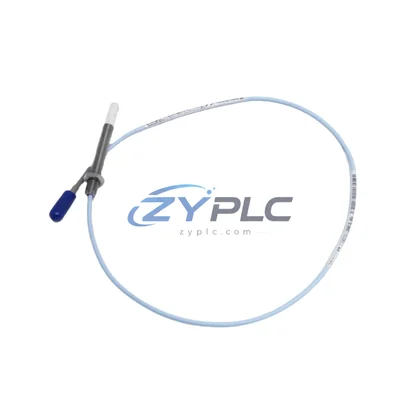
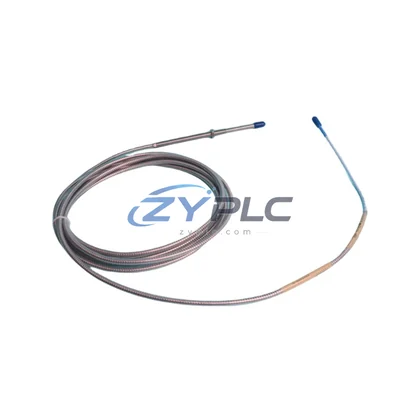
Bently Nevada 330901-00-09-70-02-05 NSV Sensor for 3300 XL
In modern rotating machinery protection and condition monitoring systems, every component must function not as an isolated device but as an integrated node within a layered control architecture. The Bently Nevada 330901-00-09-70-02-05 is a Non-contacting Voltage (NSV) proximity transducer engineered specifically for deployment within the Bently Nevada 3300 XL Series monitoring platform. Its design philosophy centers on system coherence — ensuring that vibration, position, and speed signals are captured with the precision and reliability that mission-critical industrial environments demand. Whether integrated into a turbine protection loop, a compressor monitoring rack, or a rotating equipment health management system, this sensor delivers the signal fidelity that underpins safe and efficient plant operation.
The 330901-00-09-70-02-05 operates as part of the complete 3300 XL transducer chain, which includes the proximitor extension cable, the 3300 XL 8mm proximitor sensor driver, and the associated monitor modules housed within the 3300 XL rack system. The transducer itself is a 9-meter armored cable assembly with a 70 mil (1.78 mm) tip diameter, calibrated for use with the standard 3300 XL driver electronics. Its output is a linear DC voltage proportional to the gap between the probe tip and the observed conductive target surface, making it ideal for radial vibration, axial position, differential expansion, and eccentricity measurements across a wide range of rotating machinery types.
Product Specification Table
| Parameter |
Specification |
| System Role |
Non-contacting Proximity Transducer (NSV) — Signal Input Layer |
| Compatible Platform |
Bently Nevada 3300 XL Series Monitoring System |
| Cable Length |
9 meters (armored, integral) |
| Probe Tip Diameter |
70 mil (1.78 mm) |
| Output Signal |
Linear DC voltage, proportional to gap distance |
| Measurement Types |
Radial Vibration, Axial Position, Differential Expansion, Eccentricity, Speed |
| Driver Compatibility |
3300 XL 8mm Proximitor Sensor (330180 Series) |
| Operating Temperature |
-35°C to +121°C (probe); driver per 3300 XL spec |
| Installation Environment |
Industrial — turbines, compressors, pumps, motors, gearboxes |
| Electrical Interface |
Coaxial, matched impedance to 3300 XL driver input |
| Communication Layer |
Analog signal to 3300 XL monitor; monitor integrates with DCS/SCADA via 4–20 mA or Modbus |
| Warranty |
warranty terms confirmed during quotation — full replacement or repair coverage |
System Compatibility Notes
The 330901-00-09-70-02-05 does not operate in isolation. Its value is realized only when it is correctly positioned within the full signal chain of a 3300 XL-based machinery protection system. At the field level, the probe tip is mounted adjacent to the rotating shaft, with the integral 9-meter cable routed to the Bently Nevada 330180-91-00 3300 XL 8mm Proximitor Sensor driver, which conditions the raw inductive signal into a calibrated DC voltage output. This driver is typically mounted in a junction box or directly at the machinery skid, providing the first stage of signal conditioning before transmission to the monitoring rack.
Within the control cabinet, the conditioned signal is received by a Bently Nevada 3300/16 Dual Vibration Monitor or a 3300/20 Radial Vibration Monitor module, which performs real-time amplitude analysis, alarm threshold comparison, and relay output actuation. These monitor modules are installed in the Bently Nevada 3300 XL Rack — a standardized 19-inch DIN-rail-compatible enclosure that also houses the 3300/05 Power Supply Module, providing regulated DC power to all installed monitor cards. The rack architecture supports hot-swap capability, allowing individual monitor modules to be replaced during operation without interrupting the protection function of adjacent channels.
For systems requiring redundant protection, the 330901-00-09-70-02-05 can be paired with a second transducer on the same measurement plane, with both signals routed to a 3300/55 Keyphasor Module for phase reference and speed tracking. The Keyphasor signal is shared across all monitor modules in the rack, enabling synchronous time-waveform analysis and vector-based vibration trending. This architecture is particularly important in steam turbine and gas turbine applications where phase-referenced vibration data is essential for balancing and diagnostic work.
At the system integration layer, the 3300 XL monitors communicate with the plant DCS (Distributed Control System) via 4–20 mA analog outputs or digital communication through a Bently Nevada 3500/92 Communication Gateway Module, which supports Modbus RTU, Modbus TCP, and OPC-DA protocols. This gateway enables the machinery protection system to share real-time vibration, position, and speed data with the plant historian, the operator HMI, and the asset management platform — creating a fully integrated condition monitoring loop from the transducer tip to the control room display.
In applications where the 3300 XL system is integrated alongside a Rockwell Automation ControlLogix or Siemens S7-400 safety PLC, the relay outputs from the 3300 XL monitor modules are hardwired into the PLC’s digital input cards, providing a deterministic trip signal path that is independent of the communication network. This dual-path architecture — analog relay for protection, digital network for diagnostics — is a best practice in API 670-compliant machinery protection design and is fully supported by the 330901-00-09-70-02-05 transducer system.
Industrial Application Notes
The 330901-00-09-70-02-05 finds application across a broad spectrum of heavy industrial environments where rotating machinery reliability is directly linked to production continuity and personnel safety.
In power generation facilities — including coal-fired, gas-fired, and combined-cycle plants — this transducer is deployed on steam turbine shaft monitoring systems, where it measures radial shaft vibration and axial thrust position in real time. Any deviation beyond alarm setpoints triggers an automatic turbine trip via the 3300 XL relay outputs, preventing catastrophic bearing failure or seal damage.
In petrochemical and refinery applications, the sensor is installed on centrifugal compressors and process pumps operating in hazardous area classifications. Its armored cable construction and high-temperature probe rating make it suitable for installation in Zone 1 and Zone 2 environments when used with appropriate certified junction boxes and cable glands.
In water treatment and municipal infrastructure plants, the 330901-00-09-70-02-05 supports predictive maintenance programs on large vertical turbine pumps and blower units, where early detection of bearing wear or rotor imbalance can prevent unplanned outages that affect water supply continuity.
In mining and mineral processing operations, the transducer is used on SAG mill pinion bearings, crusher drive motors, and slurry pump assemblies — environments characterized by high vibration backgrounds, dust ingress, and wide temperature swings. The robust mechanical design of the 3300 XL transducer family ensures reliable signal output even under these demanding conditions.
In pulp and paper and packaging industries, the sensor supports continuous monitoring of dryer section rolls, fan drives, and compressor trains, where the cost of unplanned downtime is measured in lost production tonnage per hour. Integration with the plant DCS via the 3500/92 gateway allows vibration trends to be correlated with process variables such as load, speed, and temperature — enabling condition-based maintenance scheduling rather than fixed-interval overhaul programs.
Product Compatibility FAQ
Q1: Is the 330901-00-09-70-02-05 directly compatible with existing 3300 XL monitor modules without additional calibration?
Yes. The 330901-00-09-70-02-05 is factory-calibrated to the standard 3300 XL sensitivity specification of -7.87 V/mm (-200 mV/mil) when used with the 330180-series 8mm Proximitor driver. No field calibration is required for standard gap and sensitivity settings. Engineers should verify the linear range and gap voltage at commissioning using the driver’s test point outputs, and confirm that the monitor module’s full-scale range is configured to match the transducer chain output. This plug-and-play compatibility significantly reduces commissioning time and eliminates the risk of calibration errors during system integration.
Q2: Can this transducer be used in a redundant dual-probe architecture, and how does the 3300 XL rack support this configuration?
Yes. The 3300 XL system supports dual-probe redundancy on a single measurement plane by routing two transducer signals — each from a separate 330901-series probe and 330180-series driver — into a dual-channel monitor module such as the 3300/16. The monitor can be configured to alarm or trip on either a single-channel or voted (2-of-2 or 1-of-2) basis, depending on the protection philosophy defined in the machinery protection specification. This architecture is recommended for API 670 Category A and B machines where single-point failure of the measurement system must not result in a missed trip or a spurious shutdown. The warranty terms confirmed during quotation covers both transducers and associated driver modules supplied by ZYPLC.
Q3: What is the recommended maintenance and replacement strategy for the 330901-00-09-70-02-05 in a long-term plant asset management program?
Bently Nevada proximity transducers are designed for continuous service life exceeding five years under normal operating conditions. However, best practice in API 670-compliant systems recommends functional verification of the transducer chain — including gap voltage check, sensitivity verification, and cable continuity test — at each planned maintenance outage, typically every 12 to 24 months. If the transducer shows sensitivity drift beyond ±5% of nominal, or if the cable insulation resistance falls below acceptable limits, replacement is recommended. ZYPLC supports RFQ sourcing for the 330901-00-09-70-02-05 and compatible 3300 XL components to support rapid replacement during planned or unplanned outages, backed by a warranty terms confirmed during quotation on all supplied units. Advance procurement of a spare transducer set is strongly recommended for critical machinery where replacement lead time could extend an outage.