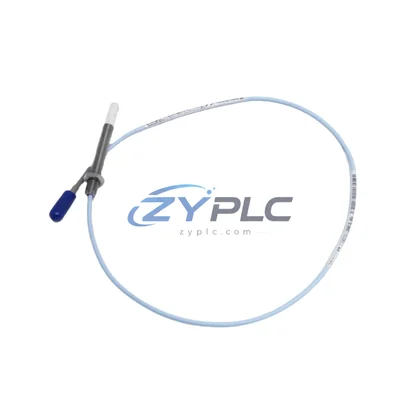
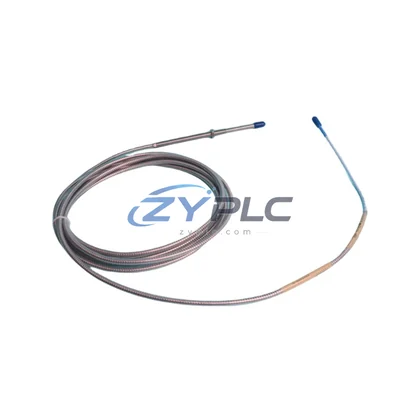
Bently Nevada 330901-00-15-70-02-05 Proximity Probe for 3300 NSv
In modern industrial automation and machinery protection systems, the integrity of the vibration monitoring layer is as critical as the control logic itself. The Bently Nevada 330901-00-15-70-02-05 is a precision eddy-current proximity probe engineered specifically for deployment within the Bently Nevada 3300 NSv Series machinery protection architecture. Rather than functioning as a standalone sensor, this probe is designed to operate as a tightly integrated component within a layered control system — connecting the mechanical execution layer directly to the signal conditioning, monitoring, and supervisory control layers above it.
The 330901-00-15-70-02-05 features a 5-meter (extension cable included) configuration with a standard 8mm probe tip diameter, optimized for radial shaft vibration measurement on rotating machinery. Its output signal is fully compatible with the 3300 NSv Proximitor® sensor (such as the 330180 series), which converts the raw eddy-current signal into a calibrated DC voltage proportional to the gap between the probe tip and the observed shaft surface. This signal chain forms the foundation of the vibration monitoring layer in any compliant machinery protection architecture.
Product Specification Table
| Parameter |
Specification |
| System Role |
Radial Vibration / Axial Position Sensor — Vibration Monitoring Layer |
| SKU / Part Number |
330901-00-15-70-02-05 |
| Brand / Series |
Bently Nevada / 3300 NSv |
| Probe Tip Diameter |
8 mm |
| Cable Length |
5 m (extension cable) |
| Measurement Range |
0.25 mm – 2.25 mm (linear range) |
| Output Signal |
–24 VDC nominal (via Proximitor® sensor) |
| Scale Factor |
7.87 V/mm (200 mV/mil) |
| Operating Temperature |
–35°C to +177°C (probe body) |
| Target Material |
AISI 4140 steel or equivalent ferromagnetic alloy |
| Communication / Integration |
Analog signal to 3300 NSv monitor rack; compatible with 3500 series via signal conditioning |
| Mounting Environment |
Bearing housing, turbine casing, compressor frame — industrial-grade IP67 equivalent |
| Compliance |
API 670 (Machinery Protection Systems) |
| Warranty |
warranty terms confirmed during quotation — covers manufacturing defects and signal calibration integrity |
System Compatibility Notes
The 330901-00-15-70-02-05 does not operate in isolation. Its value is realized only when it is correctly positioned within a complete machinery protection and process control architecture. In a typical turbomachinery or rotating equipment installation, this probe works in concert with multiple system layers:
At the signal conditioning layer, the probe pairs with the Bently Nevada 330180-X1-05 Proximitor® sensor, which provides the regulated –24 VDC power supply to the probe and converts the eddy-current impedance change into a calibrated voltage output. This output is then routed via shielded cable to the 3300 NSv monitor rack, where dedicated vibration monitor cards — such as the 3300/16 Dual Vibration Monitor — process the signal for alarm and trip logic.
At the control and protection layer, the processed vibration data is passed to the Bently Nevada 3500 Series Machinery Protection System rack, which integrates with the plant DCS or safety instrumented system (SIS). Here, the vibration readings from the 330901-00-15-70-02-05 contribute to the overall machine health picture alongside data from 3300/55 Temperature Monitors, 3500/42M Proximitor®/Seismic Monitor cards, and 3500/22M Transient Data Interface modules.
At the power supply layer, the system relies on redundant 3500/15 Power Supply modules to ensure uninterrupted sensor excitation. A loss of power to the Proximitor® sensor would result in a false trip condition, making power redundancy a non-negotiable architectural requirement when deploying the 330901-00-15-70-02-05 in critical machinery applications.
At the network and communication layer, the 3500 rack communicates with the plant historian and DCS via Modbus TCP or OPC-DA/UA protocols through the 3500/92 Communication Gateway module, enabling system integration of vibration data into the broader process control and asset management ecosystem. This system integration capability allows maintenance engineers to correlate vibration trends from the 330901-00-15-70-02-05 with process variables such as bearing temperature, lube oil pressure, and shaft speed — all within a unified supervisory environment.
At the human-machine interface layer, operators interact with the vibration data through System 1® Evolution software or third-party SCADA platforms, where the probe’s signal — after passing through the full signal chain — is displayed as a real-time vibration waveform, orbit plot, or trend graph. This end-to-end signal integrity, from the 330901-00-15-70-02-05 probe tip to the operator display, is what defines a properly architected machinery protection system.
Industrial Application Notes
The 330901-00-15-70-02-05 is deployed across a wide range of heavy industrial sectors where rotating machinery reliability is mission-critical:
Power Generation: In gas turbine and steam turbine installations, this probe monitors shaft radial vibration at journal bearings, providing early warning of rotor imbalance, misalignment, or bearing wear. Paired with the 3500 series protection rack, it enables automatic turbine trip before catastrophic failure occurs.
Oil & Gas / Petrochemical: Centrifugal compressors in LNG trains, ethylene crackers, and refinery charge pumps rely on API 670-compliant proximity probe systems. The 330901-00-15-70-02-05 meets these requirements and integrates directly into existing Bently Nevada infrastructure without requiring signal conditioning upgrades.
Mining & Metallurgy: Large ball mills, SAG mills, and crusher drives in mining operations generate significant vibration loads. The probe’s wide operating temperature range and robust construction make it suitable for the harsh environments typical of mineral processing facilities.
Water & Wastewater Treatment: High-speed pump and blower installations in water treatment plants benefit from continuous vibration monitoring to extend mean time between failures (MTBF) and reduce unplanned downtime. The 330901-00-15-70-02-05 provides the sensor foundation for predictive maintenance programs in these applications.
Pulp, Paper & Packaging: Paper machine rolls, dryer cans, and high-speed winders present unique vibration monitoring challenges. The probe’s 5-meter cable configuration provides installation flexibility in confined machine frames where direct rack mounting is not feasible.
Across all these applications, the 330901-00-15-70-02-05 contributes to system-level reliability by providing a stable, calibrated, and architecturally consistent vibration signal that feeds into the plant’s broader condition monitoring and predictive maintenance strategy. Its warranty terms confirmed during quotation ensures that replacement units meet the same calibration standards as the original installation, preserving system measurement integrity over the long term.
Product Compatibility FAQ
Q1: Is the 330901-00-15-70-02-05 compatible with the Bently Nevada 3500 Series rack, or is it limited to the 3300 NSv system?
The 330901-00-15-70-02-05 is natively designed for the 3300 NSv Proximitor® sensor ecosystem. However, it is fully compatible with the 3500 Series Machinery Protection System when used with the appropriate 3500/42M or 3500/40M monitor cards and a compatible Proximitor® sensor (such as the 330180 series). The probe’s –24 VDC excitation requirement and 7.87 V/mm scale factor are consistent across both platform generations, ensuring seamless system integration into existing 3500 series architectures without recalibration.
Q2: What are the installation and commissioning requirements for this probe in a redundant vibration monitoring architecture?
For redundant configurations — common in API 670 Class I applications — two probes are typically installed 90° apart (X and Y planes) at each monitored bearing location. Each probe requires its own dedicated Proximitor® sensor and monitor channel. During commissioning, the gap voltage must be set to –10.0 VDC ±0.5 VDC (corresponding to the midpoint of the linear range) using a non-ferromagnetic gap-setting tool. Cable routing must maintain physical separation from high-voltage power cables to prevent electromagnetic interference with the low-level analog signal. All connections should be verified against the 3300 NSv system wiring diagram before energizing the monitor rack.
Q3: What does the warranty terms confirmed during quotation cover, and how does it support long-term maintenance planning?
The warranty terms confirmed during quotation covers manufacturing defects, signal calibration drift beyond published specifications, and connector integrity failures under normal operating conditions. For maintenance planning purposes, this warranty period aligns with typical annual machinery inspection intervals in power generation and petrochemical facilities, allowing maintenance teams to schedule probe replacement or recertification as part of their planned outage activities. Warranty replacement units are supplied with calibration certificates traceable to national standards, ensuring that the replacement probe maintains the same measurement accuracy as the original — a critical requirement for systems where vibration alarm and trip setpoints are based on the original probe’s calibration data.