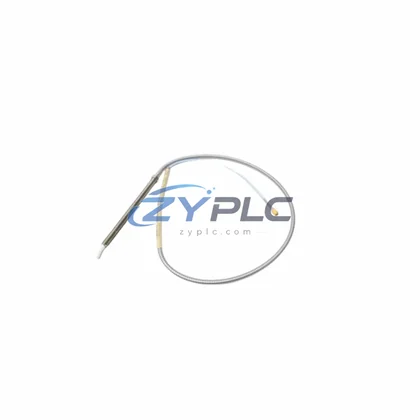
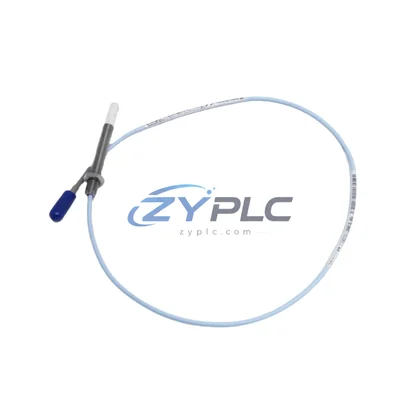
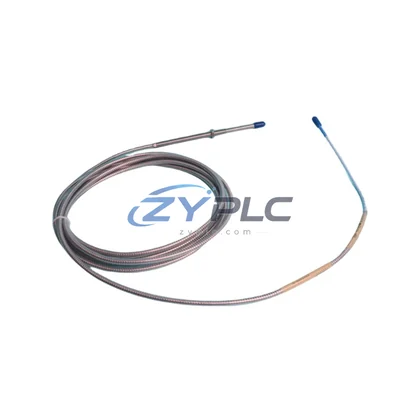
Bently Nevada 330902-00-95-05-02-00 Industrial Network Interface for 3300 NSV Systems
The Bently Nevada 330902-00-95-05-02-00 is a high-precision proximity probe engineered for the 3300 NSV Series vibration monitoring architecture — a platform that forms the industrial data backbone for rotating machinery protection in power generation, oil and gas, petrochemical, and heavy manufacturing environments. Far beyond a simple sensing element, this probe is the first link in a continuous data chain that connects raw shaft displacement signals to plant-wide SCADA systems, DCS networks, and predictive maintenance platforms. At ZYPLC, every unit is sourced from verified supply channels, fully tested prior to shipment, and backed by a warranty terms confirmed during quotation. Stock is available for shipment arranged after confirmation.
Compatibility & Integration Notes
| Parameter |
Specification |
| Model |
330902-00-95-05-02-00 |
| Full SKU |
330902-00-95-05-02-00 |
| Series |
3300 NSV (Non-Standard Voltage) |
| Brand |
Bently Nevada |
| Product Type |
Proximity Probe |
| Signal Output |
Eddy-current analog voltage signal (NSV output range) |
| Cable Length |
5 m (extension cable compatible) |
| Tip Diameter |
5 mm |
| Thread Size |
M8 x 1.0 |
| Protocol / Interface |
Analog signal interface; compatible with 3300 Series monitor inputs and Bently Nevada System 1 data acquisition |
| Network Compatibility |
Integrates with 3300 Series rack monitors, TDI Modbus gateways, and System 1 Condition Monitoring Software |
| System Application |
Shaft radial vibration, axial position, differential expansion, eccentricity monitoring |
| Origin |
USA |
| Warranty |
12 Months |
| Condition |
Tested, shipment arranged after confirmation |
Connected Automation Data Flow
In a modern rotating machinery protection system, the Bently Nevada 330902-00-95-05-02-00 proximity probe serves as the primary signal source at the field level. Mounted adjacent to the shaft of a turbine, compressor, or pump, it continuously measures radial displacement and transmits a calibrated analog voltage signal through a matched Bently Nevada 330130 extension cable to the signal conditioning stage. This cable-probe pairing is critical: mismatched cable lengths or impedance values will introduce measurement error that propagates through the entire monitoring chain, making correct SKU selection essential for data integrity.
The conditioned signal feeds directly into a Bently Nevada 3300 XL 8mm proximitor / oscillator, which converts the raw eddy-current output into a standardized voltage range readable by the rack monitor. From there, the signal enters a Bently Nevada 3500 Series rack monitor — the platform’s central processing node — where it is compared against alarm setpoints for radial vibration, gap voltage, and 1X/2X vector components. The 3500 rack communicates alarm states and live process values to the plant DCS via Modbus RTU or Modbus TCP gateway modules, enabling the distributed control system to incorporate vibration data into its process interlocks and shutdown logic without requiring a separate operator interface.
At the supervisory layer, the vibration data stream is received by Bently Nevada System 1 Condition Monitoring Software, which aggregates time-waveform, spectrum, and trend data from multiple 3500 racks across the plant. System 1 acts as the SCADA-equivalent for rotating equipment health, providing engineers with waterfall plots, orbit diagrams, and Bode plots that reveal developing faults weeks before they reach alarm thresholds. The software communicates with the 3500 racks over industrial Ethernet using the TDI (Transient Data Interface) protocol, and can forward summarized health indices to plant-level SCADA platforms via OPC-DA or OPC-UA interfaces.
For facilities running Emerson DeltaV DCS or Honeywell Experion PKS, the 3500 rack’s serial or Ethernet gateway outputs allow vibration alarm states to appear directly on the DCS operator console alongside process variables such as bearing temperature, lube oil pressure, and steam flow — giving control room operators a unified view of both process and machinery health without switching between systems. In plants where legacy Bently Nevada 3300 Series monitors are still in service alongside newer 3500 racks, the 330902-00-95-05-02-00 probe is fully backward-compatible, allowing phased upgrades without replacing field-mounted sensors.
Remote diagnostic capability is further extended through Bently Nevada TDIXnet communication interfaces, which allow System 1 to collect data from geographically distributed machinery trains — offshore platforms, pipeline compressor stations, or multi-site power generation fleets — over WAN connections. This architecture transforms the proximity probe from a local sensing element into a node in a plant-wide industrial IoT network, where every shaft displacement reading contributes to fleet-level reliability analytics and maintenance scheduling.
Solving Data Isolation in Industrial Sites
One of the most persistent challenges in rotating machinery monitoring is the fragmentation of vibration data from the rest of the plant’s information infrastructure. In many facilities, the machinery protection system operates as a standalone island: alarms are displayed on a dedicated monitor panel, but the data never reaches the DCS historian, the CMMS work order system, or the enterprise asset management platform. The result is that maintenance teams respond to vibration alarms reactively, without the process context — load, temperature, flow rate — needed to diagnose root causes efficiently.
The 330902-00-95-05-02-00 probe, as the field-level input to the Bently Nevada 3300/3500 architecture, is the starting point for breaking down this data isolation. When properly integrated through the 3500 rack’s Modbus or OPC gateway, vibration data becomes available to the plant historian alongside process variables, enabling correlation analysis that identifies whether a vibration event is driven by process upsets, mechanical wear, or operational changes such as load swings or startup transients.
For plants operating under API 670 machinery protection standards, the 330902-00-95-05-02-00’s NSV output characteristic ensures compliance with the non-standard voltage specification required by certain turbine OEM acceptance criteria. This eliminates the need for signal conditioning adapters that would otherwise introduce additional failure points in the measurement chain and complicate the calibration audit trail.
Protocol unification is addressed at the rack level: the 3500 monitor’s configurable communication ports support simultaneous Modbus RTU output to the DCS and Ethernet TDI output to System 1, meaning a single probe installation feeds both the real-time protection system and the long-term condition monitoring database without duplicating hardware. As the plant expands — adding new machinery trains or upgrading to wireless sensor networks for auxiliary equipment — the existing 3300/3500 infrastructure scales by adding rack slots and communication modules rather than replacing the field sensor layer, protecting the capital investment in correctly specified proximity probes like the 330902-00-95-05-02-00.
Industrial Connectivity FAQ
Q1: What communication protocols does the 3300 NSV system support, and how does the 330902-00-95-05-02-00 probe integrate with SCADA or DCS platforms?
The Bently Nevada 3300/3500 architecture supports Modbus RTU, Modbus TCP, and OPC-DA/UA communication through its rack monitor gateway modules. The 330902-00-95-05-02-00 probe feeds its analog signal into the rack, which then makes vibration data available to DCS platforms such as Emerson DeltaV or Honeywell Experion, as well as to SCADA historians, via these standard industrial protocols. No additional signal converters are required in a correctly configured 3500 rack installation.
Q2: How does the NSV (Non-Standard Voltage) output specification affect network compatibility and system integration?
The NSV output range differs from the standard Bently Nevada voltage output and is specified by certain turbine OEMs for compliance with API 670 acceptance criteria. When integrating with a 3500 rack monitor, the monitor’s channel configuration must be set to match the NSV scale factor to ensure accurate engineering unit conversion. ZYPLC’s technical team can advise on the correct monitor configuration parameters for the 330902-00-95-05-02-00 to ensure data accuracy at the SCADA and historian level.
Q3: Can the 330902-00-95-05-02-00 be used in a remote monitoring architecture for geographically distributed machinery?
Yes. When connected to a 3500 rack equipped with a TDIXnet or Ethernet communication module, the probe’s data stream can be accessed by Bently Nevada System 1 software over WAN connections, enabling centralized monitoring of distributed machinery trains from a single engineering workstation. This architecture is commonly used in pipeline compressor stations, offshore platforms, and multi-site power generation fleets where on-site vibration expertise is not continuously available.
Q4: What pre-shipment testing does ZYPLC perform, and what does the warranty terms confirmed during quotation cover?
Every 330902-00-95-05-02-00 unit supplied by ZYPLC undergoes functional testing that validates gap voltage output, sensitivity linearity, and cable continuity prior to shipment. The warranty terms confirmed during quotation covers manufacturing defects and component failures under normal operating conditions. Warranty claims are handled through ZYPLC’s technical support team, with replacement units dispatched from available stock to minimize machinery downtime. Units are available for shipment arranged after confirmation from current inventory.