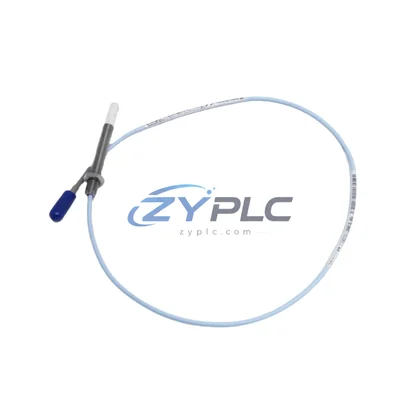
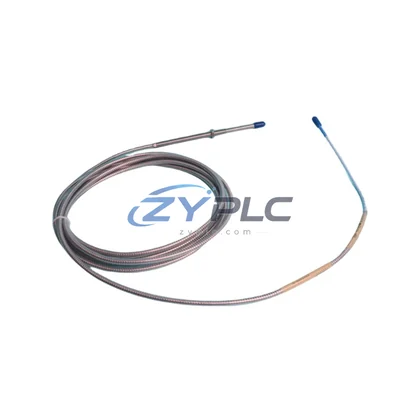
Bently Nevada 330903-00-16-10-02-05/CN Proximity Probe for 3300 NSV
The Bently Nevada 330903-00-16-10-02-05/CN is an eddy-current proximity probe engineered for seamless integration within the 3300 NSV Series vibration monitoring architecture. Designed to deliver continuous, high-resolution shaft displacement and vibration data, this probe serves as the primary sensing element in a layered industrial automation system — connecting the mechanical execution layer directly to the signal conditioning, processing, and supervisory control layers above it. Its role is not simply to measure; it is to anchor the entire condition monitoring chain with precision, reliability, and long-term architectural consistency.
In modern industrial control environments — spanning power generation, petrochemical processing, water treatment, mining, metallurgy, and rotating machinery applications — the integrity of vibration data at the field level determines the quality of every decision made at the control and enterprise layers. The 330903-00-16-10-02-05/CN is built to meet this responsibility. With a 16 mm probe body, a 10-foot (3 m) extension cable, and a 2-meter armored driver cable, this assembly is optimized for installation in confined bearing housings and high-temperature turbomachinery environments where signal fidelity and mechanical durability are equally critical.
Within the 3300 NSV system architecture, this probe operates in conjunction with the 3300 XL 8mm Extension Cable, the 3300 NSV Proximitor Sensor (such as the 330180-X1-05 series), and the 3300/16 Dual Voting Trip Module to form a complete vibration channel. The Proximitor converts the probe’s raw eddy-current signal into a calibrated voltage output — typically –24 VDC at gap — which is then routed to the 3500/42M Proximitor/Seismic Monitor for digital processing, alarm management, and relay output. This signal flow ensures that shaft radial vibration, axial position, and differential expansion data are available simultaneously to the protection system and the distributed control system (DCS) via the 3500 System Rack backplane.
At the network and communication layer, the 3500 rack interfaces with plant-level SCADA and DCS platforms — including systems built on Modbus RTU, Modbus TCP/IP, or OPC-DA/UA protocols — through dedicated communication gateway modules such as the 3500/92 Communication Gateway. This system integration capability allows the 330903-00-16-10-02-05/CN’s measurement data to be consumed by higher-level control logic, historian databases, and predictive maintenance platforms without signal degradation or protocol conversion loss. The result is a fully traceable data path from the probe tip to the enterprise asset management layer.
For redundant protection architectures — common in critical turbine, compressor, and pump applications — the 330903-00-16-10-02-05/CN can be deployed in dual-channel or triple-redundant configurations alongside a second probe channel and the 3300/55 Proximitor Sensor or 3500/40M Proximitor/Seismic Monitor. Redundant probe channels feed independent voting logic within the trip module, ensuring that a single sensor failure does not result in a spurious trip or, conversely, a missed protective action. This architecture is particularly valued in API 670-compliant installations where continuous availability and fail-safe behavior are mandatory.
At the power supply layer, the 3300 NSV system is typically powered by the 3500/15 Power Supply Module, which provides regulated, isolated DC power to all monitor modules and Proximitor sensors in the rack. Stable power delivery is essential for maintaining the –24 VDC bias voltage required by the eddy-current probe circuit. Any fluctuation in supply voltage directly affects the probe’s linear measurement range and gap calibration, making power layer integrity a prerequisite for accurate vibration monitoring.
From an engineering and commissioning perspective, the 330903-00-16-10-02-05/CN is factory-calibrated and supplied as a matched probe-cable-driver assembly, eliminating the need for field calibration of individual components. Installation requires only gap setting verification using a digital voltmeter and the published gap voltage table for the 3300 NSV system. This reduces commissioning time, minimizes human error, and ensures that the probe channel is ready for integration testing with the monitor rack and DCS within a single maintenance window.
Long-term maintenance efficiency is further supported by the probe’s robust construction — stainless steel probe body, armored cable jacket, and high-temperature-rated connector — which minimizes scheduled replacement intervals even in harsh environments. Combined with our warranty terms confirmed during quotation covering manufacturing defects and performance specification compliance, this assembly provides a predictable total cost of ownership for asset-intensive industries where unplanned downtime carries significant financial and safety consequences.
Product Specification Table
| System Role |
Primary vibration sensing element, 3300 NSV eddy-current channel |
| SKU / Part Number |
330903-00-16-10-02-05/CN |
| Brand / Manufacturer |
Bently Nevada (Baker Hughes) |
| Series |
3300 NSV (Non-Standard Voltage) Proximity System |
| Probe Body Diameter |
8 mm (standard eddy-current tip) |
| Extension Cable Length |
10 ft (3.05 m) |
| Driver Cable Length |
2 m (armored) |
| Measurement Range |
0.25 mm – 2.25 mm (linear range, gap-dependent) |
| Output Signal |
–24 VDC nominal bias; analog voltage proportional to gap |
| Operating Temperature |
–35°C to +177°C (probe); –35°C to +85°C (driver) |
| Communication Compatibility |
Analog output to 3500 monitor rack; Modbus/OPC via 3500/92 gateway |
| Compliance |
API 670, CE, RoHS |
| Installation Environment |
Turbomachinery bearing housings, compressors, pumps, generators |
| Warranty |
warranty terms confirmed during quotation — manufacturing defects and performance specification |
| Origin |
United States |
System Compatibility Notes
The 330903-00-16-10-02-05/CN achieves its full architectural value when deployed as part of a coordinated system rather than as a standalone sensor. In a typical 3500 Series protection rack, this probe feeds one channel of the 3500/42M Proximitor/Seismic Monitor, which processes up to four vibration channels simultaneously. Adjacent channels may monitor axial position using the 330130-080-00-00 Proximity Probe or differential expansion using a dedicated thrust position probe, all sharing the same rack backplane and power infrastructure.
The 3300 NSV Proximitor Sensor (330180-X1-05) conditions the probe signal before it reaches the monitor module, providing the regulated oscillator drive and demodulation circuitry that converts gap distance into a clean DC voltage. This separation of probe and driver electronics allows the probe to be located deep within the machine casing while the driver remains in a more accessible, lower-temperature zone — a critical design advantage in high-temperature steam turbine and gas turbine applications.
At the I/O and relay layer, the 3500/32M 4-Channel Relay Module translates monitor alarm and danger setpoints into hardwired relay outputs for turbine trip solenoids, shutdown logic controllers, and annunciator panels. These relay outputs are typically wired in series with the machine’s emergency shutdown (ESD) system, ensuring that the vibration protection channel participates directly in the plant’s safety instrumented system (SIS) architecture.
For human-machine interface integration, vibration trend data from the 3500 rack is typically displayed on operator workstations running System 1 Evolution software, Bently Nevada’s condition monitoring and diagnostics platform. System 1 aggregates data from multiple 3500 racks across the plant, enabling fleet-wide vibration trending, alarm rationalization, and predictive maintenance scheduling — all driven by the raw measurement data originating at the 330903-00-16-10-02-05/CN probe tip.
In installations requiring fieldbus integration, the 3500/92 Communication Gateway bridges the 3500 rack’s internal data bus to plant Modbus TCP/IP or OPC-UA networks, allowing DCS platforms such as Emerson DeltaV, Honeywell Experion, or ABB 800xA to consume vibration data as process variables. This system integration approach eliminates the need for separate vibration monitoring workstations and consolidates alarm management within the plant’s unified control environment.
Industrial Application Notes
In power generation applications — including steam turbines, gas turbines, and hydro generators — the 330903-00-16-10-02-05/CN is installed at each radial bearing location to monitor shaft vibration in compliance with API 670 and ISO 7919 standards. The probe’s high-frequency response (DC to 10 kHz) captures both synchronous (1X) and subsynchronous vibration components, enabling early detection of rotor imbalance, misalignment, oil whirl, and rub conditions before they escalate to forced outages.
In petrochemical and refinery environments, this probe is commonly deployed on centrifugal compressors, reactor agitators, and boiler feed pumps — all classified as critical rotating machinery under API 670. The armored cable construction and high-temperature probe rating make it suitable for installation in hazardous area zones (ATEX/IECEx Zone 1 and Zone 2) when paired with appropriate intrinsically safe barriers or Zener barriers in the signal circuit.
In water treatment and municipal utility plants, the 330903-00-16-10-02-05/CN supports condition monitoring of large vertical turbine pumps and centrifugal blowers, where bearing access is limited and continuous online monitoring is preferred over periodic manual measurement. The probe’s non-contact measurement principle eliminates wear and eliminates the need for periodic sensor replacement due to mechanical contact fatigue.
In mining and mineral processing applications — including SAG mills, ball mills, and large slurry pumps — the probe’s robust construction and wide operating temperature range support reliable operation in dusty, high-vibration environments where conventional contact sensors would fail prematurely. Integration with the plant’s DCS via the 3500/92 gateway allows mill vibration data to be correlated with process variables such as feed rate, mill load, and motor current for advanced process optimization.
Product Compatibility FAQ
Q1: Is the 330903-00-16-10-02-05/CN compatible with existing 3500 Series monitor racks, and does it require recalibration when replacing an older probe assembly?
A: Yes. The 330903-00-16-10-02-05/CN is a factory-matched assembly calibrated to the 3300 NSV system’s –24 VDC scale factor (200 mV/mil or 7.87 V/mm). When replacing an existing probe in a 3500 rack, no recalibration of the monitor module is required provided the replacement assembly uses the same probe-cable-driver combination and the gap is reset to the original commissioned value. Gap verification using a digital voltmeter and the published gap voltage table is the only field adjustment required, making like-for-like replacement a straightforward maintenance task.
Q2: Can this probe be used in a redundant dual-channel vibration architecture, and how does the 3500 rack handle channel voting for trip logic?
A: Yes. In API 670-compliant redundant architectures, two 330903-00-16-10-02-05/CN probes are installed 90° apart at the same bearing location (X and Y planes) and connected to separate channels of the 3500/42M monitor. The monitor’s internal voting logic — configurable as 1-of-2, 2-of-2, or 2-of-3 depending on the application’s availability and safety requirements — determines the trip output behavior. This configuration ensures that a single probe failure or cable fault does not cause a spurious machine trip, while still providing full protection against genuine vibration exceedances. The 3500/32M relay module then executes the hardwired trip output based on the voted result.
Q3: What does the warranty terms confirmed during quotation cover, and what is the process for warranty claims or technical support?
A: The warranty terms confirmed during quotation covers manufacturing defects, materials failures, and non-conformance to published performance specifications under normal operating conditions. It does not cover damage resulting from improper installation, mechanical impact, chemical exposure beyond rated limits, or operation outside the specified temperature and voltage ranges. To initiate a warranty claim or request technical support for system integration, commissioning, or architecture compatibility questions, contact ZYPLC directly at +86 19859288691 or plc.sales@zyplc.com. Our engineering team provides pre-sales architecture consultation and post-sales commissioning support to ensure the probe assembly performs as specified within your control system environment.