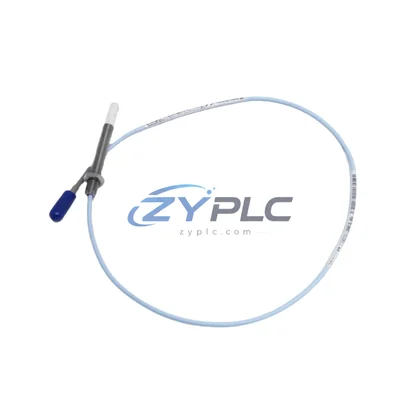
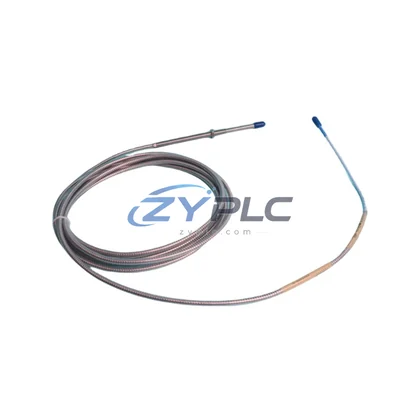
Bently Nevada 330904-00-07-05-02-00 Proximity Probe for 3300 NSV
The Bently Nevada 330904-00-07-05-02-00 is a precision eddy-current proximity probe engineered as a core sensing element within the 3300 NSV (Non-contact Vibration) monitoring architecture. In modern industrial control systems, reliable vibration measurement is not an isolated function — it is the foundation upon which layered automation decisions are made. This probe is designed to integrate seamlessly across the control layer, I/O layer, signal conditioning layer, and communication layer, ensuring that every upstream and downstream component operates with consistent, high-fidelity data.
Within a complete machinery protection system, the 330904-00-07-05-02-00 works in direct coordination with the Bently Nevada 3300 XL 8mm Extension Cable, the 3300 XL Proximitor Sensor (such as the 330180-91-00), and the 3300 16-Channel Monitor to form a fully validated measurement chain. The probe’s 5mm tip diameter and 7.87-inch (200mm) cable length are optimized for tight-clearance installations on rotating machinery shafts, making it a preferred choice for turbine, compressor, pump, and motor monitoring applications where radial vibration and axial position data are critical to system integrity.
From a system architecture perspective, the 330904-00-07-05-02-00 feeds conditioned displacement signals into the 3300 rack-based monitoring platform, which in turn communicates with the plant DCS or safety instrumented system (SIS) via hardwired relay outputs or Modbus/TCP gateways. This signal flow — from mechanical motion at the shaft, through the probe and Proximitor, into the monitor rack, and ultimately to the control room HMI — represents the complete vibration monitoring loop that underpins predictive maintenance and machinery protection strategies in critical process industries.
Product Specification Table
| Parameter |
Specification |
| System Role |
Eddy-Current Proximity Probe — Primary Sensing Element |
| Compatible Architecture |
Bently Nevada 3300 NSV Monitoring System |
| Probe Tip Diameter |
5 mm (0.197 in) |
| Cable Length |
200 mm (7.87 in) |
| Nominal Gap Voltage |
−10 VDC (at 1.27 mm / 50 mil gap) |
| Sensitivity |
7.87 V/mm (200 mV/mil) |
| Linear Range |
0.25 mm to 2.54 mm (10 to 100 mil) |
| Frequency Response |
DC to 10,000 Hz |
| Operating Temperature |
−35°C to +177°C (−31°F to +350°F) |
| Target Material |
AISI 4140 Steel (standard); other alloys with calibration |
| Communication / Output |
Analog voltage signal to Proximitor / Monitor |
| Connector Type |
Integral coaxial cable with standard BNC-compatible termination |
| Installation Environment |
Turbines, compressors, pumps, motors — radial and axial positions |
| Approvals |
CE, CSA, ATEX (zone-dependent configuration) |
| Warranty |
warranty terms confirmed during quotation — covers manufacturing defects and functional performance |
System Compatibility Notes
The 330904-00-07-05-02-00 proximity probe does not operate in isolation. Its value is fully realized when it is deployed as part of a coordinated, multi-layer control architecture. In a typical machinery protection system built on the Bently Nevada 3300 platform, the probe is paired with the 3300 XL Proximitor Sensor (330180-91-00) — the signal conditioning module that supplies the probe’s oscillator drive voltage and converts the raw eddy-current signal into a calibrated DC voltage proportional to shaft displacement.
This conditioned signal is then routed to the Bently Nevada 3300/16 Monitor or the 3300/20 Monitor, which provides channel-level alarm management, OK relay outputs, and buffered output signals for further analysis. The monitor rack is housed in a 3300 Rack (3300/05 or 3300/10), which provides the structural backbone and internal power distribution for all installed monitor cards. Power to the rack is supplied by a dedicated 3300 Power Supply Module, often configured in a redundant 1+1 arrangement to eliminate single-point power failures in critical applications.
For plants requiring integration with a distributed control system, the Bently Nevada System 1 Software or a Modbus/TCP Communication Gateway bridges the 3300 monitoring platform to the plant DCS or SCADA layer, enabling real-time vibration trend data to be displayed on operator HMI screens alongside process variables such as temperature, pressure, and flow. In facilities using Rockwell Automation ControlLogix or Siemens S7-400 as the primary PLC platform, the 3300 system’s relay outputs are hardwired to the PLC’s digital input modules, providing direct machinery trip signals that can initiate automated shutdown sequences.
At the field level, the probe cable is routed through armored conduit or flexible stainless-steel tubing to protect against mechanical damage and electromagnetic interference, ensuring signal integrity from the probe tip to the Proximitor input. Terminal blocks and junction boxes — such as those from the Bently Nevada 3300 Field Wiring Accessory Kit — provide organized, labeled termination points that simplify commissioning and long-term maintenance. This complete, coordinated system design ensures that the 330904-00-07-05-02-00 delivers consistent, reliable vibration data across the full lifecycle of the monitored machine.
Industrial Application Notes
The 330904-00-07-05-02-00 proximity probe is deployed across a wide range of critical industries where rotating machinery reliability is directly linked to production continuity and safety compliance.
In power generation facilities — including gas turbines, steam turbines, and hydro generators — the probe monitors shaft radial vibration and axial position in real time, providing the early warning data needed to prevent catastrophic bearing failures and unplanned outages. Utilities operating under NERC reliability standards rely on Bently Nevada 3300 NSV systems to meet mandatory machinery protection requirements.
In petrochemical and refining plants, the probe is installed on centrifugal compressors, reactor feed pumps, and cooling water pumps operating in hazardous area classifications. Its ATEX-compatible configuration allows deployment in Zone 1 and Zone 2 environments, where conventional contact sensors are prohibited. The probe’s wide operating temperature range makes it suitable for high-temperature process environments where ambient conditions regularly exceed 100°C.
In water and wastewater treatment facilities, the probe monitors large vertical turbine pumps and blower units, where vibration trending is used to schedule predictive maintenance intervals and avoid emergency repair costs. The probe’s DC-to-10,000 Hz frequency response captures both low-speed imbalance signatures and high-frequency bearing defect frequencies in a single measurement channel.
In mining and mineral processing operations, the probe is applied to SAG mill pinion bearings, crusher drives, and slurry pump shafts, where harsh environmental conditions demand robust, sealed sensor assemblies. The 330904-00-07-05-02-00’s stainless-steel housing and integral cable construction provide the mechanical durability required for continuous operation in dusty, wet, and vibration-intensive environments.
Across all these applications, the probe’s role within the layered automation system remains consistent: it provides the foundational measurement data that enables the control layer to make informed, timely decisions — whether that means issuing an alarm, initiating a controlled shutdown, or logging a trend for engineering review.
Product Compatibility FAQ
Q1: Is the 330904-00-07-05-02-00 compatible with both the 3300 NSV and the 3500 Series monitoring platforms?
The 330904-00-07-05-02-00 is specifically calibrated and validated for use within the Bently Nevada 3300 NSV architecture, paired with the 3300 XL Proximitor Sensor. While the probe’s eddy-current operating principle is shared with 3500 Series probes, the calibration coefficients, cable lengths, and Proximitor driver circuits differ between platforms. For 3500 Series applications, the corresponding 3500 Series probe and Proximitor assembly should be selected to ensure system-level accuracy and warranty compliance. Our technical team can assist with cross-platform compatibility assessments and provide validated replacement recommendations for your specific rack configuration.
Q2: What installation and commissioning steps are required to ensure accurate vibration measurement after replacing this probe?
After mechanical installation, the probe gap must be set to the nominal 1.27 mm (50 mil) target gap using a calibrated gap-setting tool, with the output voltage verified at −10 VDC ±0.5 VDC using a precision voltmeter. The Proximitor OK LED should illuminate, confirming that the probe-cable-Proximitor chain is within the linear measurement range. The monitor channel should then be verified for correct engineering unit scaling (mils or microns peak-to-peak) and alarm setpoints confirmed against the OEM machinery protection specification. A baseline vibration spectrum should be recorded at normal operating speed and load conditions to establish the reference trend for future predictive maintenance comparisons. All commissioning data should be documented in the plant’s machinery history records for long-term maintenance traceability.
Q3: What does the warranty terms confirmed during quotation cover, and how does it support long-term system maintenance planning?
The warranty terms confirmed during quotation covers manufacturing defects, material failures, and functional performance deviations from the published specification under normal operating conditions. It does not cover damage resulting from improper installation, mechanical impact, chemical exposure beyond the rated limits, or operation outside the specified temperature and gap range. For maintenance planning purposes, the warranty period provides a defined baseline for initial system commissioning confidence, allowing engineering teams to schedule the first predictive maintenance inspection and probe condition assessment at the 12-month mark. Stocking a spare 330904-00-07-05-02-00 probe as part of the plant’s critical spare parts inventory is recommended to minimize mean time to repair (MTTR) in the event of probe failure during the warranty or post-warranty period.