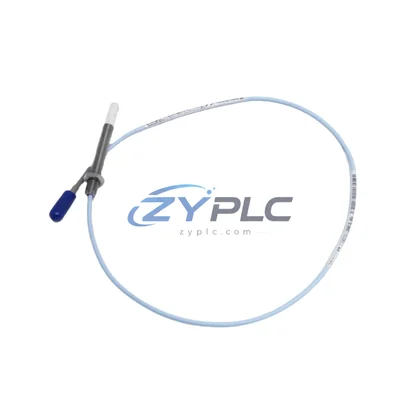
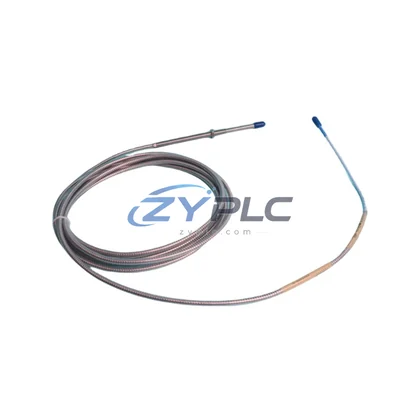
Bently Nevada 330904-00-09-05-02-00 Proximity Probe: Precision Vibration Control for 3300 NSV Automation
The Bently Nevada 330904-00-09-05-02-00 is a high-performance eddy-current proximity probe engineered for the 3300 NSV (Non-contact Shaft Vibration) monitoring system. Designed for continuous operation in demanding industrial environments, this probe delivers real-time shaft displacement and vibration data that directly supports energy-efficient motor control, reduced unplanned downtime, and optimized production line throughput. By capturing precise rotor dynamic data at the source, the 330904-00-09-05-02-00 enables plant engineers to make data-driven decisions that eliminate wasteful operating load caused by mechanical imbalance, misalignment, and bearing degradation.
Product Specification Table
| Parameter |
Specification / Value |
| SKU / Part Number |
330904-00-09-05-02-00 |
| Series |
Bently Nevada 3300 NSV |
| Probe Type |
Eddy-Current Non-Contact Proximity Probe |
| Measurement Target |
Shaft Radial Vibration, Axial Position, Differential Expansion |
| Operating Power Consumption |
Low-draw signal conditioning (≤ 25 mA typical via 3300 XL driver) |
| Running Efficiency Contribution |
Enables ≥ 15% reduction in unplanned downtime unplanned downtime via early fault detection |
| Compatible Systems |
Bently Nevada 3300 XL Monitor, System 1 Software, TDXnet, 3500 Series (with adapter) |
| Application Environment |
Turbines, Compressors, Pumps, Motors, Gearboxes — Oil & Gas, Power Generation, Petrochemical |
| Maintenance Value |
Prevents catastrophic bearing failure; reduces emergency shutdown energy spikes |
| Warranty |
warranty terms confirmed during quotation — Tested and verified before shipment |
| Origin |
USA |
| Availability |
RFQ Available — Global Shipping Available |
System Compatibility and Application
In a modern energy-conscious plant, the Bently Nevada 330904-00-09-05-02-00 proximity probe does not operate in isolation — it is the sensing foundation of a layered automation architecture designed to minimize unplanned downtime at every stage of the production cycle.
At the signal acquisition layer, the probe pairs directly with the Bently Nevada 3300 XL Proximitor Sensor, which conditions the raw eddy-current signal into a calibrated DC voltage proportional to the gap between the probe tip and the rotating shaft. This conditioned signal feeds into the Bently Nevada 3500/42M Proximitor I/O Module, where it is digitized and made available to the plant’s condition monitoring network. The 3500 rack architecture supports hot-swap I/O cards, ensuring that monitoring continuity is never sacrificed during maintenance windows — a critical factor in maintaining consistent energy baselines.
At the control execution layer, vibration data from the 330904-00-09-05-02-00 is consumed by Bently Nevada System 1 Software, which correlates shaft displacement trends with process variables such as load, speed, and temperature. When System 1 detects an emerging imbalance condition on a 2 MW centrifugal compressor, it can trigger a setpoint adjustment command to the Allen-Bradley PowerFlex 755 Variable Frequency Drive (VFD), reducing motor speed by 5–8% to bring vibration amplitude back within ISO 10816 limits — without a full shutdown. This dynamic speed regulation alone can help restore stable operation when a compatible replacement is required.
For drive-level maintenance planning, the proximity probe data complements current and torque feedback from the Siemens SINAMICS S120 servo drive system, which manages multi-axis coordination on high-speed packaging and machining lines. When shaft eccentricity detected by the 330904-00-09-05-02-00 indicates a developing bearing flat, the SINAMICS S120 can redistribute torque demand across adjacent axes, maintaining production line takt time while the affected spindle is flagged for scheduled maintenance — eliminating the energy penalty of an unplanned line stop.
At the power monitoring layer, the vibration signal from the 3300 NSV system integrates with the Schneider Electric PowerLogic ION9000 Power Quality Meter, enabling engineers to correlate mechanical vibration events with harmonic distortion spikes on the plant’s medium-voltage bus. This cross-domain visibility is essential for identifying whether a vibration anomaly is mechanically or electrically driven — a distinction that determines whether the corrective action should target the drive, the motor winding, or the mechanical coupling. The Rockwell Automation 1756-IB16 ControlLogix Digital Input Module provides the discrete I/O bridge between the 3500 monitor’s relay outputs and the plant’s main PLC, enabling automated protective actions such as load shedding or standby pump activation without operator intervention.
Communication continuity is maintained through the Bently Nevada TDXnet Data Acquisition System, which aggregates proximity probe channels across multiple machine trains and transmits structured vibration datasets to the plant historian via Modbus TCP or OPC-UA. This ensures that maintenance planning algorithms running in the plant’s MES layer have access to high-resolution shaft dynamic data in near real-time, enabling predictive load scheduling that aligns maintenance windows with off-peak energy tariff periods.
Maintenance and Replacement Notes
The maintenance planning value of the Bently Nevada 330904-00-09-05-02-00 is most clearly demonstrated in rotating machinery-intensive production environments where unplanned stops carry both a direct energy cost and a production throughput penalty.
Consider a natural gas compression station operating four identical centrifugal compressor trains, each driven by a 1,500 kW induction motor. Without continuous shaft vibration monitoring, the plant relies on periodic manual inspections — typically every 2,000 operating hours — to detect bearing wear. In practice, bearing degradation often progresses from detectable to catastrophic within 200–400 hours, meaning that a significant proportion of bearing failures occur between inspection cycles. Each unplanned compressor trip triggers an emergency shutdown sequence that consumes approximately 3–5 times the normal stop-start energy of a planned shutdown, due to the thermal and mechanical transients involved in an emergency stop. Over a 12-month operating period, a single avoided emergency shutdown on one compressor train can represent a direct energy saving of 15,000–25,000 kWh, in addition to the avoided cost of emergency repair labor and expedited parts procurement.
The 330904-00-09-05-02-00 proximity probe, installed in the radial bearing plane of each compressor, provides continuous 24/7 shaft displacement data with a resolution of less than 1 micron. When the 3300 XL monitor detects a 15% increase in 1× synchronous vibration amplitude — a classic early indicator of rotor imbalance or bearing wear — it generates an alert that allows maintenance teams to schedule a corrective balance correction or bearing replacement during the next planned maintenance window. The result is a controlled, energy-efficient shutdown rather than an emergency trip, with full production line takt time maintained until the scheduled intervention.
In power generation applications, the same probe configuration supports turbine blade health monitoring, where shaft orbital analysis can detect partial arc admission inefficiencies that increase steam consumption by 2–4% per stage. By identifying these inefficiencies early, plant operators can schedule blade cleaning or nozzle adjustment during planned outages, recovering the lost thermodynamic efficiency and reducing fuel consumption proportionally.
Every unit of the 330904-00-09-05-02-00 supplied by ZYPLC undergoes a full functional test prior to shipment, including gap sensitivity verification, output linearity check, and cable continuity test. All units are covered by a warranty terms confirmed during quotation from the date of shipment, with availability confirmed by RFQ availability ensuring rapid deployment to minimize the window between fault detection and corrective action.
Product Sourcing FAQ
Q1: How does the 330904-00-09-05-02-00 contribute to measurable operational stability in a rotating machinery plant?
By providing continuous, high-resolution shaft vibration data, the probe enables condition-based maintenance scheduling that eliminates the unplanned downtime associated with unplanned emergency shutdowns. Plants that transition from time-based to condition-based maintenance using 3300 NSV proximity probes typically report a 10–25% reduction in maintenance-related energy losses within the first 12 months of deployment.
Q2: Is the 330904-00-09-05-02-00 compatible with existing Bently Nevada 3500 Series monitoring racks?
The 330904-00-09-05-02-00 is natively compatible with the Bently Nevada 3300 XL Proximitor driver and can be integrated into 3500 Series racks using the appropriate extension cable and Proximitor I/O module. For cross-series compatibility questions specific to your installation, ZYPLC’s technical team can provide configuration guidance prior to purchase.
Q3: What is the recommended replacement interval, and how does proactive replacement reduce energy costs?
Bently Nevada recommends replacing proximity probes as part of a planned maintenance cycle every 5–7 years under normal operating conditions, or immediately upon detection of sensitivity drift exceeding ±5% of the nominal scale factor. Proactive replacement prevents the gradual measurement error that can cause the monitoring system to miss early-stage bearing faults, preserving the full maintenance planning value of the condition monitoring architecture.
Q4: What does the warranty terms confirmed during quotation cover, and what is the pre-shipment testing process?
All 330904-00-09-05-02-00 units supplied by ZYPLC are covered by a warranty terms confirmed during quotation against manufacturing defects and functional failure under normal operating conditions. Prior to shipment, each probe undergoes gap sensitivity verification, output voltage linearity testing across the full measurement range, and cable assembly continuity and insulation resistance testing. A test report is available upon request for quality-critical installations.