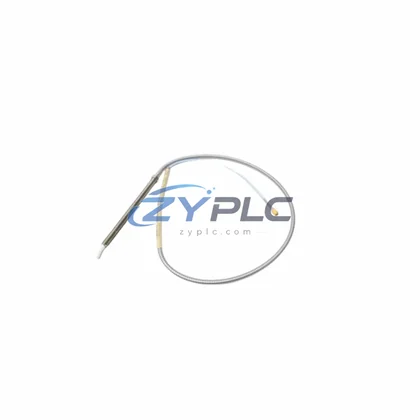
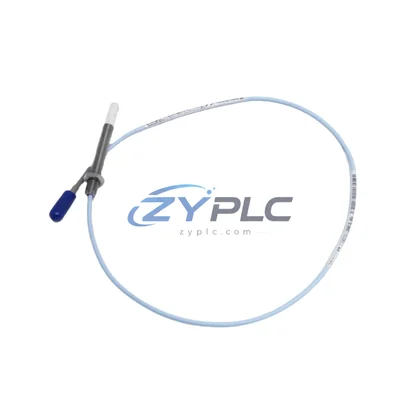
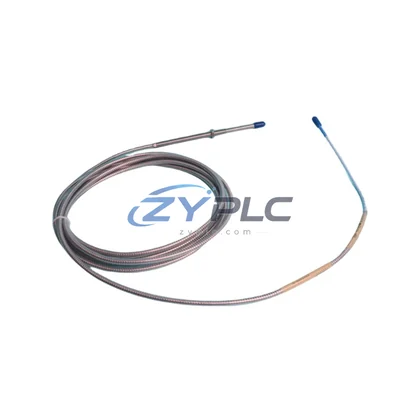
Bently Nevada 330906-02-12-70-02-05 Proximity Probe for 3300 XL
The Bently Nevada 330906-02-12-70-02-05 is a precision eddy-current proximity probe engineered for seamless integration within the 3300 XL Series machinery protection architecture. Designed to deliver continuous, high-resolution shaft displacement and vibration data, this probe serves as the primary sensing element in a layered control system that spans from field-level signal acquisition through to plant-wide SCADA and condition monitoring platforms. Whether deployed in turbomachinery, compressors, pumps, or rotating equipment in power generation, petrochemical, or heavy industrial environments, the 330906-02-12-70-02-05 provides the foundational measurement accuracy that the entire protection chain depends upon.
In a complete 3300 XL system architecture, the proximity probe does not operate in isolation. It functions as the upstream sensing node that feeds calibrated displacement signals into the 3300 XL 8mm Extension Cable and the matched Proximitor® sensor — typically the 3300 XL 8mm Proximitor® Sensor — which conditions the raw eddy-current signal into a usable voltage output. This conditioned signal is then routed to the 3300 XL Monitoring System rack, where dedicated monitor modules such as the 3300/25 Dual Voting Machine Monitor or the 3300/55 Machinery Protection Monitor interpret the data in real time. The architecture ensures that any deviation beyond configured alert or danger thresholds triggers immediate relay output to the control layer, enabling protective shutdown sequences coordinated with the plant DCS or safety instrumented system.
System consistency across the control hierarchy is a defining advantage of specifying the 330906-02-12-70-02-05 within an established 3300 XL installation. The probe’s 12.7 mm (0.5 inch) diameter tip and 70 mm cable length are factory-matched to the Proximitor® sensor’s linear range, eliminating the calibration uncertainty that arises when mixing components from different series or manufacturers. Engineers commissioning new machinery trains or replacing worn sensors on existing assets benefit from the plug-compatible design, which reduces loop calibration time and supports faster return-to-service after planned maintenance outages.
At the network and integration layer, the 3300 XL system communicates with higher-level platforms through the System 1 Evolution condition monitoring software, which aggregates vibration, position, and process data from multiple monitor racks across a facility. The 330906-02-12-70-02-05 probe’s signal, once processed by the monitor module, becomes a structured data stream available for trending, spectral analysis, and alarm management within System 1. This system integration capability allows maintenance engineers to correlate shaft displacement trends with process variables such as bearing temperature, lube oil pressure, and load — enabling predictive maintenance decisions that reduce unplanned downtime and extend equipment life.
Redundancy is a critical design consideration in high-availability machinery protection systems. The 3300 XL architecture supports dual-probe configurations on critical measurement planes, where two 330906-02-12-70-02-05 probes are mounted 90 degrees apart to capture full orbital shaft motion. Each probe feeds an independent Proximitor® sensor and monitor channel, ensuring that a single component failure does not compromise the protection function. This redundant sensing topology is particularly important in applications governed by API 670 machinery protection standards, where continuous monitoring of radial vibration, axial position, and differential expansion is mandatory for safe operation.
Power supply integrity at the field level is maintained through the 3300 XL system’s distributed power architecture. The Proximitor® sensors receive regulated DC excitation from the monitor rack’s internal power supply or from dedicated external power conditioners, ensuring stable probe bias voltage across varying ambient temperature and cable length conditions. For installations with extended cable runs between the probe tip and the monitor rack, the 3300 XL Extension Cable system maintains signal integrity by preserving the characteristic impedance of the measurement loop, preventing the signal degradation that would otherwise introduce measurement error into the displacement reading.
Installation and commissioning of the 330906-02-12-70-02-05 follows Bently Nevada’s documented gap voltage procedure, where the probe is adjusted to the midpoint of its linear range — typically -10 VDC for standard 3300 XL configurations — to maximize the usable measurement span in both directions of shaft displacement. This procedure is performed using a calibrated gap tool and verified against the Proximitor® sensor’s output curve, ensuring that the installed system meets the accuracy specifications required for machinery protection and condition monitoring applications. All units supplied by ZYPLC are pre-tested and verified against factory specifications prior to shipment.
Product Specification Table
| Parameter |
Specification |
| System Role |
Primary Shaft Displacement & Vibration Sensing Element |
| Series |
Bently Nevada 3300 XL |
| Probe Tip Diameter |
12.7 mm (0.5 inch) |
| Cable Length |
70 mm (integral) |
| Connector Type |
Coaxial, compatible with 3300 XL Extension Cable |
| Operating Temperature |
-35°C to +177°C (probe tip) |
| Bias Voltage (Nominal) |
-10 VDC (mid-range gap) |
| Output Sensitivity |
7.87 V/mm (200 mV/mil) |
| Linear Range |
0.25 mm to 2.54 mm (10 to 100 mil) |
| Communication / Integration |
Analog voltage output → 3300 XL Monitor → System 1 Evolution SCADA |
| Standards Compliance |
API 670, CE |
| Country of Origin |
United States |
| Warranty |
warranty terms confirmed during quotation — All units tested and verified before shipment |
System Compatibility Notes
The 330906-02-12-70-02-05 proximity probe anchors the field sensing layer of a coordinated 3300 XL machinery protection system. Its signal path begins at the probe tip, where the eddy-current field interacts with the rotating shaft surface, and continues through the 3300 XL 8mm Extension Cable to the 3300 XL 8mm Proximitor® Sensor mounted in the junction box or directly on the machinery skid. The Proximitor® sensor’s conditioned output feeds into the 3300 XL Monitor Rack, which houses dedicated channel modules such as the 3300/25 Dual Voting Machine Monitor for radial vibration and the 3300/16 Differential Expansion Monitor for axial measurements on steam turbines.
Within the rack, the 3300 XL Power Supply Module provides regulated excitation to all installed Proximitor® sensors, ensuring consistent bias conditions regardless of the number of active channels. The monitor rack’s relay output modules interface directly with the plant’s emergency shutdown system or DCS hardwired I/O, providing the fast-acting trip signals required by API 670 for overspeed, high vibration, and axial displacement events. At the human-machine interface layer, operators interact with the system through System 1 Evolution workstations, where real-time vibration spectra, Bode plots, and shaft centerline diagrams provide the system integration needed for informed maintenance decisions. For facilities running GE Mark VIe or Emerson DeltaV control platforms, the 3300 XL system communicates via Modbus TCP or OPC DA/UA, delivering structured machinery data to the plant historian and alarm management system without requiring additional signal conditioning hardware.
Industrial Application Notes
In power generation facilities, the 330906-02-12-70-02-05 is routinely specified for steam turbine and gas turbine shaft monitoring, where continuous radial vibration measurement is a regulatory and insurance requirement. Petrochemical plants deploy the 3300 XL probe system on critical compressor trains, where early detection of rotor instability or bearing wear prevents catastrophic failures that would result in extended production outages. Water treatment facilities use the probe on large vertical pump motors, where shaft displacement monitoring provides early warning of impeller imbalance or bearing degradation before it progresses to mechanical failure.
In mining and mineral processing operations, the 330906-02-12-70-02-05 monitors crusher drives, mill pinion shafts, and conveyor head pulleys, where the harsh environment demands the probe’s robust stainless steel construction and wide operating temperature range. Metallurgical plants integrate the 3300 XL system into their rolling mill drive trains, correlating vibration data with process variables such as roll force and strip tension to optimize maintenance intervals and reduce unplanned downtime. Packaging and discrete manufacturing lines use the probe on high-speed rotating equipment where vibration-induced product quality defects must be detected and corrected before they affect output yield.
Product Compatibility FAQ
Q1: Is the 330906-02-12-70-02-05 directly compatible with existing 3300 XL monitor racks without recalibration?
Yes. The 330906-02-12-70-02-05 is factory-matched to the 3300 XL 8mm Proximitor® sensor and monitor system. When replacing a like-for-like probe in an existing installation, the gap voltage procedure is the only field adjustment required, and no monitor module reconfiguration is necessary provided the replacement probe matches the original part number.
Q2: Can this probe be used in a redundant dual-probe configuration for API 670 compliance?
Yes. The 3300 XL architecture fully supports dual-probe radial vibration measurement with probes mounted at X and Y planes (90 degrees apart). Each probe operates on an independent Proximitor® sensor and monitor channel, satisfying the API 670 requirement for independent measurement paths on critical machinery. ZYPLC can supply matched probe pairs with traceable calibration documentation upon request.
Q3: What warranty and pre-shipment testing does ZYPLC provide for the 330906-02-12-70-02-05?
All units supplied by ZYPLC carry a warranty terms confirmed during quotation covering manufacturing defects and functional performance. Each probe undergoes electrical continuity, insulation resistance, and sensitivity verification testing before shipment. Test records are available upon request, and units are shipped with appropriate ESD and mechanical protection packaging to ensure they arrive in factory condition.