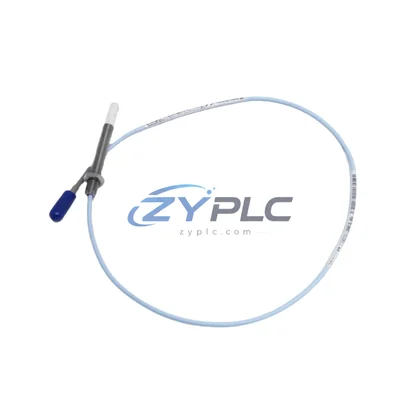
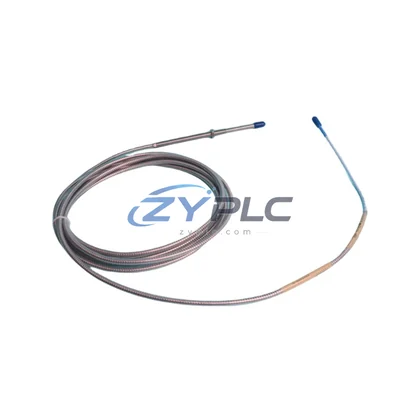
Bently Nevada 330907-05-30-05-02-00 Proximity Probe for 3300 Series
In modern industrial automation, machinery protection and condition monitoring are not isolated functions — they are deeply embedded within a layered control architecture that spans the control layer, I/O layer, network layer, power layer, human-machine interface layer, and execution layer. The Bently Nevada 330907-05-30-05-02-00 proximity probe is engineered to operate as a precision sensing element within this integrated framework, delivering reliable non-contact vibration and position measurement that feeds directly into the 3300 Series monitoring system. Its role is not simply to detect shaft displacement; it is to provide the foundational signal data upon which the entire machinery protection strategy depends.
The 330907-05-30-05-02-00 is a 5-metre extension cable-compatible, 5 mm diameter eddy current proximity probe designed for use with Bently Nevada’s 3300 XL series transducer system. Operating within the standard -24 VDC bias voltage range and delivering a sensitivity of 7.87 V/mm, this probe integrates seamlessly with the 3300/16 dual-channel monitor and the 3300/20 four-channel monitor, both of which serve as the primary signal conditioning and alarm management nodes within the machinery protection rack. When paired with the 330180 extension cable and the 330130 proximitor/oscillator driver, the complete transducer chain achieves the measurement accuracy and signal integrity required for continuous, real-time shaft vibration monitoring in rotating machinery applications.
Within the broader 3500 Series platform — Bently Nevada’s flagship modular protection system — the 330907-05-30-05-02-00 probe is fully compatible with the 3500/22M transient data interface module and the 3500/42M Proximitor/Seismic monitor module, enabling seamless migration from legacy 3300 Series installations to the more advanced 3500 rack architecture without requiring sensor replacement. This cross-platform compatibility is a critical advantage for facilities managing mixed-generation monitoring infrastructure, as it preserves capital investment in field-installed transducers while allowing incremental upgrades to the monitoring electronics.
At the power layer, the 3300 Series rack is typically supplied through the 3500/15 power supply module, which provides regulated, isolated DC power to all monitoring cards within the chassis. The stability of this power supply directly affects the bias voltage delivered to the 330907-05-30-05-02-00 probe, and any fluctuation in supply voltage will manifest as measurement drift at the monitor output. Proper power architecture — including redundant power supply configurations using dual 3500/15 modules — is therefore essential to maintaining the signal fidelity that the 330907-05-30-05-02-00 is designed to deliver.
At the network and communication layer, vibration data acquired through the 330907-05-30-05-02-00 probe is transmitted from the 3300 or 3500 monitor rack to the plant DCS or SCADA system via the 3500/92 communication gateway module, which supports Modbus RTU, Modbus TCP/IP, and OPC DA protocols. This system integration capability allows vibration trend data, alarm states, and diagnostic information to be consolidated within the plant-wide historian and displayed on operator workstations running Bently Nevada’s System 1 condition monitoring software. The result is a unified view of machinery health that spans from the sensor tip of the 330907-05-30-05-02-00 probe to the highest level of the plant information system.
For human-machine interface applications, the 330106 proximitor sensor — a compact, self-contained eddy current transducer — is often deployed alongside the 330907-05-30-05-02-00 in installations where space constraints limit the use of separate probe and driver assemblies. In control cabinet environments, the 125800-01 terminal board provides the structured wiring interface between field-installed transducers and the monitor rack, ensuring clean signal routing and simplified maintenance access. These components collectively define the I/O layer of the machinery protection architecture, where signal quality, cable routing discipline, and connector integrity are paramount.
From an engineering and commissioning perspective, the 330907-05-30-05-02-00 probe requires careful gap setting during installation — typically 1.0 mm to 2.0 mm from the target shaft surface — to achieve the linear operating range specified in the Bently Nevada transducer calibration documentation. The probe’s stainless steel housing and armoured cable construction are rated for continuous operation in environments with ambient temperatures from -35°C to +121°C, making it suitable for deployment in compressor trains, steam turbines, gas turbines, pumps, and gearboxes across petrochemical, power generation, mining, metallurgical, and water treatment facilities.
Long-term maintenance efficiency is significantly enhanced when the 330907-05-30-05-02-00 is managed as part of a documented spare parts strategy. Maintaining a buffer stock of matched probe-and-driver sets — calibrated to the same sensitivity and gap voltage — eliminates the need for field recalibration during emergency replacements, reducing mean time to repair and minimising unplanned downtime. All units supplied through ZYPLC are covered by a warranty terms confirmed during quotation, with full traceability documentation and pre-shipment functional verification to ensure that replacement units perform identically to the original installed components.
Product Specification Table
| Parameter |
Specification |
| System Role |
Non-contact eddy current proximity probe — vibration and position sensing |
| Compatible Monitor |
Bently Nevada 3300/16, 3300/20, 3500/22M, 3500/42M |
| Probe Diameter |
5 mm (standard) |
| Cable Length |
5 metres (probe cable) |
| Sensitivity |
7.87 V/mm (200 mV/mil) |
| Bias Voltage |
-24 VDC nominal |
| Operating Temperature |
-35°C to +121°C |
| Target Material |
AISI 4140 steel or equivalent |
| Communication Integration |
Via 3500/92 gateway — Modbus RTU/TCP, OPC DA (system integration) |
| Installation Environment |
Rotating machinery — turbines, compressors, pumps, gearboxes |
| Warranty |
warranty terms confirmed during quotation — functional verification included |
System Compatibility Notes
The 330907-05-30-05-02-00 proximity probe achieves its full performance potential only when integrated within a coherent, well-engineered system architecture. In a typical machinery protection rack, the probe connects to the 330130 proximitor driver, which conditions the raw eddy current signal and outputs a calibrated voltage proportional to shaft gap distance. This signal is then received by the 3300/16 dual-channel monitor or the 3300/20 four-channel monitor, where alarm setpoints, danger thresholds, and time-waveform data are processed and stored. The 3500/15 power supply module provides the regulated DC power rail that sustains stable probe bias voltage across all operating conditions. For facilities requiring higher channel density, the 3500/22M transient data interface module expands the system’s data acquisition capability, while the 3500/42M Proximitor/Seismic monitor provides dual-input monitoring for both radial vibration and axial position on the same shaft. Field wiring is terminated at the 125800-01 terminal board, and the 330180 extension cable bridges the distance between the probe tip and the proximitor driver in installations where the driver must be located outside the high-temperature machine casing. The 3500/92 communication gateway then aggregates all channel data and transmits it to the plant DCS via Modbus TCP/IP, completing the signal chain from the 330907-05-30-05-02-00 sensor tip to the control room operator display.
Industrial Application Notes
The 330907-05-30-05-02-00 proximity probe is deployed across a wide range of process industries where rotating machinery reliability is critical to production continuity. In power generation facilities, it monitors shaft vibration on steam turbine and gas turbine trains, providing early warning of rotor imbalance, bearing wear, and oil whirl instability. In petrochemical and refinery applications, it is installed on centrifugal compressors and boiler feed pumps, where continuous vibration monitoring is mandated by API 670 machinery protection standards. In mining and metallurgical operations, the probe monitors large induced draft fans, ball mill drives, and crusher gearboxes, where harsh environmental conditions demand the robust construction and wide temperature rating that the 330907-05-30-05-02-00 provides. In water treatment and municipal utility plants, it supports condition-based maintenance programs on vertical turbine pumps and blower trains, reducing scheduled maintenance intervals and extending equipment service life. Across all these applications, the probe’s role within the layered automation architecture — from field sensing through signal conditioning, monitor processing, network communication, and HMI display — remains consistent, making it a versatile and standardised component in any Bently Nevada-based machinery protection strategy.
Product Compatibility FAQ
Q1: Is the 330907-05-30-05-02-00 compatible with both the 3300 Series and 3500 Series monitor racks?
Yes. The 330907-05-30-05-02-00 proximity probe is fully compatible with both the Bently Nevada 3300 Series monitors (including the 3300/16 and 3300/20) and the 3500 Series platform (including the 3500/22M and 3500/42M modules), provided the correct proximitor driver — such as the 330130 — is used to condition the probe signal. This cross-series compatibility makes it an ideal choice for facilities managing mixed-generation monitoring infrastructure or planning phased upgrades from 3300 to 3500 architecture.
Q2: What installation and commissioning steps are required to achieve accurate vibration measurement?
Accurate measurement requires precise gap setting between the probe tip and the target shaft surface, typically within the 1.0 mm to 2.0 mm linear range. The gap voltage should be verified against the proximitor driver’s calibration curve at the specified -24 VDC bias. Cable routing should minimise electromagnetic interference from adjacent power cables, and all connectors should be inspected for continuity and insulation integrity before energising the system. Bently Nevada’s transducer installation and calibration documentation provides step-by-step commissioning procedures for the complete probe-driver-monitor chain.
Q3: What does the warranty terms confirmed during quotation cover, and how does ZYPLC support long-term spare parts management?
All 330907-05-30-05-02-00 units supplied by ZYPLC are covered by a warranty terms confirmed during quotation against manufacturing defects and functional failure under normal operating conditions. Each unit undergoes pre-shipment functional verification to confirm sensitivity, bias voltage response, and cable integrity. ZYPLC maintains buffer stock of matched probe-and-driver sets to support emergency replacement requirements, and full traceability documentation is provided with every shipment to support maintenance records and audit compliance.