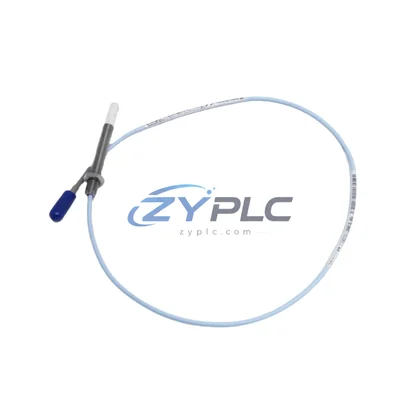
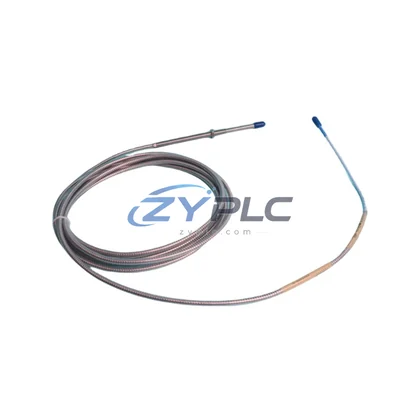
Bently Nevada 330909-00-20-10-02-05 Proximity Probe for 3300 NSV
The Bently Nevada 330909-00-20-10-02-05 is an eddy-current proximity probe engineered for seamless integration within the 3300 NSV (Non-contact Shaft Vibration) monitoring platform. Designed to deliver continuous, high-resolution radial vibration and position data, this probe serves as the primary sensing element in a layered industrial automation architecture — connecting the mechanical domain directly to the condition monitoring and control layers of a plant-wide system. Its role extends far beyond simple signal acquisition: it is a foundational component that determines the accuracy, reliability, and long-term maintainability of the entire rotating machinery protection chain.
In modern industrial control environments, the proximity probe does not operate in isolation. It functions as the first node in a signal chain that flows upward through the I/O layer, the processing layer, and ultimately into the supervisory control and data acquisition (SCADA) or distributed control system (DCS). The 330909-00-20-10-02-05 is factory-calibrated to interface directly with the 3300/16 proximitor sensor, which conditions the raw eddy-current signal into a standardized voltage output compatible with the 3500 Series machinery protection system. This tight hardware pairing ensures signal fidelity across the full measurement range without requiring field recalibration during installation or module replacement.
Product Specification Table
| Parameter |
Specification |
| System Role |
Primary radial vibration sensing element — 3300 NSV monitoring chain |
| SKU / Part Number |
330909-00-20-10-02-05 |
| Brand |
Bently Nevada |
| Series |
3300 NSV (Non-contact Shaft Vibration) |
| Probe Type |
Eddy-current proximity probe |
| Cable Length |
2.0 m (integral cable) |
| Thread Size |
10-32 UNF |
| Tip Diameter |
8 mm |
| Measurement Range |
0 to 2.0 mm (linear range) |
| Output Signal |
-18 VDC nominal (via proximitor) |
| Compatible Proximitor |
3300/16 Proximitor Sensor |
| Target Material |
AISI 4140 steel or equivalent |
| Operating Temperature |
-35°C to +120°C |
| Installation Environment |
Turbines, compressors, pumps, motors — industrial rotating machinery |
| Communication Compatibility |
Interfaces with 3500 Series rack via 3300/16 proximitor output |
| Warranty |
warranty terms confirmed during quotation — covers manufacturing defects and functional failure under normal operating conditions |
System Compatibility Notes
The 330909-00-20-10-02-05 proximity probe achieves its full value when deployed as part of a coordinated, multi-layer control architecture. At the sensing layer, the probe pairs with the 3300/16 Proximitor Sensor to convert mechanical displacement into a conditioned analog signal. This signal is then routed to a 3500/22M Transient Data Interface or a 3500/42M Proximitor, Seismic, and Velocity Monitor module housed within the 3500/15 Power Supply-equipped rack — the backbone of the Bently Nevada machinery protection platform.
Within the 3500 rack architecture, the 3500/20 Rack Interface Module manages communication between the protection system and the plant DCS or SCADA layer, typically via Modbus TCP, FOUNDATION Fieldbus, or Profibus DP protocols. This enables real-time vibration data from the 330909-00-20-10-02-05 to be surfaced on operator HMI screens and historian databases without manual data extraction. For applications requiring redundant monitoring, a second probe channel can be configured using an additional 330130-080-00-00 Extension Cable and a mirrored proximitor, ensuring that a single probe failure does not interrupt the protection function.
At the terminal and wiring layer, 3300 XL 8mm probe systems share the same mounting thread and cable connector standard as the 330909 series, allowing mixed-generation deployments within the same machinery train without bracket modifications. Engineers integrating this probe into a new installation should also account for the 3500/25 Enhanced Keyphasor Module, which provides shaft reference signals essential for phase-referenced vibration analysis and balancing operations. The complete signal chain — probe, proximitor, rack module, communication gateway, and HMI — forms a closed-loop condition monitoring architecture capable of supporting both continuous protection and predictive maintenance programs.
Industrial Application Notes
The 330909-00-20-10-02-05 is deployed across a wide range of heavy industrial sectors where rotating machinery reliability is critical to process continuity. In power generation facilities, it monitors steam turbine shaft vibration in real time, providing early warning of rotor imbalance, bearing wear, or misalignment before these conditions escalate to forced outages. In petrochemical and refinery environments, it is installed on centrifugal compressors and boiler feed pumps, where API 670 compliance mandates continuous non-contact vibration monitoring as a condition of safe operation.
In water treatment and municipal utility plants, the probe supports predictive maintenance programs on large vertical turbine pumps and blower trains, reducing unplanned downtime in facilities where redundancy is limited. Mining and mineral processing operations use this probe on crusher drives, conveyor head pulleys, and slurry pump trains — environments characterized by high shock loads and contaminated atmospheres that demand robust, sealed probe assemblies. In metallurgical and steel mill applications, the probe monitors rolling mill drive motors and continuous caster pinch roll drives, where thermal cycling and vibration amplitudes are among the most demanding in any industrial sector.
Across all these applications, the 330909-00-20-10-02-05 contributes to a layered automation strategy in which the sensing layer, protection layer, control layer, and enterprise layer are tightly integrated — enabling condition data to flow from the shaft surface to the maintenance management system with minimal latency and maximum fidelity.
Product Compatibility FAQ
Q1: Is the 330909-00-20-10-02-05 directly compatible with the 3500 Series rack without additional signal conditioning?
A: The probe requires a 3300/16 Proximitor Sensor as an intermediate signal conditioner. The proximitor converts the raw eddy-current impedance change into a calibrated DC voltage output (-18 VDC scale factor), which is then read by the 3500/42M or 3500/22M monitor module. Direct connection to the 3500 rack input without a proximitor is not supported and will result in incorrect readings. Always verify that the proximitor gap voltage is set within the linear range (typically -10 VDC ± 2 VDC) during commissioning.
Q2: Can this probe be used as a drop-in replacement in an existing 3300 NSV system without reconfiguring the rack?
A: Yes, provided the replacement probe shares the same cable length, tip diameter (8 mm), and connector type as the original installed unit. The 330909-00-20-10-02-05 is factory-calibrated to the same scale factor as other 3300 NSV series probes, so rack configuration changes are not required. However, after installation, the gap voltage should be verified at the proximitor output to confirm the probe is positioned within the linear measurement range. This verification step is essential for maintaining API 670 compliance and ensuring the protection setpoints remain valid.
Q3: What does the warranty terms confirmed during quotation cover, and how does it support long-term maintenance planning?
A: The warranty terms confirmed during quotation covers manufacturing defects and functional failures under normal operating conditions from the date of shipment. It supports maintenance planning by providing a defined reliability baseline for spare parts inventory management — engineers can schedule probe replacement cycles around the warranty period and maintain a buffer stock of certified units to minimize mean time to repair (MTTR) during unplanned outages. Warranty claims are processed through ZYPLC’s technical support team, and replacement units are dispatched with full calibration documentation to ensure seamless re-integration into the existing system architecture.