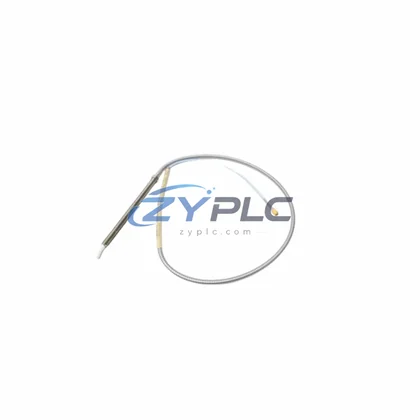
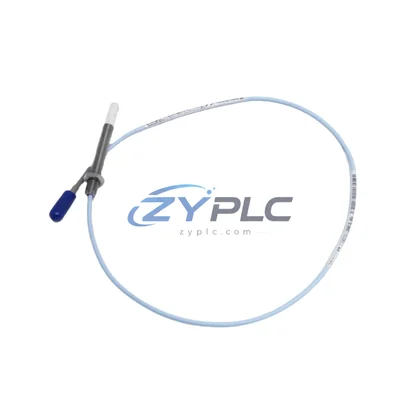
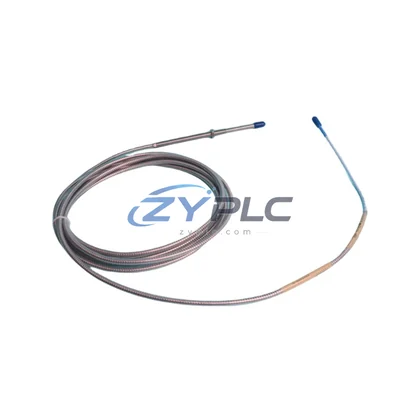
Bently Nevada 330910-00-08-10-02-00 Proximity Probe | 3300 NSV: Precision maintenance-focused Vibration Control for Industrial Automation
The Bently Nevada 330910-00-08-10-02-00 is a high-performance proximity probe engineered for the 3300 NSV (Non-contacting Vibration) Series, one of the most trusted continuous vibration monitoring platforms in rotating machinery management. Designed for demanding industrial environments, this probe delivers real-time shaft displacement and vibration data that directly supports maintenance-focused motor control, predictive maintenance scheduling, and production line throughput optimization.
In modern manufacturing facilities, undetected rotor imbalance, misalignment, or bearing wear translates directly into elevated energy consumption. Motors operating under abnormal vibration conditions draw excess current, generate unnecessary heat, and accelerate mechanical degradation — all of which inflate energy costs and reduce equipment availability. The 330910-00-08-10-02-00 addresses this at the source by providing continuous, high-resolution proximity measurements that allow control systems to detect deviations before they escalate into unplanned downtime or unplanned downtime.
Sourced directly from authorized supply channels, tested prior to shipment, and Warranty terms are confirmed during quotation.
Product Specification Table
| Parameter |
Specification / Value |
| SKU / Part Number |
330910-00-08-10-02-00 |
| Brand |
Bently Nevada |
| Series |
3300 NSV (Non-contacting Vibration) |
| Probe Type |
Eddy-Current Proximity Probe |
| Measurement Target |
Shaft radial vibration, axial position, differential expansion |
| Power Consumption |
Low-draw passive sensing; powered via 3300 series driver/monitor |
| Operating Efficiency |
Continuous non-contact measurement — zero mechanical wear, zero friction loss |
| Compatible Systems |
Bently Nevada 3300 NSV Monitor, 3300/16 Monitor, System 1 Software Platform |
| Application Environment |
Turbines, compressors, pumps, motors, fans — oil & gas, power generation, petrochemical |
| Maintenance Value |
Early fault detection reduces excess motor load, lowers energy draw by preventing vibration-induced inefficiency |
| Origin |
USA |
| Warranty |
12 Months |
| Availability |
Confirmed via RFQ before quotation |
System Compatibility and Application
The 330910-00-08-10-02-00 proximity probe operates as a critical sensing node within a layered industrial automation architecture. It connects to the Bently Nevada 3300/16 Dual Voting Monitor, which processes raw proximity signals and triggers protective relay outputs when vibration thresholds are exceeded — preventing motors from running in high-energy-waste fault states. The monitor communicates upstream to the Bently Nevada System 1 Condition Monitoring Software, where vibration trends are trended, analyzed, and correlated with energy consumption data from the plant’s power monitoring layer.
In drive-intensive applications, the proximity probe data feeds into variable frequency drive (VFD) control loops. When the 3300 NSV system detects rising vibration amplitude on a pump or fan shaft, the control system — often a Siemens S7-1500 PLC or Allen-Bradley ControlLogix — can command the associated ABB ACS880 drive or Siemens SINAMICS G120 VFD to reduce motor speed, cutting energy consumption proportionally to the cube of speed reduction. This closed-loop response between vibration sensing and drive adjustment is one of the most effective maintenance planning strategies available in rotating machinery management.
For facilities running distributed I/O architectures, the 3300 NSV monitor integrates with Bently Nevada 3500 Series Rack systems via hardwired relay or Modbus RTU/TCP communication, enabling centralized energy and condition monitoring across multiple machine trains. The 3500/22M Transient Data Interface captures high-speed vibration events during startups and shutdowns — periods of peak energy demand — allowing engineers to optimize acceleration ramps and reduce inrush current impact on the facility’s power grid.
On the HMI layer, operators monitor real-time vibration and energy data through Rockwell FactoryTalk View or Siemens WinCC dashboards, where the 330910-00-08-10-02-00 probe’s output is visualized alongside motor current, power factor, and thermal data. This integrated view enables shift engineers to identify energy anomalies — such as a compressor drawing 8% more current than baseline due to developing bearing wear — and schedule corrective maintenance before the fault worsens and unplanned downtime compounds.
Power quality monitoring instruments such as the Fluke 435-II Power Quality Analyzer are often deployed alongside the 3300 NSV system to correlate vibration events with harmonic distortion and power factor degradation, providing a complete picture of machine-level energy efficiency.
Maintenance and Replacement Notes
In a typical continuous process plant — a refinery, a power station, or a large-scale chemical facility — rotating machinery accounts for 60–70% of total electrical energy consumption. Centrifugal pumps, compressors, and turbines running with undetected vibration faults operate at reduced hydraulic efficiency, requiring more electrical input to deliver the same process output. The Bently Nevada 330910-00-08-10-02-00 proximity probe eliminates the blind spots in this energy equation.
Consider a boiler feed pump running with a developing shaft misalignment. Without proximity monitoring, the misalignment may go undetected for weeks, during which the pump operates at 5–12% below its best efficiency point (BEP), drawing proportionally more power for the same flow rate. The 330910-00-08-10-02-00, installed at the pump’s radial bearing positions, continuously measures shaft orbit and displacement. When the orbit shape begins to deviate from the baseline — indicating misalignment — the 3300 NSV monitor flags the condition, allowing maintenance to correct the alignment during a planned outage rather than an emergency shutdown.
This predictive approach directly reduces unplanned downtime: a pump restored to BEP operation after alignment correction typically recovers 4–10% of its energy consumption. Across a facility with 20–30 monitored pumps, the cumulative operational stability are substantial and measurable. Beyond pumps, the same probe model is deployed on gas turbine compressor stages, where shaft position monitoring prevents surge events — one of the most energy-intensive and mechanically destructive failure modes in rotating machinery.
Production line throughput also benefits directly. When vibration monitoring prevents unexpected shutdowns, production schedules remain intact, avoiding the energy-intensive restart sequences that follow emergency trips. Cold starts on large rotating machines — turbines, compressors, and high-inertia motors — consume disproportionate energy during acceleration. Every prevented emergency stop translates into avoided restart energy costs and preserved production capacity.
ZYPLC supports RFQ-based sourcing for the 330910-00-08-10-02-00 and conducts pre-shipment functional testing on all proximity probe assemblies. Each unit is verified for output sensitivity, cable integrity, and connector condition before dispatch, ensuring that the probe performs to specification from the moment it is installed — minimizing commissioning time and maximizing the speed at which maintenance planning benefits are realized on the production floor.
Product Sourcing FAQ
Q1: How does the 330910-00-08-10-02-00 contribute to measurable operational stability on a production line?
By providing continuous shaft vibration and position data, this proximity probe enables early detection of mechanical faults — misalignment, imbalance, bearing wear — that cause motors and driven equipment to operate below their best efficiency point. Correcting these faults based on probe data typically recovers 4–12% of machine-level energy consumption, with additional savings from avoided emergency shutdowns and unplanned restart cycles.
Q2: Is the 330910-00-08-10-02-00 compatible with existing Bently Nevada 3300 and 3500 series monitoring infrastructure?
Yes. The 330910-00-08-10-02-00 is designed for the 3300 NSV system and is also compatible with the broader Bently Nevada 3300 and 3500 series monitor racks when used with the appropriate extension cable and driver/oscillator. Always verify the driver model and gap voltage range against your existing system configuration before installation.
Q3: What is the recommended replacement interval, and how does proactive replacement reduce downtime?
Bently Nevada proximity probes do not have a fixed calendar-based replacement interval; replacement is condition-based, triggered by sensitivity drift, cable damage, or connector degradation detected during calibration checks. Proactive replacement — before probe output degrades — ensures that the monitoring system maintains full detection capability, preventing the unplanned downtime associated with undetected mechanical faults running unchecked.
Q4: What does the warranty and support terms confirmed before quote from ZYPLC cover, and what is the pre-shipment testing process?
ZYPLC’s warranty and support terms confirmed before quote covers manufacturing defects and functional failures under normal operating conditions. Prior to shipment, each 330910-00-08-10-02-00 unit undergoes functional verification including output sensitivity check, cable continuity test, and connector inspection. Units that do not meet specification are quarantined and not dispatched. This testing process ensures that every probe shipped is prepared for installation after site verification and reliable long-term operation.