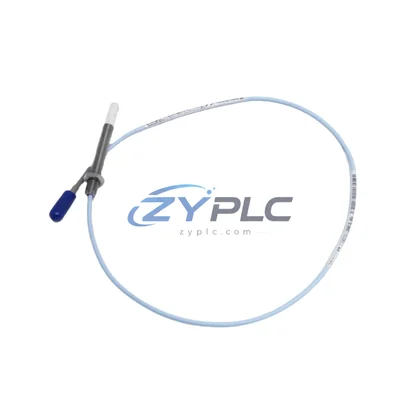
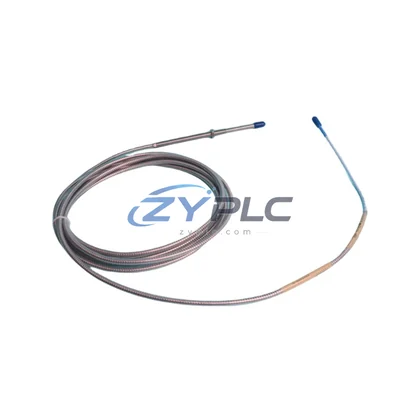
Bently Nevada 330910-16-23-10-02-00 Proximity Probe for 3300 NSv
The Bently Nevada 330910-16-23-10-02-00 is a precision-engineered eddy-current proximity probe designed as a fully integrated component within the Bently Nevada 3300 NSv vibration monitoring system architecture. Rather than functioning as a standalone sensor, this probe is purpose-built to operate in concert with the complete signal chain — from the rotating shaft surface through the extension cable, proximitor/oscillator driver, and into the 3300 NSv rack-mounted monitor modules — delivering continuous, high-fidelity radial vibration, axial position, and differential expansion data to the plant’s distributed control system (DCS) or safety instrumented system (SIS). Its role within the layered automation hierarchy makes it a foundational element for rotating machinery protection in power generation, petrochemical, oil and gas, and heavy industrial environments.
Product Specification Table
| Parameter |
Specification |
| System Role |
Eddy-Current Proximity Probe — Vibration & Position Sensing Layer |
| Part Number / SKU |
330910-16-23-10-02-00 |
| Compatible System |
Bently Nevada 3300 NSv Monitoring System |
| Probe Length |
16 mm (tip-to-tip) |
| Cable Length |
Integral — matched to 330130 / 330180 extension cable series |
| Sensing Range |
0–2.54 mm (0–100 mil) linear range |
| Sensitivity |
7.87 V/mm (200 mV/mil) nominal |
| Operating Frequency |
DC – 10,000 Hz |
| Supply Voltage |
−24 VDC (via 3300 NSv proximitor driver) |
| Output Signal |
−2 VDC to −18 VDC (proportional to gap) |
| Temperature Range |
−35°C to +177°C (probe tip) |
| Ingress Protection |
IP67 — suitable for oil mist and high-humidity environments |
| Connector Type |
02 — standard BNC-compatible field connector |
| Communication / Integration |
Analog 4–20 mA / voltage output to 3300 NSv monitor; MODBUS RTU / TCP via system gateway |
| Mounting |
Threaded body, bracket or direct-mount to bearing housing |
| Warranty |
warranty terms confirmed during quotation — covers manufacturing defects and signal integrity |
System Compatibility Notes
The 330910-16-23-10-02-00 achieves its full diagnostic value only when integrated into a coherent, multi-layer control architecture. At the field instrumentation layer, the probe is paired with a Bently Nevada 330130-080-00-00 extension cable to bridge the physical distance between the bearing housing and the proximitor driver, maintaining signal integrity across the full cable run. The proximitor driver — typically a Bently Nevada 3300 XL 8mm proximitor or the 330180-X1-05 proximitor/oscillator — conditions the raw eddy-current signal into a calibrated DC voltage output that the monitor module can interpret.
At the rack and monitor layer, the conditioned signal feeds into a Bently Nevada 3300/16 or 3300/20 monitor module housed within the 3300 NSv rack chassis. These monitors perform real-time gap, 1X, 2X, and overall vibration calculations, comparing live readings against user-configured alert and danger setpoints. The rack backplane distributes power from a Bently Nevada 3300/05 or 3300/10 power supply module, which provides the regulated −24 VDC required by all proximitor drivers in the system — ensuring that a single power architecture supports the entire probe array without ground loop interference.
For redundant protection architectures — common in API 670-compliant installations on critical compressors and steam turbines — two 330910-16-23-10-02-00 probes are mounted 90° apart (X–Y configuration) on the same bearing journal. Each probe feeds an independent monitor channel, and the system logic in the Bently Nevada 3500/42M position monitor or the 3300 NSv dual-channel vibration monitor performs voting logic to prevent spurious trips while maintaining true machinery protection. This redundancy design is further supported by the Bently Nevada 3300/55 communication gateway, which bridges the 3300 NSv rack to the plant DCS via MODBUS TCP or OPC-DA, enabling operators at the GE Proficy HMI/SCADA or equivalent human-machine interface to view live vibration trends, historical waveforms, and alarm states without interrupting the protection loop.
At the execution and interlock layer, the 3300 NSv monitor’s relay outputs connect to the plant’s safety instrumented system (SIS) relay modules or directly to turbine trip solenoids, ensuring that a confirmed danger-level vibration event triggers an automated machine shutdown within the system’s configured response time. Throughout this architecture, the 330910-16-23-10-02-00 serves as the primary data source — its calibration accuracy and long-term signal stability directly determine the reliability of every downstream decision, from operator alerts to automated protective actions.
Industrial Application Notes
In power generation facilities — including gas turbines, steam turbines, and large synchronous generators — the 330910-16-23-10-02-00 is deployed on main shaft bearings and thrust collars to provide continuous radial vibration and axial position monitoring. Compliance with API 670 and ISO 10816 standards requires that all critical rotating machinery be equipped with permanently installed, continuously monitored proximity probes, making this component a regulatory necessity as much as an operational tool. The probe’s wide operating temperature range and IP67 rating allow it to function reliably in the high-temperature, oil-mist-laden environment immediately adjacent to turbine bearing housings.
In petrochemical and oil and gas processing plants, the probe is commonly installed on centrifugal compressors, boiler feed pumps, and reactor agitators. These machines operate continuously for years between planned turnarounds, and the early detection of rotor imbalance, misalignment, or bearing wear — enabled by the 330910-16-23-10-02-00’s sub-micron resolution — allows maintenance teams to schedule corrective action during planned outages rather than responding to unplanned failures. Integration with the plant DCS via the 3300 NSv communication gateway allows vibration data to be correlated with process variables such as flow rate, pressure, and temperature, enabling condition-based maintenance strategies that reduce both maintenance costs and unplanned downtime.
In water treatment and municipal infrastructure applications, the probe monitors large vertical turbine pumps and blower trains. In mining and metallurgical facilities, it is applied to ball mills, SAG mills, and large fan drives where bearing failures carry significant production and safety consequences. In packaging and discrete manufacturing lines, the probe supports predictive maintenance programs on high-speed rotating equipment, reducing the frequency of scheduled inspections and extending mean time between failures (MTBF). Across all these sectors, the warranty terms confirmed during quotation provided with every 330910-16-23-10-02-00 unit ensures that engineering teams can commission the probe with confidence, knowing that any manufacturing defect or signal integrity issue will be addressed without additional cost during the warranty period.
Product Compatibility FAQ
Q1: Is the 330910-16-23-10-02-00 directly compatible with existing 3300 NSv rack systems without additional interface modules?
Yes. The 330910-16-23-10-02-00 is designed as a native component of the Bently Nevada 3300 NSv system architecture. When paired with the correct extension cable (330130 or 330180 series) and a compatible proximitor driver, it connects directly to any 3300 NSv monitor module channel without requiring additional signal conditioners or interface cards. The probe’s output voltage range (−2 VDC to −18 VDC) is fully within the input specification of all 3300 NSv monitor modules, ensuring plug-and-play architectural compatibility.
Q2: Can this probe be used in a redundant (dual-probe) X–Y vibration monitoring configuration, and does the warranty terms confirmed during quotation cover both units in such a setup?
Yes. The 330910-16-23-10-02-00 is fully qualified for X–Y redundant configurations as required by API 670 for critical machinery. Each probe in the pair is warranted individually under the warranty terms confirmed during quotation, covering manufacturing defects and signal integrity from the date of shipment. In a dual-probe setup, each unit feeds an independent monitor channel, and the system’s voting logic ensures that a single probe fault does not cause a spurious machine trip, while still maintaining full protective coverage.
Q3: What commissioning steps are required to verify system integration of the 330910-16-23-10-02-00 within a new or existing 3300 NSv architecture?
Commissioning requires four key steps: (1) verify the static gap voltage at the nominal operating clearance (typically −10 VDC ± 0.5 VDC at 1.0 mm gap) using a calibrated gap tool; (2) confirm the full-scale output linearity across the 0–2.54 mm sensing range using a micrometer stage; (3) configure the monitor module’s alert and danger setpoints in accordance with the machinery OEM’s vibration limits and ISO 10816 guidelines; and (4) perform a system-level loop check by simulating a gap change and verifying that the DCS, HMI, and SIS relay outputs respond correctly. system integration is confirmed when the probe’s live data appears correctly scaled and labeled in the plant historian and operator display, with alarm states propagating correctly through all downstream systems. ZYPLC’s technical support team is available to assist with commissioning verification throughout the warranty terms confirmed during quotation period.