Bently Nevada 9200-09-02-10-00 Vibration Transducer: and Upstream–Downstream Coordination
The Bently Nevada 9200-09-02-10-00 is a two-wire, loop-powered vibration transducer engineered for seamless integration within the Bently Nevada 9200 Series condition monitoring architecture. Rather than functioning as a standalone sensing device, this transducer is designed from the ground up to serve as a precision signal source within a layered industrial automation system — one that spans the control layer, I/O layer, network layer, power layer, human-machine interface layer, and the mechanical execution layer. Understanding its role within this full-stack architecture is essential for engineers specifying, commissioning, or maintaining rotating machinery protection systems in demanding industrial environments.
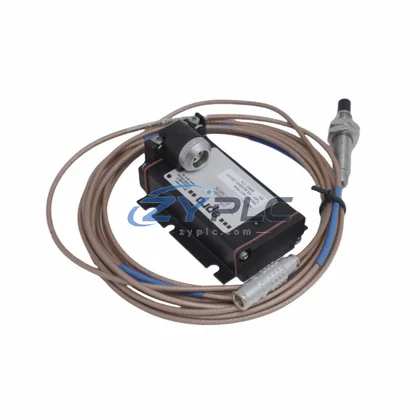
In a typical 9200 Series deployment, the 9200-09-02-10-00 transducer is mounted directly on the bearing housing or machine casing of a rotating asset — a pump, compressor, fan, or turbine — and delivers a continuous 4–20 mA vibration signal proportional to the measured velocity or acceleration. This signal is routed to the 9200 Series monitor rack, where it is conditioned, scaled, and evaluated against user-defined alarm and danger setpoints. The transducer’s two-wire loop-powered design eliminates the need for a separate excitation supply, simplifying field wiring and reducing installation costs in multi-point monitoring installations.
Product Specification Table
| Parameter |
Specification |
| System Role |
Field-level vibration sensing node within 9200 Series monitor architecture |
| Output Signal |
4–20 mA, two-wire loop-powered |
| Measurement Type |
Velocity / Acceleration (vibration) |
| Supply Voltage |
18–30 VDC (loop-powered) |
| Frequency Response |
10–1000 Hz (typical for 9200 Series transducers) |
| Ingress Protection |
IP67 (suitable for harsh industrial environments) |
| Electrical Connection |
2-wire, 4–20 mA current loop |
| Communication Compatibility |
Compatible with 9200 Series monitor racks; integrates with HART-capable I/O modules |
| Installation Environment |
Rotating machinery bearing housings; pumps, fans, compressors, turbines |
| Mounting |
Threaded stud mount (per 9200 Series mechanical interface standard) |
| Operating Temperature |
-40°C to +85°C |
| Warranty |
warranty terms confirmed during quotation — covers manufacturing defects and functional performance |
System Compatibility Notes
The 9200-09-02-10-00 does not operate in isolation. Its value is fully realized only when it is considered as one node within a coordinated, multi-layer control system. In a complete 9200 Series machinery protection architecture, the transducer works in concert with a range of complementary components that together ensure signal integrity, system redundancy, and long-term operational reliability.
At the monitor rack level, the 9200-09-02-10-00 feeds directly into the Bently Nevada 9200 Series monitor module, which processes the 4–20 mA signal and compares it against configured alarm thresholds. For installations requiring expanded channel capacity, the 9200 Series expansion rack allows additional transducer inputs to be added without redesigning the existing wiring infrastructure. The monitor rack communicates upstream via a Modbus RTU or HART gateway, enabling the vibration data to be forwarded to a plant-level DCS or SCADA system — such as a Honeywell Experion PKS or Emerson DeltaV controller — where it is integrated into the broader process control loop.
On the power layer, the 9200-09-02-10-00’s loop-powered design means it draws its operating current directly from the 24 VDC instrument power supply that also feeds the monitor rack. In redundant installations, a redundant 24 VDC power supply module with automatic switchover ensures that a power supply failure does not interrupt vibration monitoring — a critical requirement in continuous-process industries. The power distribution is typically managed through a DIN-rail mounted terminal block assembly, which provides individual fusing and isolation for each transducer loop.
At the I/O layer, the 4–20 mA signal from the 9200-09-02-10-00 may also be routed in parallel to a remote I/O module — such as a Pepperl+Fuchs KFD2-STC4-Ex1 isolating barrier or equivalent — for intrinsic safety isolation in Zone 1 or Zone 2 hazardous areas. This parallel routing supports both the local machinery protection function and the plant-wide data acquisition function simultaneously, without signal degradation.
For human-machine interface integration, the processed vibration trend data from the 9200 Series monitor is typically displayed on a Bently Nevada System 1 software platform or forwarded to a plant historian such as OSIsoft PI, where maintenance engineers can review long-term vibration trends, set predictive maintenance intervals, and generate compliance reports. In some architectures, a dedicated panel-mounted HMI — such as a Siemens TP700 or Allen-Bradley PanelView — is configured to display real-time vibration alarms alongside other process variables, giving operators a unified view of machine health and process status.
At the execution layer, the alarm outputs from the 9200 Series monitor — triggered when the 9200-09-02-10-00 signal exceeds danger setpoints — are wired to a safety relay module or directly to the machine’s emergency shutdown (ESD) circuit. This closes the loop between the sensing layer and the mechanical execution layer, ensuring that a detected vibration anomaly results in a controlled, safe machine shutdown rather than a catastrophic failure.
Industrial Application Notes
The 9200-09-02-10-00 is deployed across a wide range of heavy industrial sectors where rotating machinery reliability is directly linked to production continuity and personnel safety.
In petrochemical and refinery applications, the transducer is mounted on process pumps, compressors, and agitators operating in continuous-duty service. The 4–20 mA output integrates directly with the plant DCS, enabling vibration data to be correlated with process variables such as flow rate, pressure, and temperature — providing a complete picture of machine health in the context of process conditions.
In electric power generation, the 9200-09-02-10-00 is used on cooling water pumps, forced-draft fans, and auxiliary turbines. Its IP67 rating ensures reliable operation in the wet, dusty, and thermally variable environments typical of power plant auxiliary systems. The warranty terms confirmed during quotation provides plant maintenance teams with confidence in the transducer’s long-term performance between scheduled outages.
In water and wastewater treatment, the transducer monitors the bearing condition of large centrifugal pumps and blowers. Early detection of bearing wear or imbalance allows maintenance teams to schedule corrective action during planned downtime windows, avoiding unplanned outages that can disrupt treatment capacity.
In mining and mineral processing, the 9200-09-02-10-00 is applied to conveyor drive motors, ball mill drives, and slurry pumps — assets that operate under high load and in abrasive environments. The transducer’s robust construction and wide operating temperature range make it suitable for both underground and surface installations.
In packaging and discrete manufacturing, the transducer supports predictive maintenance programs on high-speed rotating equipment, where unplanned downtime directly impacts production throughput and delivery commitments. Integration with the plant MES via the SCADA/DCS layer enables maintenance work orders to be automatically generated when vibration alarm thresholds are exceeded.
Product Compatibility FAQ
Q1: Is the 9200-09-02-10-00 compatible with existing 9200 Series monitor racks, and can it be added to an operational system without downtime?
A: Yes. The 9200-09-02-10-00 is designed for direct compatibility with all 9200 Series monitor modules. Because it is a loop-powered, two-wire device, it can be connected to a spare monitor channel without requiring changes to the rack configuration or firmware. In most installations, the transducer can be added to a live system during a brief maintenance window, with the new channel commissioned and alarm setpoints configured without interrupting monitoring on adjacent channels.
Q2: How does the 9200-09-02-10-00 support redundant architecture designs, and what happens if the transducer fails?
A: In redundant monitoring architectures, two 9200-09-02-10-00 transducers are mounted at the same measurement point and connected to separate monitor channels — often on separate racks powered by independent power supplies. The 9200 Series monitor can be configured to generate an alert if one transducer’s signal falls outside the valid 4–20 mA range, indicating a wiring fault or transducer failure, while the redundant channel continues to provide valid vibration data. This dual-transducer approach ensures that a single-point failure in the sensing layer does not result in a loss of machinery protection. The warranty terms confirmed during quotation covers transducer replacement in the event of a manufacturing defect identified during commissioning or early operation.
Q3: What are the long-term maintenance requirements for the 9200-09-02-10-00, and how does system integration with the plant DCS support predictive maintenance?
A: The 9200-09-02-10-00 is a solid-state device with no moving parts, and under normal operating conditions it requires minimal scheduled maintenance beyond periodic loop calibration verification and connector inspection. system integration — the practice of correlating the transducer’s vibration output with upstream process variables such as load, speed, and temperature within the DCS or historian — significantly enhances the predictive value of the vibration data. By analyzing vibration trends in the context of process conditions, maintenance engineers can distinguish between vibration changes caused by process upsets and those caused by genuine mechanical degradation, reducing false alarms and enabling more accurate remaining-useful-life predictions. ZYPLC supports RFQ sourcing for the 9200-09-02-10-00 to support rapid replacement needs, and all units are covered by a warranty terms confirmed during quotation from the date of shipment.