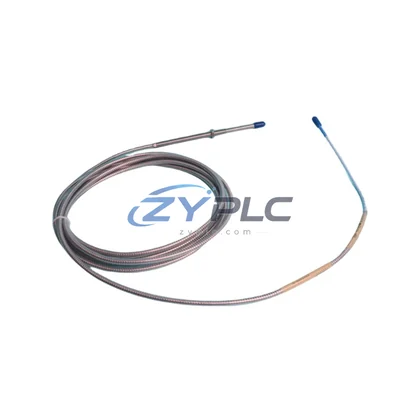
Bently Nevada 990-04-70-01-CN: Industrial Data Link for 3300 Series Condition Monitoring Networks
In modern smart factory environments, the integrity of machine health data depends entirely on the reliability of the communication chain connecting field-level sensors to plant-wide monitoring systems. The Bently Nevada 990-04-70-01-CN is a precision vibration transmitter engineered for the 3300 Series machinery protection platform, delivering continuous, high-fidelity vibration signals across industrial network architectures where uptime and data accuracy are non-negotiable. From rotating equipment on the plant floor to SCADA dashboards in the control room, this module serves as a critical node in the industrial data flow.
Compatibility & Integration Notes
| Parameter |
Specification |
| SKU |
990-04-70-01-CN |
| Brand |
Bently Nevada |
| Series |
3300 Series |
| Product Type |
Vibration Transmitter |
| Protocol Support |
4–20 mA Analog, Compatible with Modbus RTU gateway integration |
| Interface Type |
Analog Output / DIN Rail Mountable |
| Transmission Capability |
Continuous real-time vibration amplitude signal output |
| Network Compatibility |
Integrates with 3300 Series monitors, DCS, PLC, and SCADA via signal conditioning |
| System Application |
Rotating machinery protection, condition monitoring, predictive maintenance |
| Warranty |
warranty terms confirmed during quotation |
| Origin |
United States |
| Stock Status |
RFQ Available — shipment arranged after confirmation |
Connected Automation Data Flow
The 990-04-70-01-CN operates at the signal acquisition layer of the industrial automation stack. Mounted in proximity to rotating machinery — turbines, compressors, pumps, and motors — it captures vibration displacement data and transmits a conditioned analog signal downstream into the broader control and monitoring architecture.
Within a typical 3300 Series installation, the transmitter feeds directly into a Bently Nevada 3300/16 proximity monitor or a 3300/55 dual-channel monitor, which processes the raw vibration signal and applies alarm thresholds. These monitors communicate upstream to a System 1 condition monitoring software platform, where plant engineers can visualize trend data, configure alert logic, and generate predictive maintenance reports.
For facilities running hybrid automation environments, the 4–20 mA output of the 990-04-70-01-CN can be routed through a signal isolator or protocol gateway — such as a Moxa MGate MB3180 Modbus gateway or an equivalent industrial protocol converter — enabling integration with Siemens S7-300 or Allen-Bradley ControlLogix PLC systems. This allows vibration data to be incorporated into broader PLC-driven control logic, triggering automated responses such as speed reduction commands to a Danfoss VLT or ABB ACS880 variable frequency drive when vibration thresholds are exceeded.
At the SCADA layer, the digitized vibration data flows into platforms such as Wonderware InTouch, Ignition by Inductive Automation, or GE iFIX, where operators monitor real-time machine health alongside process variables from remote I/O modules and field instruments. HMI panels — including Siemens TP1200 Comfort or Rockwell PanelView Plus 7 — display live vibration trends, enabling on-floor operators to respond immediately to abnormal readings without waiting for centralized alarm escalation.
In edge computing architectures, the analog output can be digitized via an edge gateway such as a Moxa UC-8112 or Advantech WISE-5231, enabling local data preprocessing and cloud forwarding to IIoT platforms for long-term trend analysis and AI-driven anomaly detection. This positions the 990-04-70-01-CN not merely as a legacy analog device, but as a compatible front-end sensor node in Industry 4.0 data pipelines.
Solving Data Isolation in Industrial Sites
One of the most persistent challenges in industrial facilities is the fragmentation of machine health data across incompatible systems. Older machinery protection systems often operate in isolation — their vibration data never reaching the SCADA or MES layers where production decisions are made. The result is reactive maintenance, unplanned downtime, and limited visibility into equipment degradation trends.
The Bently Nevada 990-04-70-01-CN addresses this directly. Its standardized 4–20 mA analog output is universally compatible with signal conditioning equipment, protocol converters, and PLC analog input modules, making it straightforward to bridge legacy 3300 Series installations into modern digital control networks. Plant engineers can route vibration signals into existing DCS analog input cards without replacing the underlying machinery protection infrastructure.
For facilities pursuing production line transparency, the 990-04-70-01-CN enables continuous, real-time vibration monitoring that feeds into OEE (Overall Equipment Effectiveness) dashboards and predictive maintenance workflows. Rather than relying on periodic manual inspections, maintenance teams receive continuous data streams that allow them to schedule interventions based on actual equipment condition — reducing both over-maintenance and catastrophic failure risk.
Remote diagnostics capabilities are further enhanced when the transmitter’s output is integrated with remote I/O systems or edge gateways, allowing off-site engineers to monitor critical rotating equipment from centralized operations centers. This is particularly valuable in oil and gas, power generation, and chemical processing facilities where physical access to machinery is restricted or hazardous.
System expansion is equally straightforward. The modular architecture of the 3300 Series means that additional 990-series transmitters can be added to existing monitor racks without redesigning the network topology, supporting phased capacity expansion as production demands grow.
Every unit shipped undergoes pre-delivery functional testing to verify signal output accuracy and connector integrity, ensuring that the 990-04-70-01-CN performs to specification from the moment it is installed. Combined with a warranty terms confirmed during quotation and verified availability confirmed by RFQ availability, this transmitter represents a low-risk, high-reliability procurement choice for maintenance engineers and automation integrators worldwide.
Industrial Connectivity FAQ
Q: What communication protocols are compatible with the 990-04-70-01-CN?
A: The 990-04-70-01-CN outputs a standard 4–20 mA analog signal, which is compatible with virtually all industrial control systems including DCS analog input cards, PLC analog modules, and signal conditioning equipment. For digital protocol integration (Modbus RTU, PROFIBUS, EtherNet/IP), a protocol gateway or signal converter is required to bridge the analog output into the target network.
Q: How does this transmitter perform in terms of communication latency and real-time monitoring?
A: As an analog output device, the 990-04-70-01-CN provides continuous, real-time signal transmission with no digital communication latency. The signal is available instantaneously at the output terminals, making it suitable for high-speed machinery protection applications where millisecond response times are critical for alarm and trip functions.
Q: Can the 990-04-70-01-CN be integrated into an existing SCADA or HMI system?
A: Yes. The 4–20 mA output can be connected to any SCADA or DCS system with analog input capability. For HMI integration, the signal is typically routed through a PLC or remote I/O module that digitizes the value and makes it available on the control network. Compatibility has been verified with major platforms including Wonderware, Ignition, Siemens WinCC, and GE iFIX.
Q: What warranty and pre-shipment testing does the 990-04-70-01-CN include?
A: All units are covered by a warranty terms confirmed during quotation from the date of shipment. Prior to dispatch, each module undergoes functional output verification testing to confirm signal accuracy and connector integrity. Availability is confirmed via RFQ for shipment arranged after confirmation, supporting urgent maintenance and replacement requirements.