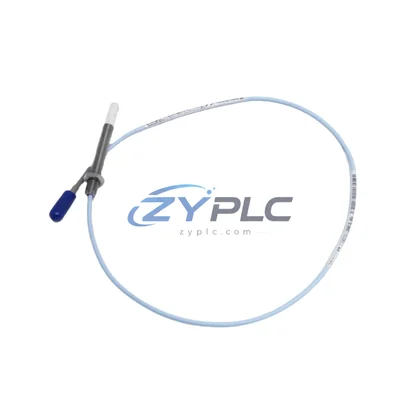
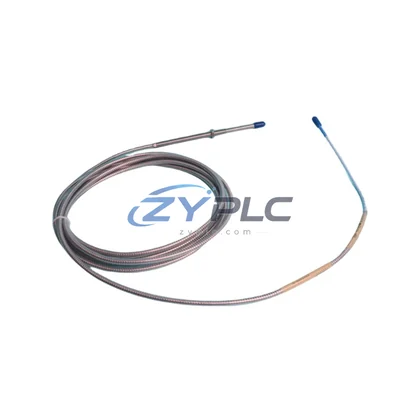
Bently Nevada 990-05-50-01-01: Industrial Vibration Data Link for Smart Factory Connectivity
The Bently Nevada 990-05-50-01-01 is a precision vibration transmitter from the renowned 3300 Series, engineered to serve as a critical node in the industrial data chain of modern smart factories. With a standard 4–20 mA analog output, this transmitter converts raw mechanical vibration signals from rotating machinery into a clean, noise-immune current signal that travels reliably across long cable runs to PLCs, DCS controllers, remote I/O modules, and SCADA systems. In an era where downtime costs manufacturers millions per hour, the 990-05-50-01-01 provides the foundational signal integrity that makes real-time condition monitoring possible.
Designed for DIN rail mounting in control cabinets, the 990-05-50-01-01 integrates seamlessly into existing panel architectures without requiring additional signal conditioning hardware. Its robust analog output is universally compatible with virtually every industrial control platform, from legacy DCS installations to modern IIoT-ready edge gateways, making it an ideal choice for both greenfield smart factory deployments and brownfield system upgrades.
Compatibility & Integration Notes
| Parameter |
Specification |
| SKU / Part Number |
990-05-50-01-01 |
| Brand / Series |
Bently Nevada / 3300 Series |
| Output Protocol |
4–20 mA Analog (2-wire) |
| Interface Type |
DIN Rail Mount, Terminal Block |
| Transmission Capability |
Long-distance analog signal, noise-immune current loop |
| Network Compatibility |
DCS, PLC Analog Input Modules, Remote I/O, SCADA, Edge Gateway |
| System Application |
Rotating Machinery Monitoring, Predictive Maintenance, Condition Monitoring |
| Power Supply |
24 VDC (loop-powered) |
| Mounting |
DIN Rail (35 mm) |
| Warranty |
Warranty and support terms confirmed before quote |
| Shipping |
DHL / FedEx Global Express |
| Availability |
Confirmed via RFQ before quotation |
Connected Automation Data Flow
In a typical smart factory deployment, the Bently Nevada 990-05-50-01-01 sits at the very beginning of the industrial data chain. Vibration sensors — such as Bently Nevada 3300 XL 8mm proximity probes or compatible accelerometers — detect shaft displacement and mechanical oscillation on pumps, compressors, turbines, and motors. The 990-05-50-01-01 conditions and transmits this raw sensor data as a precise 4–20 mA signal into the plant’s control infrastructure.
This analog signal is typically received by a Siemens S7-1500 PLC or Rockwell Automation ControlLogix analog input module, where it is digitized and processed against alarm setpoints. From the PLC, the data flows upstream via PROFIBUS DP or EtherNet/IP to a Siemens SIMATIC WinCC SCADA or GE iFIX HMI platform, where operators monitor vibration trends in real time on graphical dashboards.
For facilities leveraging distributed I/O architectures, the 990-05-50-01-01 output can be wired directly into a Phoenix Contact Axioline F or Beckhoff EL3174 analog input terminal, which then communicates over EtherCAT or PROFINET to the master controller. In more advanced IIoT deployments, the analog signal is digitized at the field level by an HMS Networks Anybus Edge Gateway or a Moxa NPort W2150A serial-to-Ethernet converter, enabling the vibration data to be published via MQTT or OPC UA to cloud-based analytics platforms and digital twin environments.
When integrated with a Bently Nevada System 1 condition monitoring software platform, the 990-05-50-01-01 becomes part of a comprehensive predictive maintenance ecosystem. Alarm thresholds, trend analysis, and spectral data from multiple 3300 Series transmitters are aggregated, enabling maintenance teams to detect bearing wear, rotor imbalance, and misalignment weeks before failure occurs. This data can further feed into ABB Ability™ Asset Health Center or Emerson AMS Device Manager for enterprise-level asset management and remote diagnostics.
The 990-05-50-01-01 also pairs naturally with Bently Nevada 3500 Series rack-based monitoring systems, where it can serve as a field-level transmitter feeding into the 3500/42M Proximitor/Seismic Monitor module, creating a layered protection architecture that satisfies API 670 machinery protection standards for critical rotating equipment.
Solving Data Isolation in Industrial Sites
One of the most persistent challenges in industrial facilities is data isolation — the condition where valuable machinery health data is trapped in proprietary monitoring systems, unable to reach the SCADA, MES, or ERP layers where it can drive operational decisions. The Bently Nevada 990-05-50-01-01 directly addresses this problem through its universal 4–20 mA output, which acts as a protocol-agnostic bridge between specialized vibration monitoring hardware and any industrial control platform.
In brownfield plants where legacy DCS systems lack native support for digital fieldbus protocols, the 990-05-50-01-01’s analog output ensures that critical vibration data is never stranded. Plant engineers can route the 4–20 mA signal into any available analog input card — whether on a Honeywell Experion PKS, Yokogawa CENTUM VP, or ABB System 800xA — without protocol conversion hardware or software middleware.
For facilities pursuing production line transparency and OEE (Overall Equipment Effectiveness) improvement, the 990-05-50-01-01 enables continuous, automated vibration data collection that replaces manual inspection rounds. When combined with a Kepware KEPServerEX OPC server, the digitized vibration values can be shared across the plant network to MES platforms, historian databases, and cloud analytics services simultaneously, eliminating data silos and enabling cross-system correlation between vibration anomalies and production quality metrics.
System expansion is equally straightforward: additional 990-05-50-01-01 transmitters can be added to monitor new machinery without disrupting existing network architecture. Each unit operates independently on its own current loop, ensuring that a fault in one monitoring point does not cascade to others — a critical reliability feature for continuous-process industries such as petrochemicals, power generation, and pulp and paper manufacturing.
Industrial Connectivity FAQ
Q1: What is the communication latency of the 990-05-50-01-01 analog output, and is it suitable for real-time protection systems?
The 4–20 mA analog output of the 990-05-50-01-01 provides essentially instantaneous signal transmission with no protocol overhead or network latency. The current loop responds in real time to changes in vibration amplitude, making it fully suitable for integration into machinery protection systems where fast alarm response is critical. When connected to a PLC or DCS with a fast analog scan cycle (typically 10–100 ms), the end-to-end latency from vibration event to control system alarm is well within the requirements of API 670 protection standards.
Q2: Is the 990-05-50-01-01 compatible with both PROFIBUS and EtherNet/IP control systems?
Yes. Because the 990-05-50-01-01 outputs a standard 4–20 mA analog signal, it is inherently compatible with any control system that accepts analog inputs — including PROFIBUS DP, EtherNet/IP, PROFINET, Modbus RTU/TCP, DeviceNet, and Foundation Fieldbus systems. The analog signal is received by the PLC or DCS analog input module, which then communicates with the rest of the network using its native digital protocol. No special configuration or protocol gateway is required at the transmitter level.
Q3: How does ZYPLC ensure network stability and product quality before shipment?
Every Bently Nevada 990-05-50-01-01 unit supplied by ZYPLC undergoes pre-shipment functional testing to verify output signal accuracy and loop integrity. Units are sourced through verified industrial supply channels and stored in ESD-safe, climate-controlled warehousing. Each unit ships with a warranty and support terms confirmed before quote covering manufacturing defects and functional failures under normal operating conditions. Fast global delivery via DHL and FedEx ensures that replacement units reach your facility quickly to minimize downtime.
Q4: Can the 990-05-50-01-01 be integrated into an existing Bently Nevada System 1 or 3500 Series monitoring rack without system reconfiguration?
Yes. The 990-05-50-01-01 is designed as a field-level transmitter that outputs a standard 4–20 mA signal compatible with the analog input channels of Bently Nevada 3500 Series monitor modules. Integration into an existing System 1 software environment requires only the configuration of a new analog input tag mapped to the transmitter’s engineering units (typically mm/s or g for vibration velocity or acceleration). No firmware updates or rack reconfiguration are required, making it an ideal drop-in addition or replacement for existing 3300 Series field instrumentation.