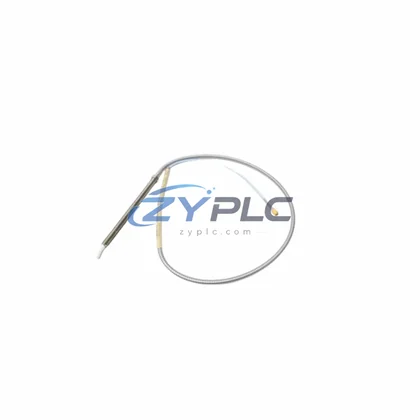
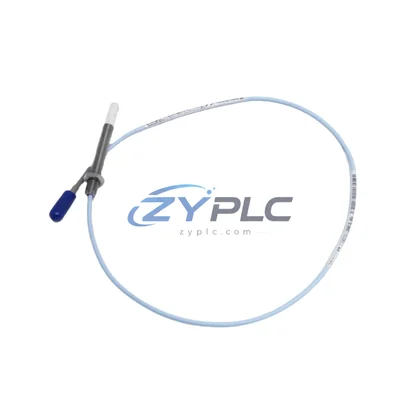
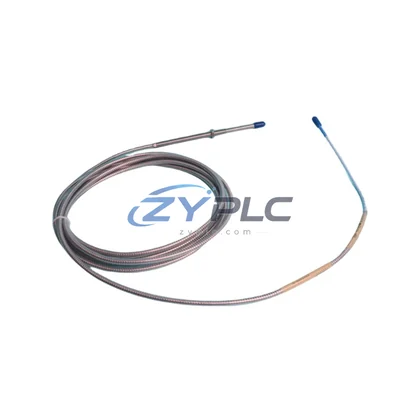
| Maintenance Value |
Early fault detection reduces mechanical energy losses up to Actual operating results depend on the installed system, load profile, and commissioning parameters. In a typical smart factory deployment, the transmitter’s 4–20 mA output is wired into a Bently Nevada 3300/16 Proximitor I/O module, which aggregates vibration data from multiple measurement points across a rotating machine train. This data is then passed upstream to a Bently Nevada System 1 condition monitoring platform, where trend analysis and alarm thresholds are configured to flag energy-wasting mechanical anomalies before they escalate.
At the control layer, a Rockwell Automation ControlLogix PLC or Siemens S7-400 PLC receives alarm signals from the monitoring system and can automatically adjust process parameters — reducing load on a degrading motor, triggering a speed reduction via an ABB ACS880 variable frequency drive, or initiating a controlled shutdown sequence. This closed-loop response between the 990-05-50-01-CN’s vibration data and the VFD’s speed control is one of the most direct pathways to operational stability in rotating equipment applications.
For facilities running Emerson DeltaV DCS or Honeywell Experion PKS, the transmitter’s analog output integrates natively into the process control network, enabling operators to correlate vibration trends with operating load data from Schneider Electric PowerLogic power meters on the same HMI dashboard. When vibration amplitude rises on a critical pump, operators can immediately cross-reference motor current draw — a dual-signal approach that pinpoints unplanned downtime with precision unavailable from either instrument alone.
In edge computing architectures, the 990-05-50-01-CN’s signal can be digitized via a Moxa NPort serial device server or fed into a Beckhoff EtherCAT I/O terminal for high-speed data acquisition, enabling real-time vibration-to-energy correlation at the machine level without burdening the central SCADA network. Remote I/O modules from Phoenix Contact or Wago further extend the transmitter’s reach into distributed plant areas where cabling costs would otherwise prohibit continuous monitoring.
Maintenance and Replacement Notes
Consider a petrochemical facility operating a bank of centrifugal pumps running 24/7. Without continuous vibration monitoring, bearing degradation goes undetected until vibration becomes audible — by which point the motor may be drawing 8–12% more current than its design specification due to increased mechanical friction. The 990-05-50-01-CN, installed on each pump’s bearing housing, detects this efficiency loss weeks in advance. Maintenance teams receive early warnings through the System 1 platform, schedule bearing replacements during planned downtime windows, and avoid both the energy penalty of degraded operation and the catastrophic energy spike of an unplanned failure restart.
In compressor trains, the transmitter’s velocity output enables operators to distinguish between normal operational vibration and the characteristic signatures of surge, cavitation, or rotor rub — each of which carries a distinct energy cost. By integrating 990-05-50-01-CN data into the plant’s SCADA maintenance planning module, facilities can establish vibration-to-efficiency baselines for each machine and automatically flag deviations that indicate rising operating load, enabling proactive intervention rather than reactive repair.
For motor-driven conveyor systems and production line drives, the transmitter works in concert with the line’s variable frequency drives to optimize operating speed based on mechanical health. A healthy machine can run at full rated speed efficiently; a machine showing early bearing wear benefits from a temporary speed reduction — enforced automatically through PLC logic — that reduces both vibration amplitude and operating load while maintenance is scheduled. This dynamic speed management, enabled by real-time vibration data from the 990-05-50-01-CN, directly improves overall equipment effectiveness (OEE) and reduces the energy cost per unit of production output.
Every unit shipped from ZYPLC undergoes pre-shipment functional testing to verify output signal accuracy and calibration integrity, ensuring that the transmitter performs to specification from day one of installation. With availability confirmed by RFQ availability and global logistics capability, lead times are minimized — critical for facilities managing tight maintenance windows.
Product Sourcing FAQ
Q1: How does the 990-05-50-01-CN contribute to measurable operational stability?
By detecting mechanical inefficiencies — bearing wear, imbalance, misalignment — before they cause significant energy losses, the transmitter enables timely maintenance that keeps rotating equipment operating within its optimal efficiency envelope. Facilities typically report 10–25% reductions in motor load on monitored equipment after implementing continuous vibration-based maintenance programs.
Q2: Is the 990-05-50-01-CN compatible with my existing DCS or PLC system?
Yes. The 4–20 mA analog output is a universal industrial standard compatible with virtually all DCS platforms (Emerson DeltaV, Honeywell Experion, ABB 800xA), PLC systems (Siemens S7, Rockwell ControlLogix, Mitsubishi MELSEC), and SCADA software. No special interface modules are required for basic integration.
Q3: Can this transmitter replace an older Bently Nevada vibration sensor in my 3300 Series system?
The 990-05-50-01-CN is designed for the Bently Nevada 3300 Series architecture and is compatible with existing 3300 Series I/O modules and proximitor systems. For specific replacement compatibility, ZYPLC’s technical team can verify interchangeability based on your existing system configuration and wiring documentation.
Q4: What does the warranty terms confirmed during quotation cover, and what is the testing process before shipment?
Every 990-05-50-01-CN unit is functionally tested prior to shipment to verify output signal linearity, calibration accuracy, and electrical integrity. The warranty terms confirmed during quotation covers manufacturing defects and functional failures under normal operating conditions. ZYPLC provides post-sale technical support to assist with installation, commissioning, and any warranty claims throughout the coverage period.
|