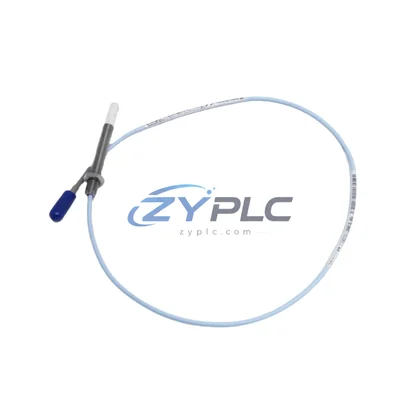
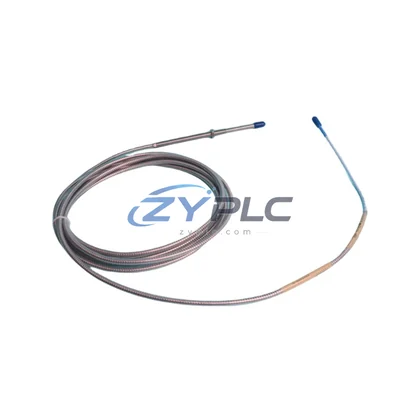
Bently Nevada 990-05-XX-01-CN: Industrial Data Link for Smart Factory Vibration Monitoring
The Bently Nevada 990-05-XX-01-CN is a precision vibration transmitter from the renowned 3300 Series, engineered to serve as a critical node in the industrial data chain of modern smart factories. Delivering a standard 4–20 mA analog output signal, this transmitter bridges the gap between rotating machinery field sensors and upper-level control and monitoring systems — including PLC controllers, DCS platforms, SCADA supervisory systems, and HMI operator interfaces. In an era where real-time machine health data drives predictive maintenance and operational transparency, the 990-05-XX-01-CN provides the reliable, low-latency signal path that industrial engineers depend on.
Designed for continuous operation in demanding industrial environments, the 990-05-XX-01-CN captures vibration data from proximity probes and eddy-current sensors mounted on rotating shafts, compressors, turbines, and pumps. Its conditioned 4–20 mA output is universally compatible with analog input modules across major PLC platforms — including Rockwell Automation ControlLogix and CompactLogix series, Siemens S7-300/S7-400 analog I/O cards, and ABB AC500 remote I/O modules — enabling seamless integration into existing control architectures without protocol conversion overhead at the field level.
Compatibility & Integration Notes
| Parameter |
Specification |
| SKU |
990-05-XX-01-CN |
| Brand / Series |
Bently Nevada / 3300 Series |
| Output Protocol |
4–20 mA Analog (Universal) |
| Interface Type |
2-Wire Analog Transmitter Output |
| Signal Transmission |
Continuous, real-time vibration amplitude signal |
| Network Compatibility |
DCS, PLC Analog Input, SCADA, HMI via signal conditioners or I/O gateways |
| System Application |
Rotating machinery protection, predictive maintenance, condition monitoring, SCADA integration |
| Power Supply |
18–30 VDC (loop-powered) |
| Operating Temperature |
-35°C to +85°C |
| Origin |
United States |
| Warranty |
warranty terms confirmed during quotation |
| Stock Status |
RFQ Available — Global Shipping Available |
Connected Automation Data Flow
In a typical smart factory deployment, the 990-05-XX-01-CN sits at the front end of the vibration monitoring data chain. Eddy-current proximity probes — such as those from the Bently Nevada 3300 XL 8mm Proximity Transducer System — feed raw displacement signals into the transmitter, which conditions and converts them into a stable 4–20 mA loop current proportional to vibration amplitude. This analog signal is then wired directly into the analog input cards of a Rockwell Automation ControlLogix L7x PLC or a Siemens S7-400 distributed control system, where engineering unit scaling converts the current value into real-time vibration readings in mils or microns.
For facilities running a Bently Nevada System 1 condition monitoring platform, the 990-05-XX-01-CN output can be simultaneously routed to a Bently Nevada 3500 Series rack-based machinery protection system, providing dual-path data availability — one path for continuous protection trip logic and another for trending and diagnostics. The 3500/22M Transient Data Interface module within the same rack captures transient events and forwards structured data packets upstream to the System 1 server via EtherNet/IP, where SCADA operators using Wonderware InTouch or GE iFIX HMI screens can visualize shaft orbit plots, trend waveforms, and alarm states in real time.
Where legacy 4–20 mA signals must be bridged into modern Modbus TCP or PROFINET networks, a Moxa NE-4100T serial-to-Ethernet device server or a ProSoft Technology MVI56E-MCM communication module installed in the ControlLogix backplane handles the protocol conversion transparently. Remote I/O nodes — such as Rockwell Automation POINT I/O 1734-IE4C analog input modules or Siemens ET 200SP IM 155-6 PN distributed I/O — aggregate multiple transmitter channels and deliver consolidated process data over PROFINET or EtherNet/IP to the main PLC CPU. From there, a Kepware KEPServerEX OPC-UA gateway archives time-series vibration data for long-term trend analysis, anomaly detection, and regulatory compliance reporting.
At the edge layer, an industrial edge gateway such as the Advantech WISE-5231 or a Siemens SIMATIC IPC427E running edge analytics software can pre-process the vibration data stream locally, applying FFT spectrum analysis and envelope detection algorithms before forwarding condensed diagnostic results to cloud-based asset management platforms. This architecture ensures that even in bandwidth-constrained plant networks, only actionable intelligence — not raw waveform data — traverses the WAN link, reducing network load while maintaining full diagnostic fidelity at the control room level.
Solving Data Isolation in Industrial Sites
One of the most persistent challenges in industrial facilities is the coexistence of legacy analog instrumentation alongside modern digital fieldbus and Ethernet-based control networks. The Bently Nevada 990-05-XX-01-CN directly addresses this challenge by providing a universally accepted 4–20 mA output that any analog input module can consume — regardless of the PLC brand, DCS vendor, or SCADA platform in use. This eliminates the data isolation that occurs when proprietary vibration monitoring systems cannot communicate with plant-wide control infrastructure.
For sites undergoing digital transformation, the 990-05-XX-01-CN serves as a stable bridge technology. Its analog output can be ingested by protocol gateway devices — such as the HMS Networks Anybus Communicator or the Red Lion Data Station Plus — which translate the 4–20 mA signal into Modbus RTU, Modbus TCP, EtherNet/IP, or PROFIBUS DP frames consumable by modern SCADA and MES systems. This approach enables production line transparency without requiring a full instrumentation overhaul, protecting capital investment while progressively modernizing the data architecture.
Remote diagnostics capability is another key benefit. By integrating the 990-05-XX-01-CN output into a SCADA system with remote access functionality — such as Ignition SCADA by Inductive Automation or Siemens WinCC — maintenance engineers can monitor vibration trends, acknowledge alarms, and initiate work orders from any location with network access. Alarm thresholds configured in the upstream PLC or DCS trigger automatic notifications via email or SMS when vibration levels exceed safe operating limits, enabling predictive maintenance interventions before catastrophic failures occur. This closed-loop feedback architecture — from field sensor through transmitter, PLC, SCADA, and back to the maintenance team — is the foundation of Industry 4.0 condition-based maintenance strategy.
System scalability is fully supported. Additional 990-05-XX-01-CN transmitters can be added to monitor multiple measurement points on the same machine or across multiple machines in a production line, with each channel independently wired to available analog input slots. As the monitoring network grows, the consistent 4–20 mA interface ensures that new transmitters integrate without software reconfiguration of the upstream control system, reducing commissioning time and engineering cost.
Industrial Connectivity FAQ
Q1: What is the communication latency of the 990-05-XX-01-CN signal output?
The 990-05-XX-01-CN delivers a continuous, real-time 4–20 mA analog signal with no digital communication latency. The signal update rate is determined by the analog input scan rate of the receiving PLC or DCS module — typically 10–100 ms for standard analog input cards — making it suitable for high-frequency vibration monitoring applications where timely alarm response is critical.
Q2: Is the 990-05-XX-01-CN compatible with PROFIBUS, Modbus, or EtherNet/IP networks?
The 990-05-XX-01-CN outputs a standard 4–20 mA analog signal, which is protocol-agnostic at the field level. Integration into PROFIBUS DP, Modbus RTU/TCP, or EtherNet/IP networks is achieved through analog input modules or protocol gateway devices connected to the receiving PLC or DCS. This makes the transmitter compatible with virtually any industrial control platform without modification.
Q3: How does the 990-05-XX-01-CN support network stability in continuous process environments?
As a loop-powered 2-wire transmitter, the 990-05-XX-01-CN has no active switching components in the signal path, resulting in an inherently stable and noise-immune output. The 4–20 mA current loop is resistant to electromagnetic interference common in industrial environments, and the live-zero (4 mA) design allows the receiving system to detect open-circuit or broken-wire faults, supporting network integrity monitoring.
Q4: What warranty and pre-shipment testing does the 990-05-XX-01-CN include?
Every 990-05-XX-01-CN unit supplied by ZYPLC is covered by a warranty terms confirmed during quotation against manufacturing defects and functional failures. Prior to shipment, each unit undergoes functional verification testing to confirm output signal accuracy and loop integrity. Units are sourced from authorized distribution channels and stored in controlled warehouse conditions to ensure full specification compliance upon delivery. Global shipping is available with lead times confirmed at the time of order.