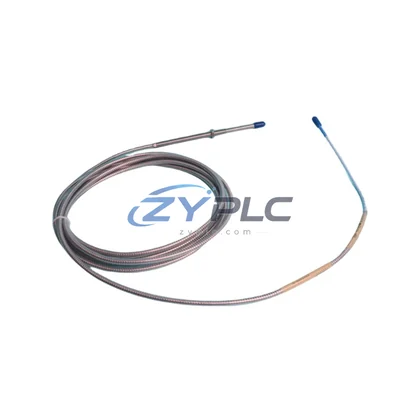
Bently Nevada 991-05-50-01-00 Thrust Transmitter for 991 Series
The Bently Nevada 991-05-50-01-00 is a precision thrust transmitter engineered for seamless integration within the Bently Nevada 991 Series condition monitoring architecture. In modern industrial automation, machinery protection is not a standalone function — it is a critical layer within a multi-tier control system that spans the field sensor layer, signal conditioning layer, monitoring and protection layer, communication layer, and supervisory control layer. The 991-05-50-01-00 occupies a pivotal role in this hierarchy, converting axial displacement signals from proximity probe systems into standardized analog outputs that feed directly into plant-wide DCS and PLC platforms.
Thrust monitoring is among the most safety-critical measurements in rotating machinery management. Axial displacement beyond design limits can result in catastrophic bearing failure, rotor-stator contact, and unplanned shutdowns. The 991-05-50-01-00 transmitter ensures that thrust position data is continuously conditioned, scaled, and transmitted with the accuracy and reliability demanded by API 670-compliant machinery protection systems. Its architecture-ready design means it is built not just to measure, but to communicate — delivering 4–20 mA analog signals that integrate directly with safety instrumented systems (SIS), distributed control systems (DCS), and programmable logic controllers without signal conversion overhead.
Within a complete Bently Nevada 991 Series monitoring rack, the 991-05-50-01-00 operates in coordination with the 991-01-00-01-00 power supply module, which provides regulated, isolated DC power to the transmitter and adjacent monitoring cards. Signal inputs originate from 330500 series proximity probes and 330130 series extension cables, which together form the field-level sensing chain for axial position measurement. The transmitter’s output is routed to the 3500/42M Proximitor/Seismic Monitor or directly to a DCS analog input card, depending on the plant architecture. In redundant configurations, dual-channel monitoring is achieved by pairing the 991-05-50-01-00 with a second transmitter channel and a 3500/20 Rack Interface Module, ensuring that a single-point failure in the monitoring chain does not compromise machinery protection integrity.
Product Specification Table
| Parameter |
Specification |
| System Role |
Thrust Position Signal Conditioner & Transmitter |
| SKU / Part Number |
991-05-50-01-00 |
| Brand / Series |
Bently Nevada / 991 Series |
| Output Signal |
4–20 mA Analog (2-wire) |
| Input Compatibility |
Bently Nevada 330500 / 330900 Proximity Probe Systems |
| Measurement Type |
Axial Thrust Position (Displacement) |
| Supply Voltage |
18–30 VDC (loop-powered) |
| Operating Temperature |
-40°C to +85°C |
| Protection Rating |
IP66 (field-mount enclosure) |
| Communication |
4–20 mA to DCS / SIS / PLC Analog Input |
| Compliance |
API 670, CE Marked |
| Mounting |
DIN Rail / Panel Mount |
| Warranty |
warranty terms confirmed during quotation — Tested & Verified Before Shipment |
System Compatibility Notes
The 991-05-50-01-00 does not function in isolation. Its value is realized within a coordinated machinery protection and process control architecture. At the field level, 330500-series proximity probes sense rotor axial position and transmit raw eddy-current signals through 330130 armored extension cables to the transmitter’s input terminals. The 991-05-50-01-00 conditions these signals and outputs a calibrated 4–20 mA loop signal that represents the full thrust measurement range.
This analog output is typically wired to a 3500/42M Proximitor/Seismic Monitor housed in a 3500 Series rack, where it is processed alongside radial vibration channels from 3300 XL series proximity probes. The 3500 rack’s 3500/20 Rack Interface Module manages communication between the monitoring system and the plant DCS — commonly a Honeywell Experion PKS, Emerson DeltaV, or ABB 800xA platform — via Modbus RTU or Ethernet/IP. In safety-critical applications, the thrust signal is simultaneously routed to a Safety Instrumented System (SIS) such as a Triconex Tricon or Rockwell GuardLogix controller, where it participates in the machinery trip logic.
Power integrity for the entire monitoring chain is maintained by the 991-01-00-01-00 power supply module, which provides clean, isolated DC power to the transmitter and adjacent I/O cards. In high-availability plant designs, redundant power feeds from dual 991-01-00-01-00 units ensure that a power supply failure does not interrupt thrust monitoring. HMI visualization of thrust trends is handled by operator stations running Bently Nevada System 1 software or third-party SCADA platforms, where historical thrust data supports predictive maintenance decisions and bearing wear trending.
For plants operating gas turbines, steam turbines, or large centrifugal compressors, the 991-05-50-01-00 is often deployed alongside 3300 XL 8mm proximity probe systems for radial vibration, 3500/61 temperature monitors for bearing temperature, and 3500/64 process variable monitors for seal gas pressure — creating a comprehensive, multi-parameter machinery health monitoring architecture within a single 3500 Series rack infrastructure.
Industrial Application Notes
The 991-05-50-01-00 thrust transmitter finds application across a wide range of heavy industrial sectors where rotating machinery reliability is mission-critical. In oil and gas processing plants, it monitors axial thrust on main gas compressors and booster pumps, providing early warning of thrust bearing degradation before it escalates to a forced shutdown. In power generation facilities — including combined-cycle gas turbine plants and steam turbine generators — the transmitter feeds thrust data into turbine control systems, enabling load management decisions that protect rotor integrity during transient operating conditions.
In petrochemical and refinery environments, the 991-05-50-01-00 is installed on reactor feed pumps, cracked gas compressors, and ethylene plant expanders, where axial position monitoring is a regulatory and insurance requirement under API 670. Water treatment and desalination plants use the transmitter on high-speed centrifugal pumps, where thrust imbalance caused by impeller wear or hydraulic instability must be detected early to prevent catastrophic pump failure. Mining and mineral processing operations deploy the 991-05-50-01-00 on SAG mill pinion drives and slurry pump systems, where harsh environmental conditions demand the transmitter’s robust IP66-rated field enclosure.
In metallurgical plants and steel mills, the transmitter monitors thrust on rolling mill drive motors and continuous caster pinch roll drives, where axial forces are high and bearing life is a key maintenance KPI. Across all these applications, the 991-05-50-01-00 delivers consistent, architecture-integrated thrust monitoring that supports both real-time protection and long-term predictive maintenance programs.
Product Compatibility FAQ
Q1: Is the 991-05-50-01-00 compatible with existing 3500 Series monitoring racks and DCS analog input cards?
Yes. The 991-05-50-01-00 outputs a standard 4–20 mA two-wire signal that is universally compatible with 3500 Series rack analog inputs and any DCS or SIS analog input card accepting 4–20 mA signals. No signal conversion or additional interface modules are required for integration into Honeywell, Emerson, ABB, or Siemens DCS platforms. Verify loop supply voltage (18–30 VDC) is available from the DCS or a dedicated loop power supply before installation.
Q2: Can the 991-05-50-01-00 be used in a redundant thrust monitoring configuration, and what additional components are needed?
Yes. Redundant thrust monitoring is achieved by installing two 991-05-50-01-00 transmitters on independent probe channels (typically a primary and a backup proximity probe pair) and routing their outputs to separate analog input channels on the 3500/42M monitor or the SIS. A 3500/20 Rack Interface Module manages voting logic between channels. Redundant 991-01-00-01-00 power supply modules should be used to eliminate power as a single point of failure in the monitoring chain.
Q3: What does the warranty terms confirmed during quotation cover, and how is long-term spare parts availability managed?
The 991-05-50-01-00 is supplied with a warranty terms confirmed during quotation covering manufacturing defects, calibration accuracy, and electrical performance under normal operating conditions. Each unit is tested and verified before shipment. For long-term maintenance planning, we recommend holding at least one spare transmitter per critical machine train to support rapid swap-out during planned turnarounds or unplanned trips. Our inventory is maintained to support ongoing spare parts supply, and our engineering team can assist with cross-referencing obsolete part numbers to current equivalents within the Bently Nevada 991 Series product family.