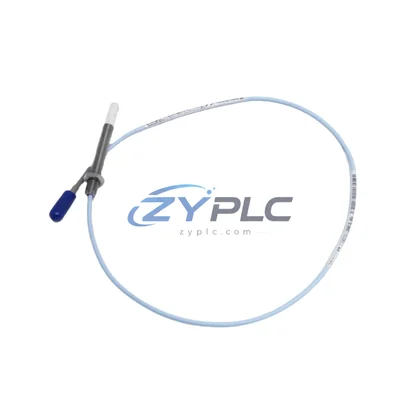
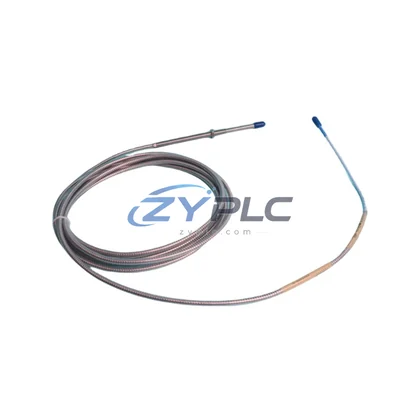
Bently Nevada 991-06-50-01-CN: Industrial Data Link for Smart Factory Thrust Monitoring
The Bently Nevada 991-06-50-01-CN is a high-precision thrust transmitter engineered for continuous axial position monitoring in rotating machinery environments. Designed as a core node in the 991 Series signal chain, this transmitter converts raw displacement data from eddy-current proximity probes into a stable 4-20mA analog output — the universal language of industrial process control. In smart factory deployments, the 991-06-50-01-CN serves as the critical bridge between field-level mechanical sensing and upper-layer control, SCADA, and asset management systems, enabling real-time data flow across the entire automation hierarchy.
At the field device layer, the 991-06-50-01-CN interfaces directly with Bently Nevada 3300 XL series proximity probes and extension cables, receiving raw gap voltage signals and conditioning them into a linear, noise-immune 4-20mA current loop. This signal is inherently immune to cable resistance variation and electromagnetic interference — a key advantage in high-voltage motor rooms, turbine halls, and compressor stations where signal integrity is non-negotiable. The transmitter’s output is then routed to distributed control systems (DCS) or PLC analog input modules, such as those found in the Bently Nevada 3500 Series rack-based monitoring platform, where it is digitized and processed for alarm logic, trend analysis, and protective shutdown sequencing.
Compatibility & Integration Notes
| Parameter |
Specification |
| Output Protocol |
4-20mA Analog (2-wire current loop) |
| Interface Type |
Analog Signal Output / Terminal Block |
| Transmission Range |
Up to 1000m via shielded twisted-pair cable |
| Network Compatibility |
DCS, PLC Analog Input, SCADA via I/O gateway, Fieldbus via signal converter |
| System Application |
Rotating Machinery Protection, Thrust Monitoring, Vibration Analysis, Smart Factory Asset Management |
| Signal Accuracy |
±1% Full Scale |
| Power Supply |
18–30 VDC (loop-powered) |
| Operating Temperature |
-40°C to +85°C |
| Warranty |
warranty terms confirmed during quotation | Tested Before Shipment |
Connected Automation Data Flow
In a typical smart factory architecture, the 991-06-50-01-CN sits at the intersection of mechanical sensing and digital control. The data flow begins at the rotating shaft, where a Bently Nevada 3300 XL 8mm proximity probe detects axial displacement in real time. The probe signal travels through a matched extension cable to the 991-06-50-01-CN transmitter, which conditions and scales the signal into a 4-20mA loop current proportional to thrust position.
This current signal is wired directly into the analog input card of a Bently Nevada 3500/40M proximitor I/O module housed within the 3500 Series monitoring rack. The rack’s communication backplane aggregates data from multiple channels — including radial vibration from 3500/42M modules, speed from 3500/25 keyphasor modules, and temperature from 3500/60 temperature monitors — and transmits the consolidated dataset upstream via Modbus TCP or OPC-UA to the plant DCS or SCADA server.
At the SCADA layer, platforms such as GE iFIX, Wonderware System Platform, or Ignition by Inductive Automation receive the thrust position data alongside vibration amplitude, phase, and speed vectors. Operators at HMI workstations can visualize shaft centerline plots, trend thrust excursions, and configure alarm setpoints for high-thrust and danger-level trips. When the 991-06-50-01-CN signal crosses a configured threshold, the 3500 rack issues a relay output to the turbine control system — often a Woodward 505 governor or a Siemens S7-400 safety PLC — triggering a controlled shutdown sequence to protect the machine from catastrophic axial contact.
For facilities integrating edge computing, the 4-20mA output of the 991-06-50-01-CN can be digitized by an edge gateway such as a Moxa ioLogik E1240 or a Advantech ADAM-6017, which converts the analog signal to Modbus TCP or MQTT for transmission to cloud-based asset performance management (APM) platforms. This enables remote diagnostics, predictive maintenance scheduling, and fleet-wide benchmarking without requiring modifications to the existing wiring infrastructure. Industrial network switches — such as those in the Hirschmann MICE or Cisco IE 4000 series — provide the managed Ethernet backbone that carries this data reliably across the plant floor network, ensuring deterministic latency and VLAN segmentation between the safety instrumented system (SIS) and the business network.
Solving Data Isolation in Industrial Sites
One of the most persistent challenges in rotating machinery protection is data isolation — the condition where critical mechanical health data is trapped within proprietary monitoring racks and never reaches the plant’s broader automation and business intelligence infrastructure. The Bently Nevada 991-06-50-01-CN directly addresses this problem by outputting a universally compatible 4-20mA signal that any PLC, DCS, or I/O gateway can consume without proprietary drivers or software licenses.
In legacy plants where the 3500 Series rack communicates only via RS-232 or RS-485 Modbus RTU, a protocol gateway such as the Moxa MGate MB3180 or ProSoft Technology MVI56-MCM can bridge the serial Modbus data to Ethernet Modbus TCP, making thrust position data available to modern SCADA and MES systems. This eliminates the data silo that has historically separated machinery protection systems from process historians like OSIsoft PI (now AVEVA PI System), where long-term trend data is essential for condition-based maintenance programs.
For multi-machine installations — such as a compressor train with a high-pressure compressor, low-pressure compressor, and driver turbine — the 991-06-50-01-CN can be deployed across all machines simultaneously, with each transmitter’s 4-20mA output wired to a dedicated channel in the 3500 rack. The rack’s system-level communication then delivers a unified data stream to the SCADA historian, enabling cross-machine correlation analysis. Maintenance engineers can compare thrust trends across the train, identify coupling misalignment signatures, and schedule bearing inspections before unplanned downtime occurs.
Remote monitoring capability is further enhanced when the 991-06-50-01-CN’s signal chain is integrated with a plant-wide industrial Ethernet network. With proper VLAN configuration and firewall segmentation, remote engineers can access live thrust data through a secure VPN connection to the SCADA server, enabling off-site diagnostics and alarm acknowledgment without dispatching field personnel. This capability is particularly valuable for offshore platforms, remote pipeline compressor stations, and unmanned substations where travel costs and safety risks make on-site visits expensive.
Industrial Connectivity FAQ
Q1: Does the Bently Nevada 991-06-50-01-CN support digital fieldbus protocols such as HART, PROFIBUS, or Foundation Fieldbus?
A: The 991-06-50-01-CN outputs a standard 4-20mA analog signal. It does not natively support HART, PROFIBUS, or Foundation Fieldbus. However, the 4-20mA signal can be converted to any digital protocol using a signal converter or I/O gateway, making it compatible with virtually any DCS or SCADA architecture. For native digital protocol support within the 991 Series ecosystem, consult the Bently Nevada 3500 rack communication options.
Q2: What is the maximum cable length for the 4-20mA output signal, and does cable resistance affect accuracy?
A: The 4-20mA current loop signal of the 991-06-50-01-CN can be transmitted over shielded twisted-pair cable up to approximately 1000 meters without significant signal degradation, provided the total loop resistance (cable + load) remains within the transmitter’s specified compliance voltage range. Unlike voltage signals, current loop signals are inherently resistant to resistive cable losses, making them ideal for long-distance field wiring in large industrial facilities.
Q3: How is network stability and data continuity ensured in high-vibration or high-EMI environments?
A: The 991-06-50-01-CN is designed for installation in harsh industrial environments. The 4-20mA current loop output provides inherent noise immunity against electromagnetic interference (EMI) from variable frequency drives (VFDs), large motors, and high-voltage switchgear. For additional protection, shielded cable with proper grounding at a single point is recommended. The transmitter’s robust housing and wide operating temperature range (-40°C to +85°C) ensure reliable operation in demanding plant conditions.
Q4: What quality assurance and warranty coverage is provided with the 991-06-50-01-CN?
A: Every Bently Nevada 991-06-50-01-CN unit supplied by ZYPLC undergoes functional testing prior to shipment, verifying output linearity, loop compliance, and signal stability across the full measurement range. All units are covered by a warranty terms confirmed during quotation against manufacturing defects. Availability is confirmed via RFQ for shipment arranged after confirmation, supporting urgent maintenance and replacement requirements for critical rotating machinery protection systems.