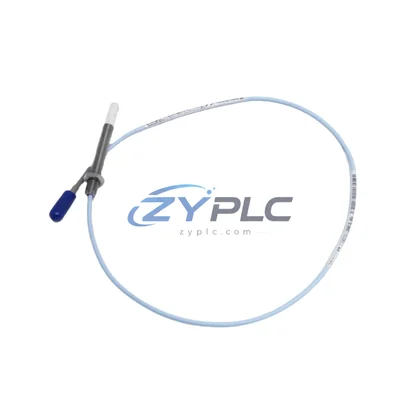
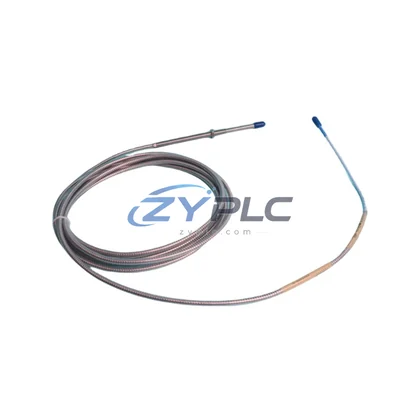
Bently Nevada 991-06-50-02-00 Eddy Current Sensor for 3300 Series Automation
The Bently Nevada 991-06-50-02-00 is a high-precision eddy current sensor designed for continuous, non-contact shaft vibration and position monitoring in demanding industrial environments. As part of the Bently Nevada 3300 Series proximity system, this sensor plays a critical role in reducing unplanned downtime risk by enabling real-time condition monitoring that prevents unplanned downtime, eliminates over-maintenance cycles, and keeps rotating machinery operating at peak efficiency.
In modern manufacturing and process plants, undetected rotor imbalance, shaft misalignment, or bearing wear forces motors and drives to compensate with excess power draw. The 991-06-50-02-00 addresses this directly: by delivering accurate radial vibration data to the control system, it allows engineers to identify mechanical inefficiencies before they escalate into energy-wasting fault conditions. When paired with a Bently Nevada 3500/42M Proximitor I/O Module, the sensor feeds continuous displacement signals into the plant’s condition monitoring network, enabling the control layer to make informed decisions about load distribution and motor speed adjustment.
Facilities running Rockwell Automation Allen-Bradley PowerFlex 755 variable frequency drives benefit significantly from integrating the 991-06-50-02-00 into their closed-loop control architecture. The vibration data captured by this sensor can be used to trigger speed corrections in the VFD, reducing motor load during low-load periods and preventing resonance-induced power spikes. Similarly, when connected to a Siemens S7-1500 PLC via PROFIBUS or PROFINET, the sensor’s output can be mapped to maintenance planning routines that automatically adjust setpoints based on real-time mechanical health data.
The sensor’s compatibility with the Bently Nevada System 1 software platform further extends its maintenance planning value. System 1 aggregates vibration, temperature, and process data across multiple assets, enabling plant-wide energy audits and predictive maintenance scheduling. By replacing reactive maintenance with data-driven intervention, facilities report measurable reductions in motor rewind costs, bearing replacement frequency, and associated production losses.
For high-speed turbomachinery applications, the 991-06-50-02-00 is typically deployed alongside the Bently Nevada 3300 XL 8mm Proximitor Sensor and the 3300/16 Proximitor I/O Module to form a complete shaft monitoring loop. This configuration supports both radial and axial position measurement, giving the control system a full picture of rotor dynamics. When integrated with a Yokogawa CENTUM VP DCS or an ABB System 800xA, the sensor data feeds directly into maintenance planning algorithms that modulate steam or gas flow in turbine applications, reducing fuel consumption without sacrificing throughput.
In pump and compressor stations, the 991-06-50-02-00 works in conjunction with Emerson AMS Device Manager and the Rosemount 3051 pressure transmitter to create a multi-variable monitoring environment. Pressure and vibration data are correlated to detect cavitation, impeller wear, and seal degradation — all of which cause measurable increases in pump operating load. Early detection through the 991-06-50-02-00 allows maintenance teams to schedule corrective action during planned shutdowns rather than emergency stops, preserving both energy efficiency and production continuity.
Every unit shipped by ZYPLC undergoes full functional testing prior to dispatch, including signal output verification, gap voltage calibration, and sensitivity confirmation against Bently Nevada factory specifications. Stock is maintained on-hand to support urgent replacement requirements, with same-day shipping available for availability confirmed by RFQ items. All products are covered by a warranty terms confirmed during quotation from the date of shipment.
Product Specification Table
| Parameter |
Specification |
| SKU / Part Number |
991-06-50-02-00 |
| Brand / Manufacturer |
Bently Nevada |
| Series |
3300 XL Proximity System |
| Sensor Type |
Eddy Current (Non-Contact) Proximity Sensor |
| Measurement Range |
0 – 2.54 mm (0 – 100 mil) |
| Output Signal |
–24 VDC nominal (gap voltage), linear analog |
| Operating Temperature |
–35°C to +121°C (–31°F to +250°F) |
| Compatible Systems |
Bently Nevada 3300, 3500 Series; System 1 Software |
| Application Environment |
Rotating machinery, turbines, compressors, pumps, motors |
| Maintenance Value |
Enables predictive maintenance, reduces unplanned downtime & excess motor load |
| Origin |
United States |
| Warranty |
warranty terms confirmed during quotation from date of shipment |
System Compatibility and Application
The 991-06-50-02-00 is engineered to integrate seamlessly into multi-layer industrial automation architectures where energy efficiency is a design priority. At the field level, the sensor connects to the Bently Nevada 3300/16 Proximitor I/O Module, which conditions the raw eddy current signal and transmits calibrated displacement data to the process control layer. This signal is then consumed by a Bently Nevada 3500/42M Proximitor I/O Module within the machinery protection rack, where it is compared against user-defined alert and danger thresholds.
At the control execution layer, the conditioned vibration signal integrates with Siemens S7-1500 PLCs running maintenance planning function blocks, or with Allen-Bradley ControlLogix L8x controllers via EtherNet/IP. These controllers use the vibration data to modulate the output frequency of connected Siemens SINAMICS G120 variable speed drives or Rockwell PowerFlex 755 VFDs, reducing motor speed — and therefore operating load — when mechanical conditions permit.
For data monitoring and visualization, the sensor’s output feeds into Bently Nevada System 1 Condition Monitoring Software, which provides trend analysis, alarm management, and operating load correlation across the asset fleet. HMI visualization is handled by Siemens SIMATIC TP1200 Comfort Panels or Rockwell PanelView Plus 7 terminals, giving operators real-time insight into shaft dynamics and energy draw without leaving the control room.
Communication between the field devices and the plant historian is managed via PROFIBUS DP or PROFINET IO protocols, ensuring low-latency data delivery to the SCADA layer. Power supply to the Proximitor system is provided by dedicated Bently Nevada 3500/15 Power Supply Modules, which maintain stable excitation voltage to the sensor under all load conditions — a prerequisite for accurate gap measurement and reliable maintenance planning decisions.
Maintenance and Replacement Notes
In a typical continuous process plant running centrifugal compressors or steam turbines, undetected rotor eccentricity can increase bearing friction losses by 3–8%, translating directly into elevated motor current draw and higher energy costs. The 991-06-50-02-00 eliminates this hidden energy drain by providing sub-micron resolution shaft position data that allows the control system to detect and respond to developing mechanical faults before they affect power consumption.
On automotive and heavy manufacturing lines where large induction motors drive conveyor systems, presses, and cooling towers, the sensor enables a shift from time-based to condition-based maintenance. Instead of shutting down equipment on a fixed schedule — which often means stopping healthy, energy-efficient machines — maintenance is triggered only when vibration trends indicate actual degradation. This approach reduces unnecessary production interruptions, keeps line throughput consistent, and avoids the energy penalty of repeated motor start-up cycles.
In power generation facilities, the 991-06-50-02-00 is deployed on generator shaft monitoring loops where even minor rotor imbalance can cause significant efficiency losses in the electromagnetic conversion process. By maintaining shaft displacement within optimal operating bands, the sensor contributes directly to generator efficiency and grid stability. Plants using this sensor as part of a comprehensive Bently Nevada protection system report reduced forced outage rates and improved capacity factor — both of which have direct energy cost implications.
The sensor’s non-contact measurement principle means it introduces zero mechanical load on the monitored shaft, consuming only the excitation power provided by the Proximitor module. This makes it one of the most energy-efficient monitoring technologies available for rotating machinery, with a negligible power footprint relative to the operational stability it enables across the asset lifecycle.
Product Sourcing FAQ
Q1: How does the 991-06-50-02-00 contribute to operational stability in a motor-driven system?
By providing continuous, high-resolution shaft vibration and position data, the sensor enables the control system to detect mechanical inefficiencies — such as imbalance, misalignment, or bearing wear — that cause motors to draw abnormal load. Early detection allows corrective action before unplanned downtime becomes significant, and integration with variable frequency drives enables speed optimization based on real mechanical load conditions.
Q2: Is the 991-06-50-02-00 compatible with existing Bently Nevada 3300 and 3500 Series systems?
Yes. The 991-06-50-02-00 is fully compatible with the Bently Nevada 3300 XL Proximity System and integrates with 3500 Series machinery protection racks via standard Proximitor I/O modules. It is also compatible with Bently Nevada System 1 software for condition monitoring and energy trend analysis.
Q3: What is the recommended replacement or upgrade path for older Bently Nevada proximity sensors?
The 991-06-50-02-00 is a direct replacement for earlier 3300 Series eddy current sensors. No re-cabling or Proximitor module changes are required in most installations. ZYPLC recommends verifying the gap voltage calibration after installation to ensure optimal signal accuracy and condition monitoring performance.
Q4: What testing is performed before shipment, and what warranty coverage is provided?
Every 991-06-50-02-00 unit supplied by ZYPLC is tested for output signal linearity, gap voltage accuracy, and sensitivity conformance prior to dispatch. Units are shipped with a warranty terms confirmed during quotation covering manufacturing defects and functional failures under normal operating conditions. Same-day shipping is available for availability confirmed by RFQ items to minimize production downtime.