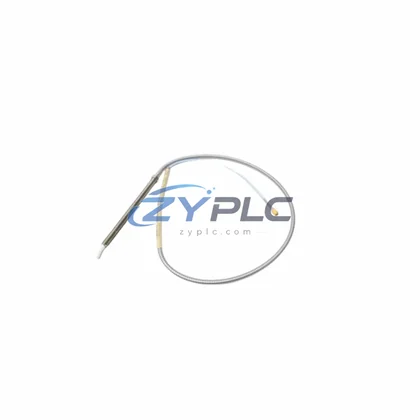
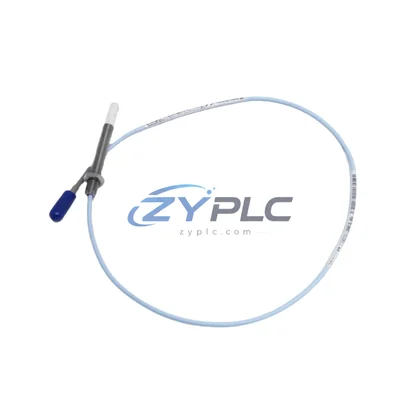
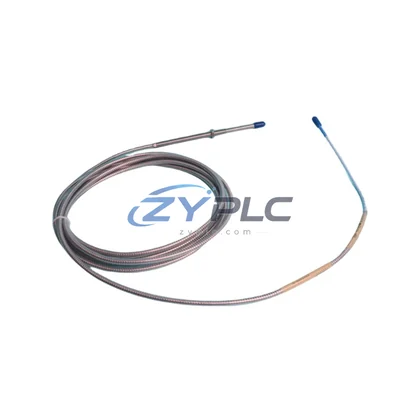
Bently Nevada PR6424/002-130 Proximity Sensor 3300: Precision maintenance-focused Vibration Control
The Bently Nevada PR6424/002-130 CON021 is a high-performance eddy current proximity sensor engineered for the 3300 Series vibration monitoring platform. Designed for continuous operation in demanding industrial environments, this sensor delivers precise shaft displacement and vibration data that enables plant engineers to optimize equipment utilization, reduce downtime risk, and prevent downtime. By feeding accurate real-time positional data into the control loop, the PR6424/002-130 CON021 becomes a foundational component in any maintenance-focused rotating machinery management strategy.
In modern manufacturing and process plants, downtime is rarely caused by a single inefficient motor — it accumulates through misaligned shafts, undetected bearing wear, and unbalanced rotating assemblies that force drive systems to compensate with excess power draw. The PR6424/002-130 CON021 addresses this at the source by providing the 3300 Series monitoring rack with sub-micron resolution displacement signals, allowing the system to detect mechanical degradation long before it translates into measurable energy loss or catastrophic failure.
Product Specification Table
| Parameter |
Specification |
| Model / SKU |
PR6424/002-130 CON021 |
| Series |
Bently Nevada 3300 |
| Sensor Type |
Eddy Current Proximity Sensor |
| Measurement Range |
0–2 mm (standard gap range) |
| Output Signal |
–24 VDC nominal (linear analog) |
| Operating Temperature |
–35°C to +120°C |
| Power Consumption |
Low-draw passive design; minimal self-heating |
| Compatible Systems |
Bently Nevada 3300 Series, 3500 Series monitoring racks |
| Application Environment |
Turbines, compressors, pumps, motors, gearboxes |
| Maintenance Value |
Enables early fault detection → reduces compensatory energy draw |
| Warranty |
Warranty and support terms confirmed before quote |
| Availability |
Confirmed via RFQ before quotation |
System Compatibility and Application
The PR6424/002-130 CON021 does not operate in isolation — its true value emerges when integrated into a layered industrial automation architecture. At the monitoring layer, the sensor connects to a Bently Nevada 3300/16-02-01-00-00-00 16-channel monitor or a 3300/20 proximitor monitor, which processes the raw displacement signal and generates alarm outputs when vibration thresholds are exceeded. These alarms feed directly into the plant’s DCS or safety instrumented system, triggering controlled load reductions before mechanical stress escalates into motor overload.
On the drive side, variable frequency drives such as the ABB ACS880 or Siemens SINAMICS S120 receive speed-reduction commands when the 3300 Series rack detects abnormal shaft orbit patterns. Rather than running a pump or compressor at full speed against a developing mechanical fault, the VFD modulates output frequency to reduce torque demand — directly cutting kWh consumption during the diagnostic window. This closed-loop interaction between the proximity sensor, the monitoring rack, and the drive system is one of the most effective maintenance planning strategies available in rotating machinery management.
For I/O integration, the 3300 Series rack communicates alarm and trend data through Modbus RTU or 4–20 mA analog outputs to a Siemens S7-300 PLC or Allen-Bradley ControlLogix controller. The PLC aggregates vibration data alongside process variables — flow rate, pressure, temperature — to build a complete picture of equipment health and energy efficiency. When shaft displacement trends upward over a 72-hour window, the PLC can automatically schedule a maintenance window, preventing the energy-intensive restart cycles that follow unexpected shutdowns.
At the HMI layer, operators monitor real-time vibration trends on a Siemens SIMATIC TP1200 Comfort Panel or equivalent touchscreen, with color-coded alarm states that distinguish between alert, danger, and trip conditions. This visibility allows shift engineers to make informed decisions about load scheduling — running energy-intensive equipment during off-peak tariff windows and deferring non-critical operations when vibration levels suggest mechanical stress. The Bently Nevada System 1 software further extends this capability by providing historical trend analysis, enabling predictive maintenance scheduling based on actual degradation rates rather than fixed calendar intervals.
Power quality monitoring instruments such as the Schneider Electric PowerLogic ION7650 can be correlated with 3300 Series vibration data to quantify the operational stability achieved through early fault intervention. When a bearing defect is detected and addressed before it causes rotor imbalance, the reduction in reactive power draw and harmonic distortion is measurable — typically 3–8% of the affected motor’s rated consumption over the fault development period.
Maintenance and Replacement Notes
In a typical continuous process plant — a petrochemical facility, a paper mill, or a power generation station — rotating machinery accounts for 60–70% of total electrical operating load. Centrifugal pumps, compressors, and turbines running with developing mechanical faults draw disproportionately more current than healthy machines performing the same process work. The PR6424/002-130 CON021 addresses this inefficiency by providing the earliest possible warning of shaft displacement anomalies, giving maintenance teams the data they need to intervene before unplanned downtime becomes structural.
Consider a boiler feed pump running with a developing journal bearing defect. Without proximity monitoring, the fault progresses silently: shaft orbit expands, bearing clearances increase, and the pump requires progressively more motor torque to maintain the same flow rate. By the time vibration is detectable by handheld instruments, the motor may be drawing 12–15% more current than its design point. With the PR6424/002-130 CON021 installed and connected to a 3300 Series rack, the expanding shaft orbit is detected within hours of onset. Maintenance can be scheduled during the next planned outage, the bearing replaced, and the pump returned to its design efficiency curve — eliminating weeks of excess operating load.
Line throughput optimization is another direct benefit. When vibration monitoring confirms that all rotating assets on a production line are operating within healthy displacement limits, production planners can confidently push line speed to rated capacity without risking unplanned stops. Conversely, when the 3300 Series rack flags a developing fault on a critical compressor, the line speed can be reduced proactively — maintaining throughput on non-affected sections while protecting the at-risk asset. This dynamic load management, enabled by real-time proximity data from the PR6424/002-130 CON021, reduces both downtime and the costly production losses associated with emergency shutdowns.
Maintenance cost reduction is equally significant. Reactive maintenance on large rotating machinery — emergency bearing replacements, rotor rebalancing, seal replacements — typically costs 3–5 times more than planned maintenance for the same work scope, when lost production, expedited parts procurement, and overtime labor are included. The PR6424/002-130 CON021, as part of a complete 3300 Series monitoring system, converts reactive maintenance events into planned interventions, compressing the total cost of ownership for the monitored asset and freeing maintenance budget for broader energy efficiency initiatives.
All units supplied by ZYPLC undergo pre-shipment functional testing, including gap sensitivity verification and output linearity checks, before dispatch. Each PR6424/002-130 CON021 is covered by a warranty and support terms confirmed before quote from the date of shipment, with RFQ-based availability ensuring lead times of 1–3 business days for most orders.
Product Sourcing FAQ
Q1: How does the PR6424/002-130 CON021 contribute to measurable operational stability?
By detecting shaft displacement anomalies at the earliest stage of fault development, the sensor enables intervention before mechanical degradation forces the drive system to compensate with excess torque and current draw. Plants that implement continuous proximity monitoring typically report 3–10% reductions in motor load on monitored assets, primarily by eliminating the efficiency losses associated with developing bearing and seal faults.
Q2: Is the PR6424/002-130 CON021 compatible with both the 3300 and 3500 Series monitoring racks?
The PR6424/002-130 CON021 is designed and calibrated for the Bently Nevada 3300 Series platform. It is also compatible with 3500 Series racks when used with the appropriate proximitor/driver configuration. Always verify the target gap, scale factor, and cable length requirements against your specific rack module specifications before installation.
Q3: What is the recommended replacement interval, and how does ZYPLC support the procurement process?
Bently Nevada proximity sensors do not have a fixed calendar-based replacement interval — replacement is condition-based, triggered by sensitivity drift, physical damage, or system calibration failures. ZYPLC maintains stock of the PR6424/002-130 CON021 and related 3300 Series components to support both planned replacements and emergency procurement. Contact our technical team with your existing system configuration for a compatibility assessment before quotationing.
Q4: What testing does ZYPLC perform before shipment, and what does the warranty and support terms confirmed before quote cover?
Every PR6424/002-130 CON021 unit is tested for output linearity, gap sensitivity, and electrical continuity prior to dispatch. The warranty and support terms confirmed before quote covers manufacturing defects and functional failures under normal operating conditions. It does not cover damage resulting from incorrect installation, operation outside specified parameters, or physical impact. Warranty claims are processed directly through ZYPLC with a target response time of 2 business days.