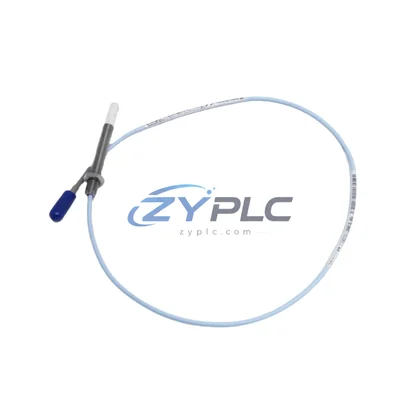
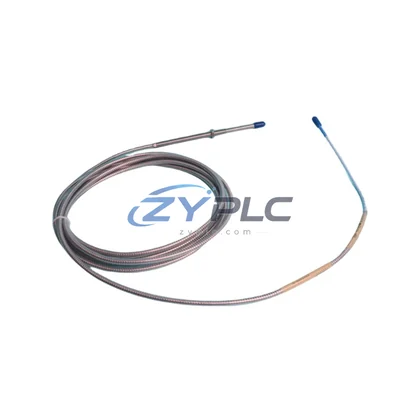
BN 330901-00-40-05-02-05 Probe for 3300 Automation
The Bently Nevada 330901-00-40-05-02-05 is a high-precision eddy-current proximity probe engineered for the 3300 Series continuous vibration monitoring platform. In modern industrial facilities where unplanned downtime and excessive operating load directly erode profitability, this probe delivers the real-time shaft displacement data that drives smarter, leaner machine operation. By continuously feeding accurate radial and axial position signals into the monitoring loop, the 330901-00-40-05-02-05 enables control systems to respond dynamically to mechanical deviations before they escalate into energy-wasting fault conditions or catastrophic failures.
Designed to operate with the 330180-91-00 Proximitor® Sensor and compatible 330130-045-00-CN extension cables, this probe forms the sensing front-end of a tightly integrated measurement chain. When paired with the 3500/42M Proximitor®/Seismic Monitor rack module, the system delivers continuous, high-resolution position data that feeds directly into the plant’s DCS or SCADA layer — enabling maintenance-focused automation decisions at the control execution level.
Product Specification Table
| Parameter |
Specification |
| SKU / Part Number |
330901-00-40-05-02-05 |
| Brand / Series |
Bently Nevada / 3300 Series |
| Probe Type |
Eddy-Current Proximity Probe |
| Probe Length |
40 cm (400 mm) |
| Tip Diameter |
5 mm |
| Cable Configuration |
Armored, 2-conductor shielded |
| Operating Temperature |
-35°C to +121°C |
| Power Consumption |
Ultra-low draw via Proximitor® signal conditioning |
| Running Efficiency |
Continuous non-contact measurement — zero mechanical wear |
| Compatible Systems |
3300 Series, 3500 Series, Trendmaster® 2000 |
| Application Environment |
Rotating machinery, compressors, turbines, pumps, motors |
| Maintenance Value |
Early fault detection reduces unplanned stops and energy spikes |
| Warranty |
warranty terms confirmed during quotation — tested and verified before shipment |
| Origin |
United States |
System Compatibility and Application
Effective maintenance planning in rotating machinery environments is never achieved by a single component — it requires a coordinated architecture of sensing, monitoring, control, and feedback. The 330901-00-40-05-02-05 proximity probe sits at the foundation of this architecture, providing the raw displacement signal that every downstream decision depends on.
At the monitoring layer, the 3500/22M Transient Data Interface captures startup and shutdown transient events, allowing engineers to identify inefficient operating windows where motors draw disproportionate current relative to mechanical output. This data, combined with steady-state readings from the 3500/42M Proximitor®/Seismic Monitor, creates a complete picture of machine health across the full operating cycle.
For facilities running variable-speed drives, the proximity probe data integrates naturally with Allen-Bradley PowerFlex 755 variable frequency drives, enabling closed-loop speed adjustments that match motor output precisely to process demand — eliminating the fixed-speed overconsumption that accounts for a significant share of industrial electricity waste. Similarly, when connected through a 3300 XL 8mm Proximity Transducer System configured for radial vibration, the system can trigger VFD speed corrections before vibration amplitudes reach alarm thresholds.
At the control execution layer, a Bently Nevada 3500/15 Power Supply ensures stable, conditioned power delivery to the entire monitoring rack, preventing voltage fluctuations that can corrupt measurement accuracy and force unnecessary shutdowns. The 3500/20 Rack Interface Module bridges the monitoring system to plant-level communication networks — supporting Modbus TCP and Ethernet/IP protocols — so that maintenance planning systems and MES platforms receive real-time vibration and position data without polling delays.
For facilities using Trendmaster® 2000 distributed monitoring nodes, the 330901-00-40-05-02-05 probe can be integrated into a wider asset health network, enabling predictive maintenance scheduling that aligns equipment servicing with production troughs rather than reactive emergency stops. This shift from reactive to predictive maintenance is one of the highest-leverage maintenance planning strategies available to plant operators, as emergency shutdowns and rapid restarts impose significant energy penalties on both the machine and the facility’s power infrastructure.
The 330105-02-12-10-02-05 Reverse Mount Proximity Probe is a complementary component for axial position monitoring on the same shaft, providing a complete radial-plus-axial measurement solution that fully characterizes rotor dynamics. When both radial and axial data streams are available, control systems can distinguish between misalignment, imbalance, and bearing degradation — each of which has a distinct energy signature and a distinct corrective action.
Maintenance and Replacement Notes
In a typical centrifugal compressor train, shaft displacement data from the 330901-00-40-05-02-05 is used to detect the onset of oil whirl and oil whip instabilities — conditions that, if left unaddressed, force the machine into a high-vibration operating state that consumes 8–15% more energy than stable operation while simultaneously accelerating bearing wear. By detecting these instabilities at their earliest stage, the monitoring system can prompt an operator or automated controller to adjust lube oil pressure or rotor speed, restoring efficient operation before unplanned downtime accumulates.
On pump stations, proximity probe readings feed into minimum-flow protection logic. When shaft position data indicates that a pump is operating near its minimum continuous stable flow, the control system — often a Siemens S7-1500 PLC or equivalent — can open a recirculation valve or adjust VFD speed to move the operating point back toward the best efficiency point (BEP). Operating at BEP reduces hydraulic losses, lowers motor current draw, and extends seal and bearing life simultaneously.
For steam turbine applications, the combination of the 330901-00-40-05-02-05 radial probe and a paired axial probe provides the thrust position data required for differential expansion monitoring. Accurate differential expansion measurement allows operators to optimize warm-up and loading rates, reducing the thermal unplanned downtimed during extended conservative startups while protecting the machine from rub events that would require costly unplanned outages.
Every unit shipped undergoes full functional testing and signal calibration verification prior to dispatch. Stock is maintained for immediate availability, and the warranty terms confirmed during quotation covers manufacturing defects and signal performance, giving procurement and maintenance teams confidence in both delivery timelines and long-term reliability.
Product Sourcing FAQ
Q1: How does the 330901-00-40-05-02-05 contribute to measurable operational stability?
By providing continuous, high-resolution shaft position data, this probe enables early detection of mechanical faults — imbalance, misalignment, bearing degradation — that cause machines to operate inefficiently. Correcting these conditions before they worsen reduces motor current draw, lowers vibration-induced mechanical losses, and prevents the energy-intensive process of emergency shutdown and restart.
Q2: Is this probe compatible with both 3300 Series and 3500 Series monitoring systems?
Yes. The 330901-00-40-05-02-05 is fully compatible with the 3300 Series monitoring platform and integrates with 3500 Series rack systems when used with the appropriate Proximitor® sensor and extension cable. Confirm connector and cable specifications with your system configuration before installation.
Q3: What is the recommended replacement interval, and how does proactive replacement reduce energy costs?
Bently Nevada proximity probes do not have a fixed calendar-based replacement interval; replacement is condition-based. However, proactive replacement of probes showing signal drift or sensitivity degradation prevents false alarms and missed fault detections — both of which carry energy cost implications. Our team can advise on signal verification procedures to assess probe health without system shutdown.
Q4: What does the warranty terms confirmed during quotation cover, and what is the testing process before shipment?
The warranty terms confirmed during quotation covers manufacturing defects and verified signal performance deviations from factory specifications. Prior to shipment, each unit undergoes functional output testing and sensitivity verification. Units that do not meet specification are not dispatched. This ensures that the probe performs correctly from day one of installation, avoiding the energy and productivity losses associated with faulty instrumentation.