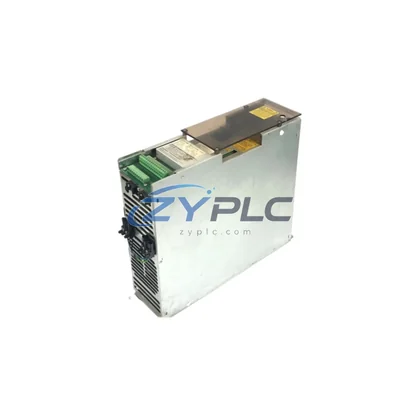
Bosch Rexroth DKC04.3-200-7-FW AC Servo Drive for IndraDrive Control System
In modern industrial automation, the performance of a servo drive is never evaluated in isolation. The Bosch Rexroth DKC04.3-200-7-FW is a high-performance AC servo drive controller from the EcoDrive Cs series, engineered to operate as a fully integrated node within a layered IndraDrive control architecture. Its role spans the motion control layer, the I/O interface layer, and the communication backbone, making it a critical component for engineers designing scalable, redundant, and maintainable automation systems across manufacturing, energy, and process industries.
The DKC04.3-200-7-FW is rated for 200% peak current output and supports firmware variant FW, which enables advanced positioning, velocity, and torque control modes. Within a complete Bosch Rexroth IndraDrive system, this drive operates in close coordination with upstream controllers, downstream actuators, and peer-level I/O and communication modules. Its architecture-ready design ensures that system integrators can deploy it with confidence in both new installations and retrofit projects requiring backward compatibility with existing Rexroth drive platforms.
Product Specification Table
| Parameter |
Specification |
| Model / SKU |
DKC04.3-200-7-FW |
| Brand |
Bosch Rexroth |
| Series |
EcoDrive Cs / IndraDrive |
| System Role |
AC Servo Drive Controller (Motion Layer) |
| Peak Current Rating |
200% of nominal |
| Firmware Variant |
FW (Multi-mode: position, velocity, torque) |
| Control Interface |
SERCOS II / Analog / Digital I/O |
| Communication Capability |
SERCOS fiber optic ring, fieldbus-ready |
| Installation Environment |
Control cabinet, DIN rail or panel mount |
| Origin |
Germany (DE) |
| Warranty |
warranty terms confirmed during quotation |
| system integration |
Supported — compatible with IndraDrive Cs/Cc/Mi platforms |
System Compatibility Notes
The DKC04.3-200-7-FW achieves its full potential when deployed within a coordinated Bosch Rexroth IndraDrive system architecture. At the controller level, it interfaces directly with Rexroth IndraControl L or IndraControl V series PLCs, which issue motion commands via SERCOS II fiber optic communication rings. This deterministic, high-speed protocol ensures synchronized multi-axis motion across all drives in the system, including peer units such as the DKC01.3, DKC02.3, and DKC11.3 series drives, which share the same EcoDrive Cs platform and firmware ecosystem.
On the power supply side, the DKC04.3-200-7-FW is designed to operate with Rexroth HCS02.1E or HCS03.1E power supply units, which provide regulated DC bus voltage to the drive. In multi-axis cabinet configurations, a shared DC bus topology using the CZM01.1 capacitor module or TVD01.3 regenerative power supply can be employed to improve energy efficiency and reduce heat dissipation across the drive stack. This power-layer coordination is essential for high-cycle applications such as packaging lines and press automation.
For I/O expansion and signal conditioning, the DKC04.3-200-7-FW integrates with Rexroth CFL01.1 fieldbus communication modules and CSB01.1N or CSH01.1C control section boards, which extend the drive’s digital and analog I/O capacity. These modules allow engineers to connect proximity sensors, encoder feedback lines, and safety relay circuits without requiring additional PLC I/O cards, reducing cabinet wiring complexity and improving signal integrity. The HMS01.1N multi-axis interface module further enables coordinated axis grouping in gantry or synchronization applications.
At the human-machine interface layer, the drive’s status and parameter data are accessible through Rexroth IndraWorks DS engineering software, which provides a unified commissioning environment for all IndraDrive family members. Operators can monitor real-time drive diagnostics, configure motion profiles, and execute firmware updates — including FWA-ECODR3 firmware packages — directly from the engineering workstation without interrupting production. This system integration capability ensures that the DKC04.3-200-7-FW remains fully aligned with the broader system’s operational state at all times.
In redundant architecture designs, the drive supports hot-standby configurations when paired with Rexroth redundancy switching modules, ensuring that a single drive failure does not halt the entire production line. This is particularly valuable in continuous process industries such as petrochemical refining, water treatment, and power generation, where unplanned downtime carries significant operational and safety consequences.
Industrial Application Notes
The DKC04.3-200-7-FW is deployed across a wide range of industrial sectors where precise motion control and system-level reliability are non-negotiable. In automotive manufacturing, it drives servo axes on robotic welding cells, transfer lines, and press-feed systems, where synchronization accuracy at the millisecond level is required. Its SERCOS II communication ensures that all axes in a multi-robot cell respond to the same motion command cycle simultaneously, eliminating positional drift and improving weld quality.
In the power generation and electrical utility sector, the drive is used in turbine governor control systems and valve actuator drives, where its high peak current capability supports rapid load changes without drive fault. The warranty terms confirmed during quotation provides procurement teams with the assurance needed for long-lead capital projects where replacement parts must be guaranteed available throughout the commissioning and initial operations phase.
In water treatment and municipal infrastructure applications, the DKC04.3-200-7-FW controls pump and blower drive systems within SCADA-integrated automation architectures. Its fieldbus compatibility allows seamless integration with existing Modbus or PROFIBUS networks via appropriate gateway modules, enabling operators to monitor drive health and energy consumption from centralized control rooms. In mining and metallurgical processing, the drive’s robust design and wide operating temperature range make it suitable for conveyor drive systems, crusher feed controls, and ore processing equipment where environmental conditions are demanding.
For packaging and food processing lines, the drive’s multi-mode firmware supports electronic cam and gearing functions, enabling complex synchronized motion profiles for form-fill-seal machines, labeling systems, and robotic pick-and-place cells. The ability to store multiple motion programs in the drive’s onboard memory reduces PLC program complexity and improves machine changeover speed.
Product Compatibility FAQ
Q1: Is the DKC04.3-200-7-FW compatible with existing IndraDrive Cs and EcoDrive Cs system architectures?
Yes. The DKC04.3-200-7-FW is fully compatible with the Bosch Rexroth EcoDrive Cs platform and can be integrated into existing IndraDrive Cs multi-axis systems without requiring controller-level hardware changes. It shares the same SERCOS II communication protocol, DC bus power architecture, and IndraWorks DS commissioning environment as other DKC series drives, ensuring seamless system integration into both new and legacy system architectures.
Q2: What commissioning steps are required when replacing a DKC04.3-200-7-FW in a running production system?
Replacement commissioning involves backing up the existing drive parameters using IndraWorks DS, installing the new unit in the same cabinet slot, restoring the parameter set, and verifying motor encoder feedback alignment. The FW firmware variant supports parameter import from previous DKC04.3 units, significantly reducing re-commissioning time. All units supplied under our warranty terms confirmed during quotation are pre-tested and shipped with factory default firmware, ready for parameter upload on arrival.
Q3: How does the warranty terms confirmed during quotation apply to system-level deployments involving multiple drive axes?
Each DKC04.3-200-7-FW unit carries an individual warranty terms confirmed during quotation covering manufacturing defects and functional failures under normal operating conditions. In multi-axis system deployments, warranty claims are handled on a per-unit basis, ensuring that a single drive replacement does not affect the warranty status of adjacent units in the same cabinet. Our technical support team provides architecture-level guidance to minimize system downtime during any warranty replacement procedure.