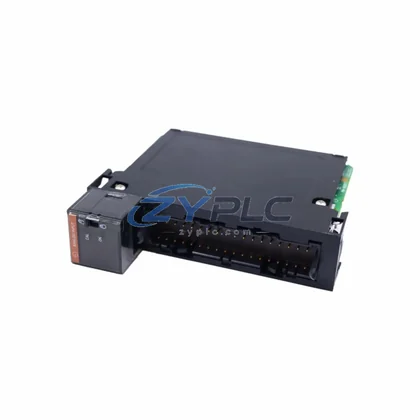
Fuji NB1-P40X-AC PLC for NB Series Automation
The Fuji NB1-P40X-AC is a high-performance programmable logic controller from Fuji Electric’s NB Series, engineered to deliver precise, maintenance-focused control across demanding industrial environments. With 40 I/O points and AC power input, this compact yet powerful PLC is purpose-built for manufacturers seeking to reduce unplanned downtime, improve equipment utilization, and optimize production line throughput without sacrificing reliability or control accuracy.
In modern manufacturing, energy efficiency is no longer a secondary consideration — it is a core operational metric. The NB1-P40X-AC addresses this directly by enabling tighter scan-cycle management, deterministic I/O response, and seamless integration with variable frequency drives, servo systems, and power monitoring modules. Whether deployed in a standalone machine cell or as part of a distributed control architecture, this controller helps engineering teams eliminate idle-state energy draw, reduce motor inrush events, and maintain consistent production cadence.
Product Specification Table
| Parameter |
Specification |
| Model / SKU |
NB1-P40X-AC |
| Series |
NB Series |
| Brand |
Fuji Electric |
| I/O Points |
40 (expandable) |
| Power Supply |
AC 100–240V |
| Program Memory |
16K steps |
| Scan Cycle |
0.2 ms / 1K steps (typical) |
| Communication |
RS-232C / RS-485 (Modbus RTU compatible) |
| Operating Temperature |
0°C to 55°C |
| Compatible Systems |
FRENIC Series VFDs, Fuji Servo Systems, HMI panels, SCADA |
| Application Environment |
Discrete manufacturing, packaging, conveyor, HVAC, pump control |
| Energy Saving Value |
Reduces idle-state power draw via optimized I/O polling and drive coordination |
| Warranty |
warranty terms confirmed during quotation — tested before shipment |
| Origin |
Japan |
| Stock Status |
RFQ Available — shipment arranged after confirmation |
System Compatibility and Application
The NB1-P40X-AC is most effective when integrated into a layered automation architecture where energy data flows continuously from field devices back to the control layer. In a typical deployment, the NB1-P40X-AC serves as the central execution engine, coordinating inputs from proximity sensors, pressure transducers, and encoder feedback while issuing real-time commands to downstream drive and actuator systems.
For motor-driven applications, the NB1-P40X-AC pairs naturally with the Fuji FRENIC-Ace series variable frequency drives (e.g., FRN0.4C2S-2J), enabling speed-reference outputs that match actual load demand rather than running motors at fixed frequency. This alone can help restore stable operation when a compatible replacement is required. The PLC’s analog output module — such as the Fuji NB1-A04X expansion unit — provides the 4–20mA or 0–10V reference signals required for precise VFD speed control.
On the servo side, the NB1-P40X-AC communicates with Fuji ALPHA5 Smart servo drives via RS-485 or pulse-train interfaces, enabling position-controlled axes to execute motion profiles with minimal overshoot and energy-efficient deceleration ramps. This is particularly valuable in pick-and-place, labeling, and indexing applications where repeated acceleration-deceleration cycles account for a significant share of total operating load.
For power quality monitoring, the NB1-P40X-AC can be integrated with Fuji Electric power monitoring relays or third-party energy meters via Modbus RTU over RS-485. This allows the PLC program to read real-time kWh, power factor, and demand values, enabling conditional logic that sheds non-critical loads during peak demand windows — a strategy that directly reduces utility costs in facilities with demand-charge tariffs.
The I/O architecture of the NB1-P40X-AC supports expansion through NB1-series digital and analog I/O modules, allowing engineers to scale the control system without replacing the base unit. Typical expansions include the NB1-D16X digital input module for additional sensor inputs and the NB1-D16Y transistor output module for high-speed switching of solenoids and relay coils. These modules maintain the same low-power consumption profile as the base unit, ensuring that system expansion does not disproportionately increase panel power draw.
For operator interaction, the NB1-P40X-AC connects to Fuji UG series HMI panels via RS-232C or RS-485, providing operators with real-time visibility into operating load trends, cycle counts, and alarm states. When operators can see energy data at the machine level, they are better positioned to identify inefficient operating patterns and adjust setpoints accordingly.
In networked plant environments, the NB1-P40X-AC supports Modbus RTU communication, enabling it to exchange data with SCADA systems and MES platforms that aggregate energy and production data across multiple lines. This connectivity is essential for facilities pursuing ISO 50001 maintenance planning certification or implementing OEE (Overall Equipment Effectiveness) tracking programs.
Maintenance and Replacement Notes
Consider a mid-scale packaging line running three conveyor zones, two labeling stations, and a case-sealing unit. Without coordinated PLC control, each motor runs continuously regardless of product flow, resulting in significant idle-state unplanned downtime during changeovers, jams, and scheduled breaks. With the NB1-P40X-AC managing zone-by-zone motor enable signals and coordinating speed references to the FRENIC-Ace VFDs on each conveyor drive, the line can implement demand-based motor control — motors ramp down or stop when no product is detected, and ramp back up smoothly when flow resumes.
This approach typically reduces conveyor motor load by Actual operating results depend on the installed system, load profile, and commissioning parameters. More importantly, it reduces mechanical wear on belts, rollers, and gearboxes by eliminating unnecessary run hours, which directly extends mean time between failures (MTBF) and reduces unplanned downtime costs.
The NB1-P40X-AC’s fast scan cycle — typically under 1 ms for small programs — ensures that control responses to sensor inputs are deterministic and repeatable. This is critical for maintaining production line cadence (takt time) in high-speed applications where a delayed response to a jam signal could result in product damage or equipment collision. By maintaining tight control loop timing, the PLC helps production teams achieve consistent cycle times, which is a prerequisite for accurate OEE calculation and continuous improvement programs.
Predictive maintenance integration is another key maintenance planning lever. By monitoring motor current feedback through the FRENIC-Ace drives and logging run-hour data in the NB1-P40X-AC’s data registers, maintenance teams can establish baseline current signatures for each motor and detect deviations that indicate bearing wear, belt slip, or coupling misalignment — all of which increase operating load before they cause a failure. Early intervention based on this data reduces both unplanned downtime and unplanned downtime.
All units supplied by ZYPLC are sourced from verified supply channels, undergo functional testing prior to shipment, and are covered by a warranty terms confirmed during quotation. Stock is maintained for shipment arranged after confirmation, minimizing lead times for urgent replacement or project commissioning requirements.
Product Sourcing FAQ
Q1: How does the NB1-P40X-AC contribute to measurable operational stability on a production line?
The NB1-P40X-AC enables demand-based motor control by coordinating enable/disable signals and speed references to connected VFDs such as the FRENIC-Ace series. By stopping or slowing motors during idle periods and optimizing acceleration ramps, facilities typically achieve Actual operating results depend on the installed system, load profile, and commissioning parameters.
Q2: Is the NB1-P40X-AC compatible with existing Fuji FRENIC series drives and third-party equipment?
Yes. The NB1-P40X-AC supports RS-485 Modbus RTU communication, which is compatible with FRENIC-Ace, FRENIC-Multi, and FRENIC-MEGA series drives, as well as a wide range of third-party inverters, energy meters, and HMI panels that support the Modbus protocol. Analog I/O expansion modules provide additional compatibility with non-networked drive systems.
Q3: What is the recommended replacement or upgrade path if the NB1-P40X-AC is being used to replace an older controller?
For direct replacement of legacy NB Series units, the NB1-P40X-AC is a drop-in compatible option in most panel configurations. For applications requiring higher I/O density or Ethernet connectivity, Fuji Electric’s NW Series or SPH Series controllers may be considered as upgrade paths. ZYPLC can advise on compatibility and program migration requirements based on your existing system documentation.
Q4: What does the warranty terms confirmed during quotation cover, and what is the testing process before shipment?
Every NB1-P40X-AC unit supplied by ZYPLC undergoes pre-shipment functional testing to verify power-on operation, I/O response, and communication port integrity. The warranty terms confirmed during quotation covers manufacturing defects and functional failures under normal operating conditions. Units are shipped with appropriate ESD protection and packaging to prevent transit damage. For warranty claims, contact ZYPLC directly with the unit serial number and fault description.