GE DS200SBCBG1ADC System-Ready Signal Conditioner for Mark VI Control System Architecture
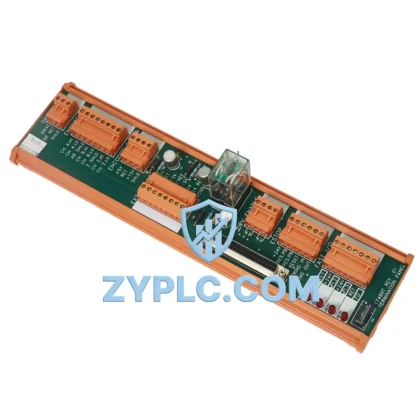
The GE DS200SBCBG1ADC is a precision signal conditioning board engineered for seamless integration within the GE Mark VI turbine control system architecture. Rather than functioning as a standalone component, this module occupies a critical position in the layered automation hierarchy — bridging raw field signals from sensors, transmitters, and actuators with the high-integrity digital processing environment of the Mark VI controller platform. Its role in ensuring signal fidelity, noise rejection, and electrical isolation makes it indispensable for maintaining system-wide consistency across control, I/O, network, power, HMI, and execution layers.
In modern industrial automation, the reliability of a control system is only as strong as its weakest signal path. The DS200SBCBG1ADC addresses this by providing conditioned, stable analog and digital signal interfaces that feed directly into the Mark VI’s core processing modules. Whether deployed in gas turbine control, steam turbine management, or combined-cycle power plant automation, this board ensures that upstream sensor data arrives at the controller with the accuracy and integrity required for safe, efficient operation.
Architecture Specification Table
| Parameter |
Specification |
| Part Number |
DS200SBCBG1ADC |
| Brand |
GE (General Electric) |
| Series |
DS200 / Mark VI Turbine Control |
| Module Type |
Signal Conditioning Board |
| System Role |
Analog/Digital Signal Interface — I/O Layer |
| Compatible Platform |
GE Mark VI, Mark VIe Control Systems |
| Signal Types Supported |
Analog Input/Output, Digital I/O, Thermocouple, RTD (inferred by series) |
| Electrical Isolation |
Channel-to-channel and field-to-logic isolation |
| Operating Voltage |
24 VDC (nominal, Mark VI backplane powered) |
| Operating Temperature |
0°C to 60°C (standard industrial range) |
| Mounting |
Mark VI rack/backplane slot installation |
| Communication |
Internal backplane bus — IONet compatible architecture |
| Redundancy Support |
Compatible with TMR (Triple Modular Redundancy) configurations |
| Certifications |
CE, UL (GE Mark VI platform standard) |
| Origin |
United States |
| Warranty |
12-Month Warranty — Tested, inspected, and verified prior to shipment |
Coordinated Control System Design
The DS200SBCBG1ADC does not operate in isolation — it is one node in a tightly coordinated control system architecture. Understanding its upstream and downstream relationships is essential for engineers designing, commissioning, or maintaining Mark VI-based systems.
At the control layer, the Mark VI controller boards — such as the DS200TCQCG1A (TCQC Quad Core Controller) and the DS200TCDAG1A (TCDA Analog I/O Controller) — rely on conditioned signal inputs to execute turbine sequencing, speed governing, and protection logic. The DS200SBCBG1ADC ensures that the analog signals entering these controllers are clean, scaled, and within the expected electrical parameters, preventing false trips or control deviations.
At the I/O layer, the board works in concert with terminal boards such as the DS200TBCIG1A and DS200TBTCH1A, which provide the physical field wiring termination points. Signal conditioning between the terminal board and the controller board is where the DS200SBCBG1ADC adds its greatest value — filtering transients, scaling voltages, and isolating field-side faults from the logic-side electronics.
At the power layer, the DS200PSDAG1A power supply distribution board provides the regulated DC voltages that the DS200SBCBG1ADC and its neighboring modules depend on. Stable power delivery is a prerequisite for accurate signal conditioning; any ripple or dropout at the power layer will directly compromise signal integrity at the I/O layer.
At the network and communication layer, the Mark VI system uses IONet — GE’s proprietary high-speed deterministic network — to transmit I/O data between the controller and remote I/O packs. Modules such as the IS200IOCIG2A (IONet Communication Interface) manage this data transport, and the DS200SBCBG1ADC’s role is to ensure that the data entering the IONet pipeline is accurate and consistent. In redundant architectures, the DS200DSPCH1A (DSP Communication Handler) coordinates data synchronization across redundant controller paths.
At the HMI layer, operator workstations running GE’s Mark VI HMI software (Toolbox ST) display real-time process values derived from the conditioned signals processed by the DS200SBCBG1ADC. Accurate signal conditioning directly translates to reliable operator displays, alarm management, and trend data — all critical for safe turbine operation.
At the execution layer, actuators, servo valves, and variable frequency drives receive control outputs that originate from the same signal chain. The DS200VPBLG1A (Vibration Protection Board) and DS200SHCPG1A (Speed/Health Control Processor) are examples of execution-layer modules that depend on the integrity of the signal conditioning chain to deliver precise, responsive control actions.
This Contextual Integration approach — understanding the DS200SBCBG1ADC within its full system context — is the foundation of reliable Mark VI architecture design and long-term maintenance planning.
Application in Layered Automation Systems
Power Generation (Gas & Steam Turbines): The DS200SBCBG1ADC is most commonly deployed in gas turbine and steam turbine control panels where the Mark VI platform governs fuel control, speed regulation, temperature monitoring, and protective shutdown sequences. In combined-cycle power plants, where multiple turbines and heat recovery steam generators operate in coordinated fashion, signal conditioning quality directly impacts plant efficiency and availability.
Petrochemical & Refinery Process Control: In refinery and petrochemical applications, the Mark VI platform is used to control compressors, pumps, and rotating equipment. The DS200SBCBG1ADC supports the high-accuracy analog signal processing required for flow, pressure, and temperature control loops in hazardous process environments.
Water Treatment & Utilities: Municipal water treatment facilities and utility substations use Mark VI-based systems for pump station control, chemical dosing, and SCADA integration. The board’s robust electrical isolation protects the control system from ground loops and electrical noise common in these environments.
Mining & Metals Processing: In mining and metallurgical applications, the DS200SBCBG1ADC supports the control of large rotating machinery including mills, crushers, and conveyor drives. The harsh electrical environment of these facilities demands the high noise immunity and isolation characteristics that this signal conditioning board provides.
Packaging & Discrete Manufacturing: While the Mark VI is primarily a process control platform, its modular architecture allows deployment in high-speed packaging lines and discrete manufacturing environments where precise motion and I/O coordination is required. The DS200SBCBG1ADC contributes to the signal integrity needed for synchronized multi-axis control.
Architecture Engineering FAQ
Q1: Is the DS200SBCBG1ADC compatible with both Mark VI and Mark VIe control systems?
The DS200SBCBG1ADC is designed for the GE Mark VI platform. While the Mark VIe shares architectural principles with the Mark VI, it uses a different I/O module form factor and backplane interface. Engineers should verify rack and backplane compatibility before deploying this board in a Mark VIe system. For Mark VIe applications, GE’s IS200 series I/O modules are the recommended replacement family. Our technical team can assist with cross-reference and compatibility verification prior to order.
Q2: Can this board be installed in a Triple Modular Redundancy (TMR) configuration, and what are the installation requirements?
Yes, the DS200SBCBG1ADC is compatible with TMR architectures, which are standard in critical turbine protection applications. In a TMR configuration, three independent signal conditioning paths process the same field signal simultaneously, with the controller performing a 2-out-of-3 voting logic to determine the valid output. Installation requires careful attention to backplane slot assignment, cable routing separation between redundant paths, and verification of power supply redundancy at the DS200PSDAG1A level. Commissioning should include signal injection testing across all three channels to confirm voting logic integrity before live operation.
Q3: What does the 12-Month Warranty cover, and what support is available for long-term maintenance planning?
All DS200SBCBG1ADC units supplied by ZYPLC are covered by a 12-Month Warranty from the date of shipment. This warranty covers manufacturing defects, functional failures under normal operating conditions, and includes pre-shipment functional testing and inspection. For long-term maintenance planning, we recommend maintaining a minimum of one spare DS200SBCBG1ADC per Mark VI rack to support rapid replacement during unplanned outages. Our inventory management support service can assist with spare parts planning, obsolescence management, and sourcing of discontinued GE Mark VI components. Contact our engineering team for a customized maintenance inventory assessment.
© 2026 ZYPLC. All rights reserved.
Original Source: https://zyplc.com
Contact: +86 19859288691 | plc.sales@zyplc.com